This morning, I celebrated with my love over one of our weekly coffee dates—savoring the sweet decadence of chocolate bunnies and chocolate eggs. Now, I am celebrating with my other family—my parents—to continue the festivities diving fully into the spiritual heart of Russian Orthodox Easter.
In Russia and the Orthodox world, spring’s arrival is marked by Pascha (Пасха), a profoundly moving celebration of Christ’s Resurrection. Far less commercial than Western Easter, Orthodox Pascha is a deeply spiritual observance that unfolds over weeks, centered entirely on the triumph of life over death.
We no longer attend church services as regularly, but the traditions remain vivid. Pascha falls according to the Julian calendar, often several weeks after Catholic and Protestant Easter—sometimes as much as five weeks later. Its date is calculated as the first Sunday after the first full moon following the spring equinox.
The journey to Pascha begins with Great Lent: a rigorous 40-day period of fasting, prayer, and introspection. The fast is stricter—no meat, dairy, or eggs for anyone (unless you are ill)—making the eventual Easter feast all the more glorious.
The peak of the celebration is the Paschal Midnight Service. On Saturday night, churches fill with worshippers holding unlit candles. Just before midnight, the priest leads a solemn procession around the church three times, carrying the icon of the Resurrection. At the stroke of midnight, the church doors swing open, lights flood the space, and the triumphant cry echoes:
“Христос Воскресе!” (Khristos Voskrese!) — “Christ is Risen!”
The joyful reply comes back:
“Воистину Воскресе!” (Voistinu Voskrese!) — “Truly He is Risen!”
The service overflows with hymns, the Easter Gospel read in multiple languages, and the blessing of food baskets. Many stay until dawn, basking in the victory of light over darkness.
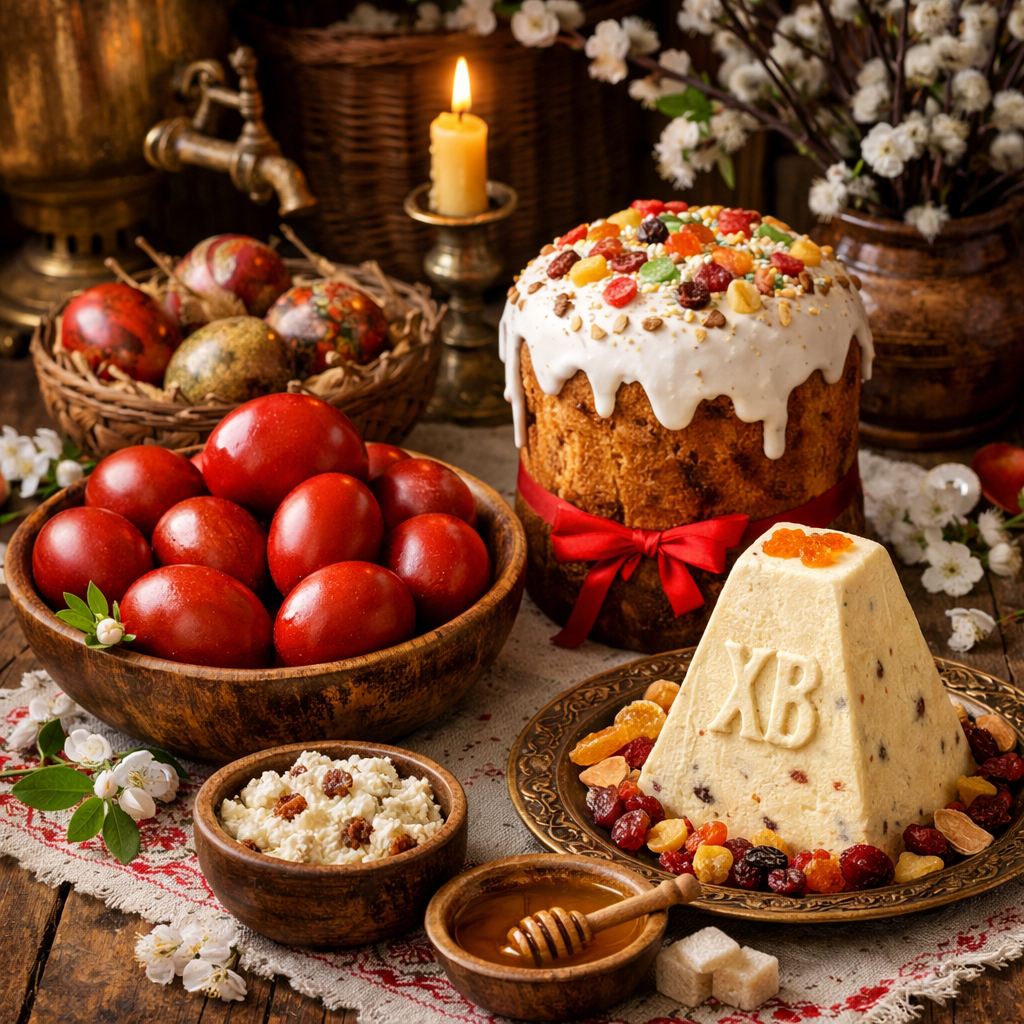
After weeks of fasting, the Easter table becomes a feast of abundance: Kulich: a tall, cylindrical sweet yeast bread studded with raisins, candied fruit, and nuts, topped with white icing and the letters “XB” (for “Christ is Risen” in Cyrillic). Think: fruit cake…. Baked in special tall tins, it symbolizes the risen Christ. Plus there is paskha: a rich, molded cheese dessert made from tvorog (farmer’s cheese), butter, eggs, and sugar. Shaped into a pyramid representing the Tomb of Christ and decorated with crosses, “XB,” or lambs. Like here, we also have brightly decorated eggs—often dyed deep red to symbolize the blood of Christ—and exchanged as gifts. While Ukrainian pysanky are famously intricate, Russian eggs tend toward simpler, vibrant designs. We also enjoy smoked meats, sausages, and plenty of vodka or wine for toasts (especially in this house!)
Families traditionally bring their baskets to church for blessing before the grand Sunday feast begins.
Even though church attendance has varied since the Soviet years when religion was not allowed (your President is supposed to be the almighty one!), Pascha remains one of Russia’s most beloved holidays. In Moscow and St. Petersburg, cathedrals overflow at midnight. Across the Orthodox observers—from New York to Sydney—Russian Orthodox communities celebrate with deep passion and tradition.
And here I am, beautifully caught between two worlds: enjoying Western chocolate Easter treats in the morning and savoring kulich, paskha, and champagne toasts with family in the evening. It is the perfect fusion of cultures, love, and faith.
Pascha truly feels like the Russian soul’s awakening—after the long, dark winter and the discipline of Lent comes light, renewal, warmth, and peace. (Read my Spring post here)!
Христос Воскресе!
Воистину Воскресе!
Christ is Risen! Truly He is Risen!


 Kat’s Musings
Leave a reply to BLaP1776 Cancel reply