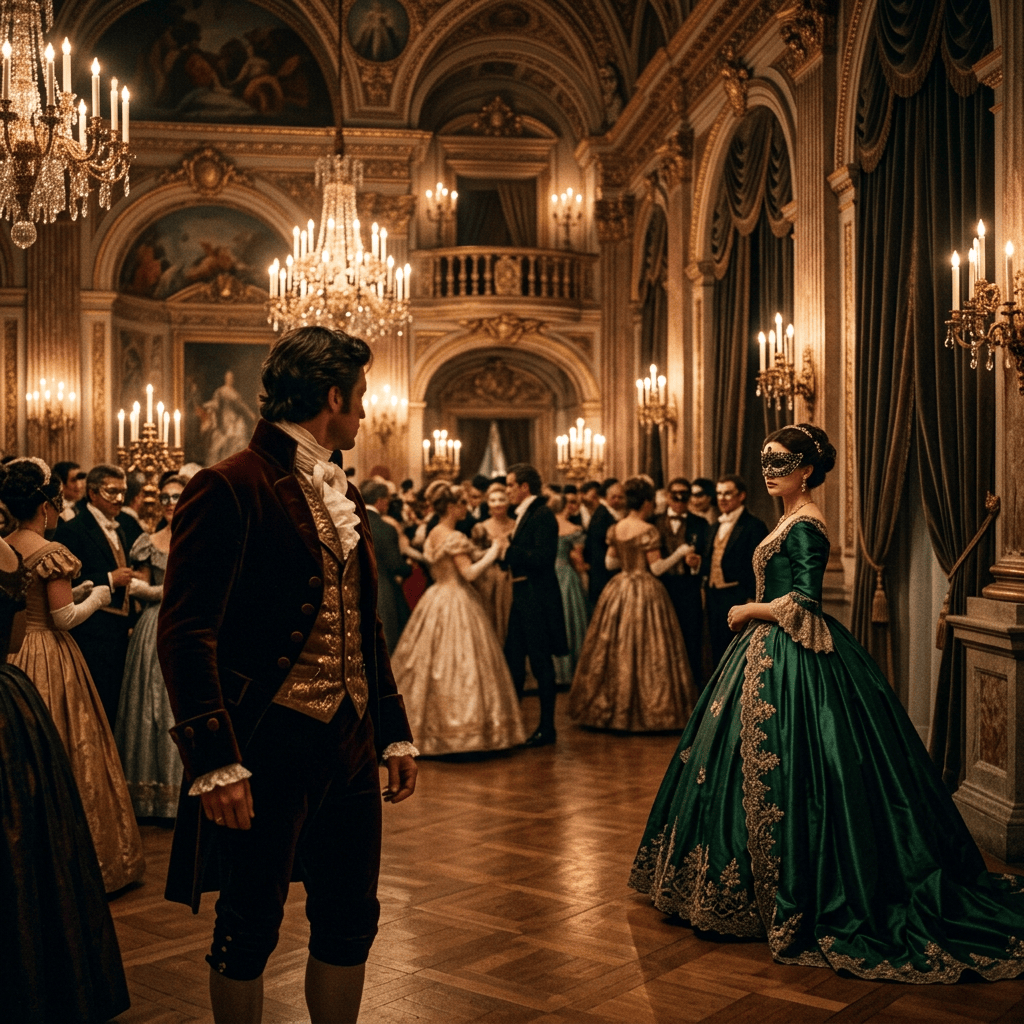
I did not plan on still being here. When the first season of Bridgerton arrived, I treated it like a pretty, slightly silly costume piece I could dip in and out of while my boyfriend was away. The balls were gorgeous, the gossip was sharp, and the clothes were elegant. I expected to enjoy the surface and then move on. Instead, I kept pressing play. Then I pressed it again. Now the evenings arrive and I catch myself calculating how many episodes I can reasonably fit in before I have to be a functional girlfriend again
Part of it is simply that I love love. Not the practical kind that makes for solid marriages and shared grocery lists, but the kind that arrives unexpectedly. The kind that rearranges a person’s life without asking permission. Bridgerton specializes in that. The glances across a ballroom last half a second too long. The almost-touches in crowded rooms carry more charge than most shows manage in an entire season of explicit content. I know the plot beats are coming. I can usually predict the misunderstanding that will stretch across three episodes. I still lean forward. I still feel the small, ridiculous drop in my stomach when the music swells and someone finally says the thing they have been refusing to say. It is not particularly sophisticated of me. It is also not something I feel any particular urge to outgrow.
The “woke” elements—the color-blind casting, the occasional anachronistic social commentary, the way the show sometimes winks at its own modern audience—do not bother me nearly as much as i assumed they would. They exist. I notice them. Then the story drops me back into a drawing room or a garden or a carriage at night, and the noticing stops mattering. I am not watching Bridgerton for a rigorous seminar on social history. I am watching it because, for roughly fifty minutes at a time, the rest of the day gets to stand outside and wait. The intensity is allowed to take up all the available space. Passion is not required to be tasteful or restrained or especially realistic. It is allowed to be too much. I let it be too much. There is a particular relief in that permission.
What has surprised me most is the sex. I expected tasteful fades to black and a few artfully arranged limbs. What I got was considerably more direct. Bodies are shown learning each other. Hands map skin that has never been mapped that way before. Mouths figure out, in real time, what the other person likes. The show does not treat these moments as interruptions to the romance; it treats them as the place where the romance becomes legible. That has turned out to be more compelling than I anticipated.
Part of the fascination is historical, or at least historical-adjacent. The young women in these stories are not raised with any practical knowledge of sex. They are raised with a great deal of knowledge about propriety, reputation, and the precise distance one must keep between one’s body and the possibility of scandal. Desire is something they are expected to feel only after a ring is on the finger, and even then only in carefully managed amounts. When a man who has actually lived in the world begins to show one of them what her own body can do, the scene carries a particular charge. It is not just arousal. It is the sudden, disorienting arrival of information that was deliberately withheld. I find myself watching the women’s faces as much as the rest of the scene. The surprise. The concentration. The moment when embarrassment gives way to curiosity and curiosity gives way to something less polite. It feels, in its heightened way, like a kind of education that the period itself refused to provide.
My boyfriend finds this whole situation funny. We have our evening shows. We settle in and fade into whichever adventure he chooses and I will sit there half-listening while my mind drifts toward whatever Bridgerton episode is waiting. He has started narrating my restlessness in a dry voice. “You don’t even want to watch our show anymore.” Or, more recently, “You’re calculating whether you have time for one more before bed.” He is not wrong. I have tried to be normal about it. I have failed. There is something slightly embarrassing about looking forward to a show this much when you are an adult with a a perfectly good partner waiting on you. The embarrassment has not been enough to stop me.Plus he just loves to listen to the lofty recaps I give after each episode.
What keeps me going is the way the show lets intensity be the point instead of a problem to be solved. Real life requires proportion. It requires that I notice when I am being unreasonable, that I keep some part of myself available for ordinary tasks and ordinary people. Bridgerton does not. For the length of an episode I am allowed to be entirely occupied by whether two people who should not, by every rule of their world, want each other this badly are going to manage to be honest about it before the season ends. The wanting is allowed to be total. The consequences are allowed to feel enormous. I come back to it because that scale of feeling is rare, and because the show is unusually willing to stay inside it instead of apologizing for it.
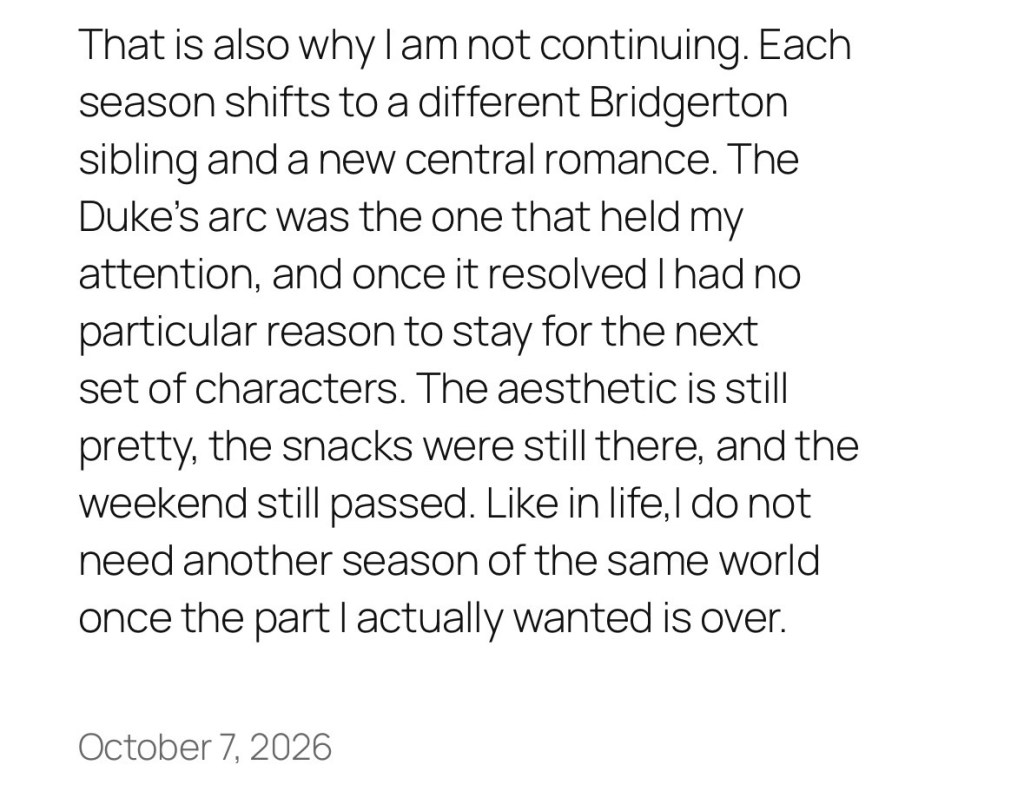
I do not expect this to last forever. At some point the seasons will end, or the particular flavor of longing will stop working on me, or I will simply get tired of the same emotional notes played at the same volume. Until then, I am still here. In fact, I almost flew through all the seasons. I still feel the small, private lift when the opening credits begin and the world on the other side of the screen is once again allowed to be louder and more beautiful and more willing to risk everything than the one I actually live in. My boyfriend will keep laughing. I will keep watching. For now, that arrangement seems to be working well enough for both of us.


Leave a Reply