Tag: dailyprompt

  • Dinner with F. Scott Fitzgerald: The Allure of Literary Luxury

    Dinner with F. Scott Fitzgerald: The Allure of Literary Luxury

    Which author would you love to have dinner with?

    If I were to have dinner with an author, it would be F. Scott Fitzgerald. Not because of the obvious masterpiece everyone names first—The Great Gatsby—but because he understood luxury as a temperature, a texture, a way of moving through a room. He did not merely describe wealth. He lived inside its shimmer and its hangover, and he wrote as if both were equally sacred.

    Ornate wood-paneled library with bookshelves, seating, chandelier, and city views
    A richly appointed library lounge invites quiet reading beneath a glowing chandelier and tall arched windows.

    I have never been especially moved by stories that ask me to stay where I already am. Many people prefer fantasy worlds they can visit and leave, or novels that feel “relatable,” which often means ordinary kitchens, ordinary disappointments, ordinary weather. I have always been drawn the other way: toward silk, late hours, expensive mistakes, and the particular loneliness that arrives when the party is still going and you realize you are the only one who notices the light has changed. Fitzgerald paints that picture better than almost anyone. He makes luxury look not like a shopping list but like a climate.

    The Great Gatsby is the public cathedral. It is the book of the green light, the orchestra, the rumor. It is magnificent. But The Beautiful and Damned is the private room. Anthony Patch and Gloria Gilbert are not striving toward a dream so much as they are already inside one and slowly ruining the furniture. They are beautiful, idle, certain the future will keep paying their bills because it always has. They drink, they quarrel, they buy a second house they cannot afford because the idea of a gray country house is prettier than the math. They treat inheritance like weather: something that will arrive if you wait long enough in the right clothes. I recognize that hunger. Not the poverty of wanting more, but the more dangerous appetite of people who already have enough to be ruined by taste.

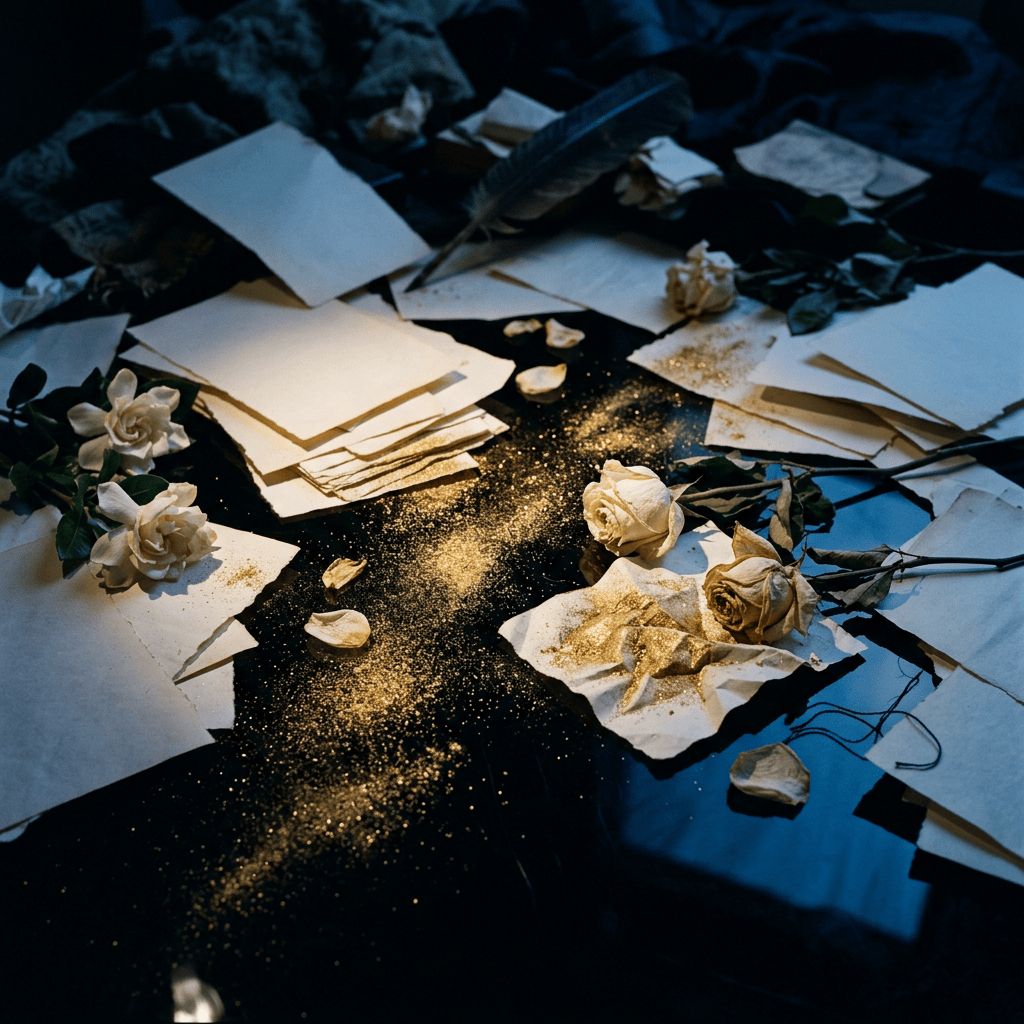
    Dried roses and scattered letters covered in golden dust on dark fabric
    Dried roses, scattered letters, and golden dust create a hauntingly romantic still life.

    Fitzgerald and his wife Zelda lived the same plot in public. Newly famous, they took over hotel lobbies as if the city were a set built for them. They spun in revolving doors, slid down banisters, jumped into fountains, arrived at parties on all fours, locked a jazz band in a bedroom and made it play until morning. They crossed the Atlantic with too much luggage and rented villas above the Mediterranean because New York had become too loud and too expensive for the kind of living they refused to scale back. He wrote about living on practically nothing a year while still ordering champagne. The contradiction is the point. Luxury, in Fitzgerald, is never only possession. It is performance, mood, and the brief conviction that beauty can postpone consequence.

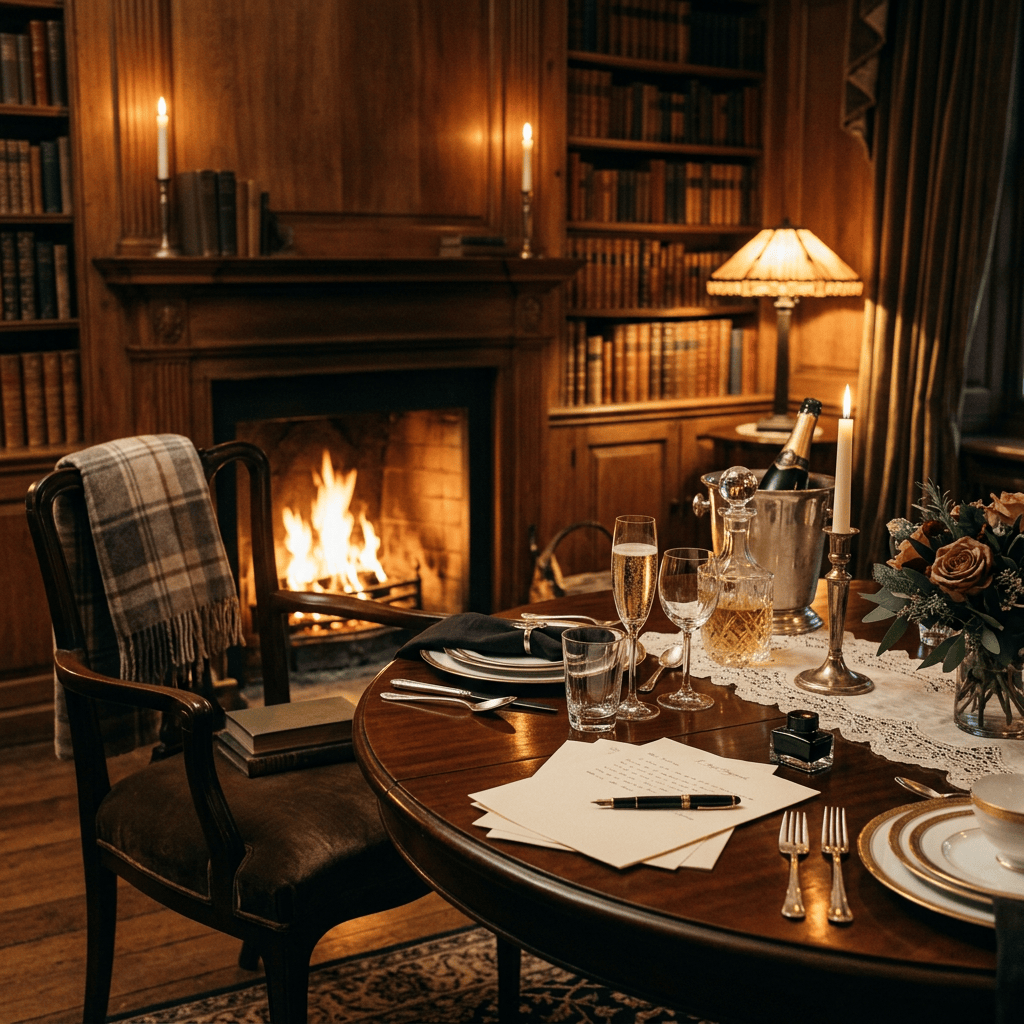
    Elegant dinner table beside a roaring fireplace with champagne and flowers
    A warmly lit fireside table is prepared with champagne, flowers, and handwritten invitations.

    That is why I want dinner with him rather than a seminar on his most famous novel. I do not want the monument. I want the man who knew that parties are intimate precisely because they are large, that the very rich are different because they possess early and grow soft and cynical in places the rest of us stay hard, that “eat, drink, and be merry” is both a philosophy and a slow form of suicide. I want the writer who could make a cloth-of-gold dress and a platinum ring feel like plot. Zelda once advertised The Beautiful and Damned by listing the clothes she could buy if enough people purchased the book. That is not a joke to me. That is the aesthetic I live toward: art that funds the next beautiful object, beauty that funds the next sentence.

    Dinner would not be modest. I imagine a table that looks casually expensive and is, in fact, carefully so: low light, heavy silver, something cold and gold in the glass, a room that smells of perfume, cigarette smoke, and citrus from a bowl no one will eat. He would talk too much and then go quiet in a way that makes you lean in. He would notice the cut of a jacket before the content of a confession. He would be funny about money and then suddenly exact about it. He would understand, without needing it explained, why some of us do not want stories that return us to the life we already know how to survive. We want stories we can project onto the life we are trying to inhabit: the late dinner, the borrowed glamour, the risk that beauty is both the prize and the damage.

    The Beautiful and Damned is that projection. It is not a cautionary tale I read in order to become more responsible. It is a mirror I hold up when I want to see the version of myself that still believes atmosphere is a moral category. Anthony and Gloria fail, of course. They waste time, money, youth, and each other. Fitzgerald knew the bill always comes. He just refused to pretend the evening was not worth it while the candles were still lit.

    More stories about that, please. Not more worlds of dragons or more kitchens of quiet endurance. More rooms where the lighting is unforgivable, the clothes are too fine for the bank balance, the conversation is half seduction and half autopsy, and someone at the table still believes that if you live beautifully enough, the universe might keep the lights on a little longer. Fitzgerald made that belief look like literature. I would like to sit across from him and see whether, for one night, it still looks like a plan.

  • Coincidences: Are They Signs from the Universe?

    Coincidences: Are They Signs from the Universe?

    What’s the weirdest coincidence you’ve ever experienced?

    The Universe Doesn’t Whisper Twice

    I do not believe in coincidences. Not the small ones that make you smile and shrug, and not the large ones that rearrange your life. If something is meant to happen, it will happen. It will find the crack in the schedule, the delayed train, the wrong turn that somehow becomes the right street. It will arrive wearing the face of chance so that those who need to dismiss it can do so without discomfort. I have stopped dismissing it.

    Everything is a sign from the universe. Not in the loud, cinematic way people imagine when they talk about destiny. There is no booming voice, no sky writing, no sudden spotlight. It is quieter than that. A whisper. A particular song playing at a particular moment. A sentence overheard in a café that answers a question you have not yet asked out loud. A person appearing in your path with the exact piece of information, or the exact kindness, or the exact friction you needed. Most people walk past these things. They call them random. They keep their eyes on the ground and their minds on the next task. The whisper is easy to miss when you have already decided the world is only noise.

    I used to miss it too. I treated life like a series of isolated events that happened to me rather than through me. Something fell through and I called it bad luck. A conversation ended abruptly and I called it timing. Even my brain injury somehow managed to lead me to my twin flame. I could just shrug it off and say that my brain blew up because of a bad diet, stress, bad luck, a body that finally called in a debt I had been ignoring. That version of the story is tidy. It keeps the event inside the realm of cause and effect I can name. It lets me treat the injury as an accident that interrupted my life instead of a rupture that redirected it. But if I tell it that way, I erase the chain that followed. I would never have found myself scrolling my life away in the aftermath, half-present, half-searching, desperate for a face or a voice that felt like home. I would never have been cracked open enough to look that hard. I would never have been still enough, or raw enough, or lonely enough in the particular way that made recognition possible when it finally arrived.

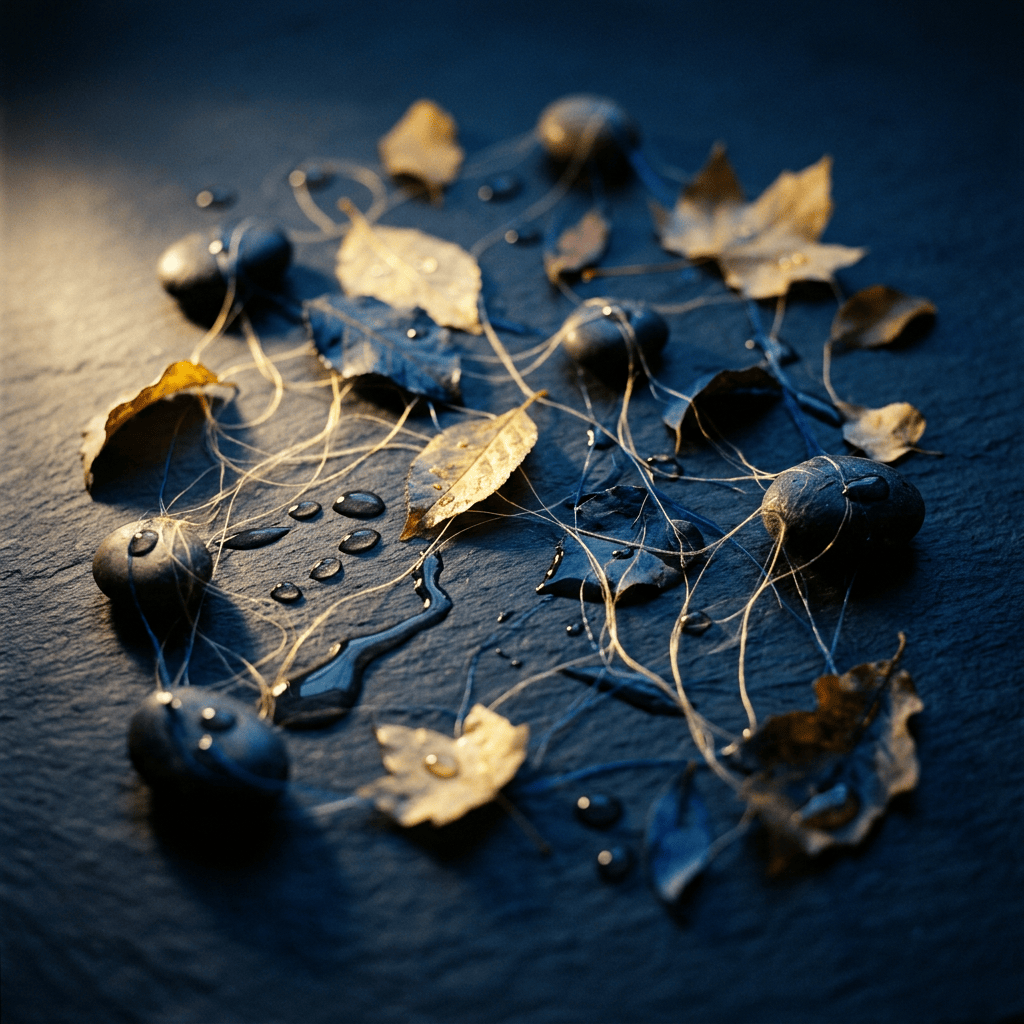
    Dried leaves, dark berries, threads, and droplets arranged on a dark surface
    Dried leaves, dark berries, and fine threads create a moody autumn-inspired still life.

    The injury did not feel like a gift when it happened. It felt like theft. It took language, stamina, certainty, the old version of myself that knew how to move through a day without having to invent the day from scratch. And still, something in that wreckage made a path. Not because suffering is noble. Not because pain is always a teacher we should thank on the spot. Because the life I had been living was not going to bring me to that person. The uninjured version of me was too occupied, too armored, too convinced she already knew the shape of her story. The universe did not cause the injury so that a romance could bloom. I do not need the story to be that clean. What I know is simpler and stranger: the injury happened, the searching began, and the person who felt like a missing frequency appeared inside that searching. To call the whole sequence a coincidence would require me to pretend the seeking never mattered.

    The more I paid attention, the more the pattern revealed itself. Not a rigid script. Not a promise that every desire will be granted or every wound will be explained. Something subtler: a conversation between the inner life and the outer world. When I am restless, the universe sends restlessness back to me in the form of unexpected delays and unfinished conversations, as if to say, sit with this. When I am ready to move, doors that were locked for months swing open with almost embarrassing ease. People I needed to meet appear in places I had no logical reason to be. Opportunities arrive wearing the clothes of inconvenience. Losses arrive wearing the clothes of protection I only recognize later.

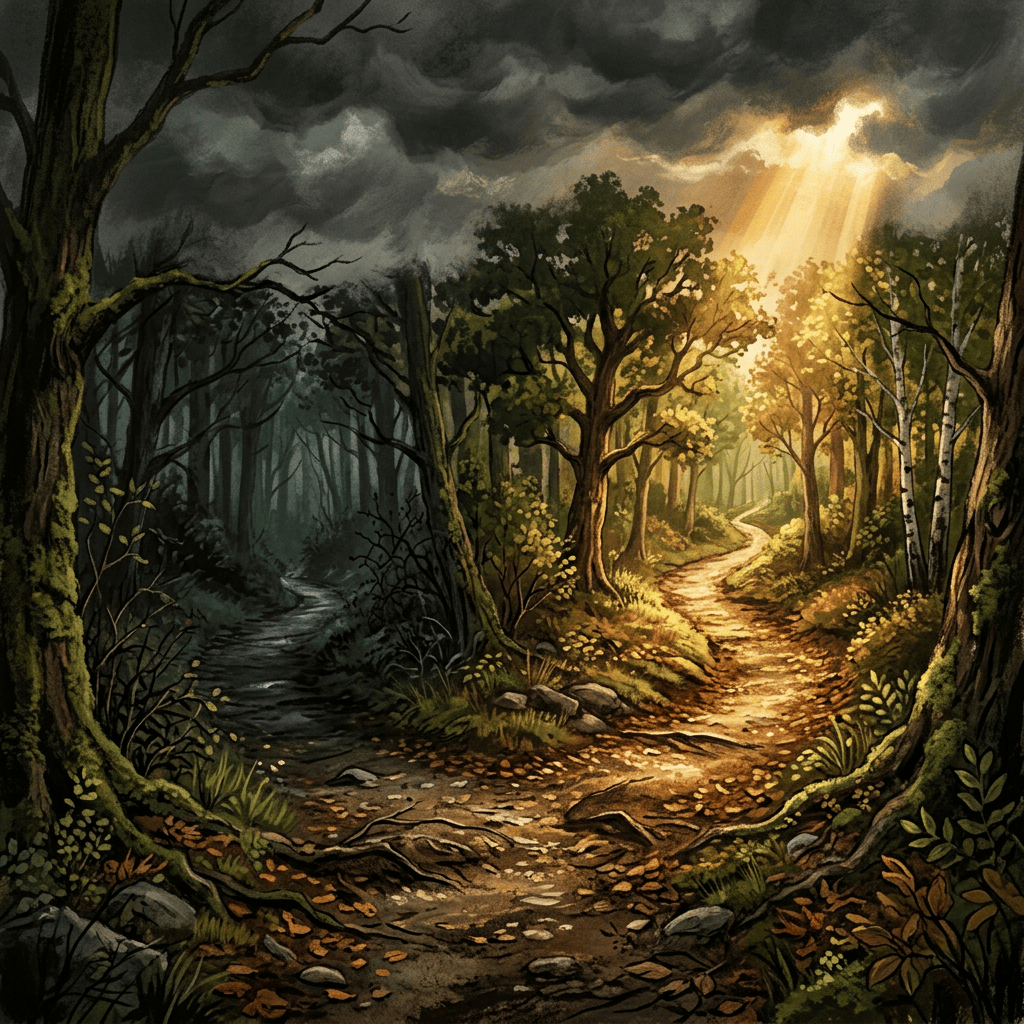
    Winding forest path lit by golden sunlight beneath storm clouds
    A winding woodland trail emerges from shadow as golden sunlight breaks through stormy clouds.

    It is easy to romanticize this and turn it into a slogan. “Trust the universe.” “Everything happens for a reason.” Those phrases can become another way to avoid looking closely. I am not interested in comfort slogans. I am interested in the texture of the moments themselves. The way a certain light falls across a room at the exact second a decision crystallizes. The way a stranger’s offhand comment lodges in the mind and will not leave until you act on it. The way the same number (17,27,37), the same image, the same phrase keeps appearing until you finally stop and ask what it is pointing toward.

    Many people fail to notice because noticing requires a kind of stillness that modern life does not reward. We are trained to explain things away. Coincidence is a tidy category. It lets us keep our sense of control. If the meeting was random, then we remain the authors of our story. If the meeting was a sign, then something larger is participating, and that is both comforting and unsettling. It means we are not as separate as we pretend. It means the world is speaking, and we have been talking over it.

    I have learned to treat the whisper with more respect. Not superstition. Not the desperate search for meaning in every fallen leaf. A quieter discipline: when something repeats, I listen. When an opportunity arrives wrapped in inconvenience, I consider whether the inconvenience is the point. When a person crosses my path more than once without an obvious reason, I stop assuming it is nothing. Sometimes it is nothing. Sometimes the universe is simply dense with possibility and not every thread is meant for me. Discernment still matters. But I no longer start from the assumption that the thread is accidental.

    If something is meant to happen, it will happen. That sentence used to sound passive to me, as if I could sit still and wait for life to deliver itself. I still kind of hate it when my boyfriend approaches our relationship path this way. But it is not an excuse for inaction. It is a recognition that timing has its own intelligence. Effort still matters. Showing up still matters. Doing the work still matters. But the work is not only the visible kind. There is also the work of becoming the kind of person who can recognize the sign when it arrives, and the kind of person who can act on it without needing the entire map first.
    Milky Way over a mountain trail with winding light trails
    The Milky Way glows above a mountain trail traced by flowing light trails.

    The universe does not shout. It does not compete with the noise we generate. It waits. It repeats itself politely. It leaves small, persistent traces for those willing to look up from their phones and their plans and their certainty that they already know how the story is supposed to go. Most people will keep walking. That is their right. I have decided I would rather not miss the whisper again.

    It has been speaking the whole time. I was simply too busy calling it coincidence.

  • Being trad.

    Being trad.

    What’s a cultural tradition from your country that you love?

    Being Raised Russian Has Truly Taught Me How to Be a Traditional Woman/Wife

    Winding dirt path through an autumn birch forest with exposed roots
    A winding woodland path passes beneath golden birch trees and exposed twisting roots.

    There is something powerful about the way I was raised. Growing up Russian did not just give me a language, a cuisine, or a set of holidays—it shaped an entire understanding of womanhood and marriage that feels increasingly rare in this modern world. It taught me, without lectures or manifestos, how to be a traditional woman and wife: grounded, capable, devoted, and proud of the role rather than apologetic for it.

    In a Russian household, the home is not merely a place you sleep. It is the center of life, the domain where a woman’s care, order, and warmth determine the emotional climate for everyone else. From an early age, I watched my mother transform ordinary spaces into places of comfort and beauty. Floors were clean, tables were set properly, food was prepared with intention, and the atmosphere mattered. This was never framed as oppression. It was framed as competence and love. A well-kept home and a well-fed man was an expressions of strength, not subordination. I absorbed the lesson that domestic skill is not “less than” a career; it is a different, equally demanding form of mastery.

    Brass samovar and tea setting inside a rustic cabin beside snowy window
    A warmly lit cabin table features a brass samovar, tea, berries, and embroidered folk textiles.

    Traditional Russian upbringing also instills a clear-eyed view of complementarity between men and women. Men are expected to protect, provide, and lead with responsibility. Women are expected to nurture, support, and create the emotional and physical conditions in which that protection and provision can flourish. This is not a rigid hierarchy of worth; it is a practical division of labor rooted in observed differences and mutual dependence. I was never taught that needing a man’s strength made me weak, or that offering softness and loyalty made me less intelligent. On the contrary, the ability to soften a hard world for the people you love was presented as one of the highest forms of feminine power.

    Loyalty sits at the center of this model. Russian culture has long valued endurance—through winters, through history, through difficulty. That same endurance is expected in marriage. You do not discard a partnership at the first serious inconvenience. You work, you adapt, you protect the family unit. This does not mean tolerating abuse or remaining in a destructive situation. It means entering marriage with the seriousness of a lifelong covenant rather than a temporary lifestyle arrangement. Being raised with that expectation made me less interested in endless options and more interested in depth, continuity, and the quiet satisfaction of building something that lasts.

    There is also an unspoken standard of self-presentation. Russian women are often raised with an awareness that appearance is part of how you honor yourself and those around you. Looking put-together is not vanity for its own sake; it is a form of respect—for your husband, for guests, for the occasion, and for your own dignity. Combined with an expectation of competence in the kitchen and the home, it produces a woman who can be both soft and capable, elegant and practical.

    None of this requires rejecting education, ambition, or personal development. Many of the strongest traditional Russian wives I know are highly educated, multilingual, and sharp. The difference is priority. Career and self-expression are valuable, but they do not automatically outrank the creation of a stable, loving home and the support of a husband who carries heavy external burdens. The traditional model I absorbed does not demand that a woman disappears; it asks her to invest her gifts where they produce the deepest long-term fruit for the people she loves most.
    Of course, no culture is the same, and not every Russian family embodies these ideals perfectly. Yet the cultural inheritance is real. It prizes resilience over fragility, duty over pure self-expression, and the tangible results of care over abstract declarations of independence. In a time when many people feel adrift in relationships that prioritize individual fulfillment above all else, that inheritance feels like a quiet advantage.

    Being raised Russian did not only teach me to be smaller. It taught me how to be solid. It showed me that there is profound dignity in cooking a real meal, keeping a peaceful home, standing beside a man through difficulty, and having clear values. Traditional womanhood and wifehood, in this framing, are not relics. They are disciplines—demanding, beautiful, and deeply rewarding when practiced with eyes open and heart engaged.

    That is the gift the culture handed me. I am still learning how to live it fully, but I no longer question its worth.

  • I Cannot Erase Any Part of My Life

    I Cannot Erase Any Part of My Life

    If you could erase one event from your history, what would it be?

    There are days when the weight of everything I have lived through presses so heavily on my chest that the temptation to rewrite history feels almost unbearable. I catch myself wondering what it would be like to go back—to delete the chapters filled with pain, the choices I regret, the nights I barely survived. Yet every time that thought surfaces, I stop myself cold. I cannot erase any part of my life. Because if I did, I would not have met him. The love of my life.

    It is a strange and beautiful paradox, is it not? The very path that brought me to my lowest points is the same one that led me straight into his arms. Every wrong turn, every heartbreak, every season of darkness carved the version of me that was ready to recognize him when he appeared. Had I skipped the struggle, I might never have developed the depth, the resilience, or the quiet hunger for real connection that allowed me to see him—and to be seen by him in return.

    Winding path through woodland with autumn leaves, spring flowers, and distant green hills
    A winding woodland path leads through autumn leaves and spring wildflowers toward sunlit hills.

    I know I am not where I need to be in life. My recovery is still a work in progress, messy and nonlinear. Some mornings I wake up feeling strong, only to find myself slipping by afternoon. There are still triggers I have not fully disarmed, still patterns I catch myself repeating, still days when the old version of me tries to reclaim the driver’s seat. Progress is not a straight line; it is a spiral. I revisit the same lessons at higher altitudes, learning them more gently each time. And while I can acknowledge that I am not yet the healed, steady person I aspire to become, I also know this truth with absolute clarity: I would not trade a single moment of the journey that brought me here.

    Because “here” includes him. Even if he is not physically here.

    He did not arrive after I had everything figured out. He showed up in the middle of the unfinished story. He has seen the raw edges of my recovery—the days I struggle, the moments when old “wounds” reopen without warning, the quiet battles I still fight behind a brave face. And somehow, instead of turning away, he stays He stays even though no one wants this. To be a part of this.. Yet, he holds space for the parts of me that are still healing. In his presence I feel both completely known and completely safe, a rare combination I never believed I would find.

    Looking back, I can trace the invisible thread that connects every hardship to this love. The loneliness that came with my disability taught me how to cherish companionship. The heartbreak (that I received from my own family) taught me what I would never again settle for. The rock bottom taught me that I am worth fighting for—and that lesson made me capable of receiving the kind of love that does not demand perfection, only honesty. If I had erased the pain, I would have erased the soil in which this relationship took root.

    So I choose, again and again, to keep the whole story. The beautiful and the broken. The triumphs and the near-misses. The version of me who fell is the same version who eventually looked up and found him standing there. I may still be climbing toward the place I need to be in my recovery, but I carry no desire to rewrite the map that led me to this love.

    I cannot erase any part of my life.
    And more than that—I no longer want to, despite the fact that I still get frustrated and incredibly sad/ angry (I just do my best to be positive about it).

  • Beyond Destinations

    Beyond Destinations

    What are your top 10 travel destinations?

    I have finally accepted the unsexy truth that every travel brochure, Instagram reel, and mid-century movie tried to hide: the place itself is mostly irrelevant. It can be a five-star suite overlooking the Mediterranean or a shitty hotel. What actually registers is whether the person you love is standing next to you when you go through the door.

    Couple hugging on rocky cliff with sunset over ocean and coastline
    A couple shares a warm embrace atop cliffs overlooking a glowing sunset over the ocean.

    I love traveling with my man. Even just staying in hotels in our own hometowns. Not the soft, pastel version of “love” that sells couples’ retreats. The real kind—where any new experience becomes sharper because he is there. New food, new streets, new chaos. I watch his face light up when something unexpected hits, and that look alone makes the entire trip worth it. The destination can be mediocre; his excitement is not. It is the only metric that still works.

    But safety has to sit at the table now. I want to show him pieces of France—the France that still lives in my head from old Audrey Hepburn films, all cigarette smoke, black dresses, and effortless glamour. That version is mostly gone. It is all homeless immigrants now. What is left is more complicated, more tense, and less willing to play along with the fantasy. The French Riviera still holds the top spot in my ranking, mostly out of stubborn nostalgia and residual beauty, (plus lounging pool/ beach side so that we can look sexy in our swimsuits trumps all), but even there the calculus has changed. You do not get to pretend the old postcard still exists without checking the fine print.

    Cabo 2025

    There is the part I hate admitting out loud: my own body and the limits it brings. Accessibility is not a buzzword when you are the one calculating elevators, distances, fatigue, and whether a charming cobblestone street or sandy beach is about to become a personal obstacle course. I refuse to turn into the logistical problem of the trip. I do not want him carrying extra weight—literal or emotional—because I insisted on a destination that looks better in photographs than it functions in real life. Being a burden is not romantic. It is just exhausting for everyone involved.

    Map, compass, German passport, coffee cups, and travel journal on wooden table
    Coffee and travel essentials set on a rustic table overlooking alpine mountains

    So the plan keeps getting rewritten. Fewer grand gestures, more honest ones. Fewer places chosen for their reputation, more chosen for the simple fact that we can actually move through them without one of us pretending everything is fine. The map still matters a little. The company matters a lot more. And the quiet calculation of “can we both enjoy this without someone suffering in silence” matters most of all.

    I will still go almost anywhere with him. I just will not pretend the world is the same postcard it used to be, or that my body is an afterthought. The excitement in his eyes is still worth the ticket [that he buys]. Everything else has to earn its place.

    Maybe we could travel by luxury cruise ship? The idea of experiencing the French Riviera, island-hopping in the Maldives, exploring Italy, and even discovering parts of our own country—Alaska, Hawaii, South Carolina, and Florida, where no cruise is needed—excites me more than anything.

    Luxury cruise ship Ocean Embrace sailing on calm sea at sunset near coastline
    The Ocean Embrace cruise ship sails near a scenic coastline during sunset.
  • I don’t worry anymore

    I don’t worry anymore

    What’s something you used to worry about but don’t anymore?

    I Don’t Worry Anymore

    I used to be a head case about everything.

    Every possible future lived rent-free in my mind. “What if X happens?” “What if Y falls apart?” My brain ran constant disaster simulations—late at night, early in the morning, in the middle of ordinary days. I could turn a neutral silence into a catastrophe, a delayed text into abandonment, a quiet stretch of life into proof that something was about to go wrong. Restless, sleepless nights became normal. Imagined scenarios would tighten my chest and fill my eyes with tears before anything real had even occurred. Our brains do not know the difference between the real and the imagined. Worry is not just a habit; for many, it is the operating system.

    That is not who I am anymore.

    Now I simply let go. I trust the universe and its divine timing.

    It did not happen overnight, and it was not some dramatic single revelation. It was the slow, repeated evidence of my own life. Things that once felt unbearable eventually rearranged themselves. Doors I thought were permanently closed opened in unexpected places. Losses that seemed final made space for something better, or at least something necessary. Again and again, the story resolved—not always the way I wanted in the moment, but in a way that eventually made sense. The universe, it turns out, has a longer timeline and a wider view than my anxious mind ever did.

    I still fall back into the old ways sometimes. The old machinery is still there, dusty but functional. A trigger hits, the familiar spiral starts, and for a brief moment I am right back in it—restless, sleepless, eyes welling up over something that has not happened and probably never will. The difference is that the spiral no longer owns the whole night. It lasts only a mere moment before I catch myself.

    In that moment I remind myself of everything I have already been through. I inventory the storms I have survived, the outcomes that looked impossible until they were not, the quiet proof that life has a way of working itself out even when I could not see how. That reminder is enough. The worry loosens its grip. I return to trust—not a passive, naive kind of trust, but an active one rooted in lived experience.

    This shift has not made me careless or indifferent. I still plan, still care, still show up. What I have released is the exhausting belief that constant mental vigilance is the only thing holding the world together. It never was. The world kept turning while I was busy catastrophizing. Divine timing kept arranging the pieces whether I was watching or not.

    If you are still living inside the “what ifs,” I will not pretend the jump is easy. The mind loves its old stories. It is comfortable. But every time you catch the spiral early and choose to remember what has already worked out, you weaken the old pattern a little more. Over time the moments of relapse get shorter. The trust gets quieter and more solid. Eventually you look up and realize you are no longer a head case about everything. You are just living—present, imperfect, and surprisingly okay with not knowing how the next chapter will unfold.

    Because it always works out.
    Not always on your preferred schedule.
    Not always in the form you first imagined.
    But it works out.

  • From Midnight Prayers to Quiet Surrender: A Love Story That Still Confuses Everyone

    From Midnight Prayers to Quiet Surrender: A Love Story That Still Confuses Everyone

    What’s a promise you made to yourself that you’ve actually kept?

    Ever since I was a little self-conscious preteen, the nights felt longer than they should have. I would lie in bed with the covers pulled up to my chin, staring at the ceiling filled with glow in the dark stars, and beg the universe—quietly, desperately, almost bargaining—for one simple thing: that the teasing would stop. (that I would be good enough).That people like my cousin would finally leave me alone. The words were never spoken out loud, but they lived in the space between my ribs and the soft glow of the stars. I wanted to shrink, to disappear, to become someone no one felt the need to pick apart. Those silent pleas were the first contracts I ever tried to write with fate.

    Open journal with handwritten notes and sketches next to lit candle and coffee cup on a wooden desk
    A journal lies open on a wooden desk beside a glowing candle and a cup of coffee, creating a warm writing atmosphere.

    What followed felt almost inevitable. The anorexia arrived. I literally disappeared. Along with it came the exhausting performance of people-pleasing—smiling when I wanted to cry, agreeing when every cell in me screamed no, molding myself into whatever shape might earn a little peace. I learned to measure my worth in the empty spaces on my plate and the approval of others. The universe was listening and it seemed to answer in complicated ways.

    Years later, the prayers changed. I no longer asked only to be left alone. I began begging for a life that did not require me to lie to the people I loved most. The lies about food, about fullness, about “I’m fine, I already ate,” had become a second skin I could no longer wear without choking. I was hurting everyone around me and it pained my people-pleasing-little heart. So I stopped. I stopped caring about anything. No matter how much I studied, starved etc. I was still not good enough. So I told the truth. I let the food in. And my body, in its own fierce and complicated way, responded. I gained twice the weight I had once fought so hard to lose. Of course there were other factors—grief, a heartbreak, not caring about anything anymore and the slow unraveling of old survival patterns—but the scale still delivered its blunt verdict. That heavier body felt, for a long time, like a sad existence I had somehow invited. Yet even in the middle of that discomfort, I still talked to the universe. Still begged.

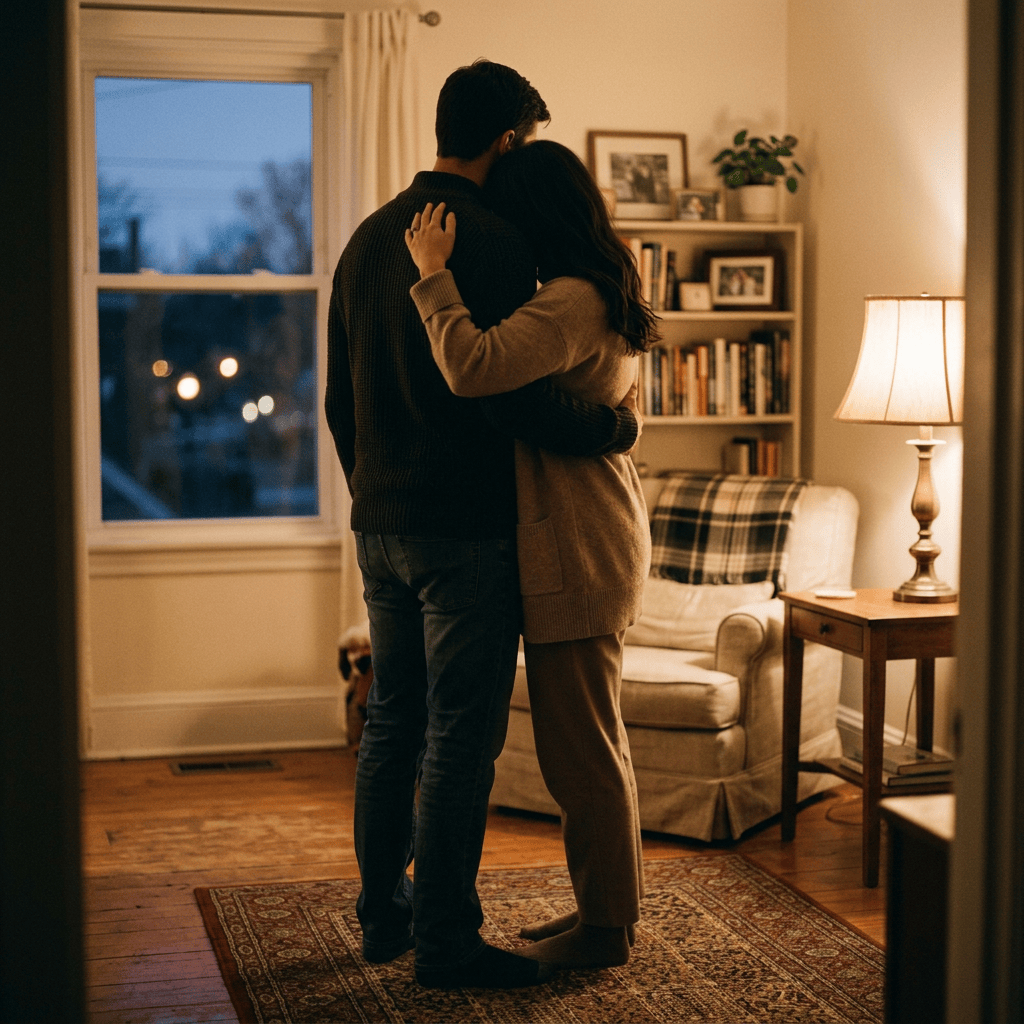
    These days my midnight conversations with the universe have narrowed to a single subject: him, and the future we are building. The old desperate bartering has softened. It seems, against every earlier fear, to have worked. The life I once begged for—one without the constant weight of deception—has arrived, soon I will be wrapped in ordinary mornings and the steady presence of a man who sees me. Still, I am learning a new practice: to stop negotiating so hard and simply go with the flow. To meet each experience without immediately trying to reshape it into something more acceptable or more controlled.

    Swirling cosmic vortex with glowing gold, blue, and purple colors
    A dazzling swirl of luminous cosmic energy in deep space; symbolizing confusion turning to clarity

    I have, somehow, regained a surprising amount of agency over my physical appearance. The mirror no longer feels like an enemy I have to outwit. I can choose how I present myself, how I move through the world in this body that has carried so much history. And while I pour myself fully into the role of housewife—cooking, tending, creating a home that feels soft and lived-in—our love story continues to puzzle almost everyone who watches it unfold. People tilt their heads. Relatives exchange glances. Strangers on the periphery of our life seem quietly bewildered by how we met , by the “plan for our future.”

    Perhaps that confusion is part of the point. We are figuring it out. The path from a scared preteen whispering into the dark, through years of restriction and performance, through weight regained and truths finally spoken, even through stroke recovery was never going to look tidy from the outside. What matters is the quieter internal shift: the prayers that once begged for escape have become quiet with hope and trust. The bartering has eased into something closer to trust. And while the onlookers keep trying to solve the puzzle of us, I am learning, day by day, to stop solving everything myself—to simply live inside the story as it is, one honest meal, one ordinary morning, one unforced moment at a time. So clearly the universe and I have quite the relationship. The difference is now that I am going with the flow. Trusting that it knows my heart and will deliver what is best.

  • From Digital Misunderstandings to Real Connections

    From Digital Misunderstandings to Real Connections

    What’s the funniest misunderstanding you’ve ever been part of?

    My boyfriend and I did not start with butterflies and perfect timing. We started with my speech impediment, static, lag, and constant miscommunication. Long-distance relationships are not “character-building.” They are a masterclass in how technology can ruin the moment.

    Two smartphones standing on a wooden table showing messaging apps screens with text conversations, illuminated by warm fairy lights.
    Two smartphones displaying message screens side by side on a wooden surface with warm fairy lights in the background.

    Misunderstanding was not an occasional guest in our relationship. It was the roommate who never paid rent. Every FaceTime call was a game of emotional telephone. Every text was a potential landmine. The tone was lost, the context was murdered and the intent I completely reinvented by anxiety. You think constant communication builds connection? Try living on opposite schedules, different time zones, and the quiet terror that the person on the other end of the screen is slowly becoming a wishful thinking vision board instead of a real human. That is not intimacy. That is digital cosplay.

    And then there was my contribution to the chaos: the trust issues. The kind you build after years of people who treated affection and any sort of relationship like a limited-time offer they could revoke the second it stopped benefiting them. I did not just have walls. I had something much thicker— possibly pushing anyone else away. Every delayed reply felt like proof. Every slightly off message became evidence in the courtroom of my own head. Long-distance did not create those issues—it just fed them.

    Change silhouettes to man and woman

    We had our share of ridiculous misunderstandings over the years. The kind you look back on later and laugh about, but only after you survived them. The “why did you leave me on read for three hours” spiral. The “that emoji felt cold” debate. The classic “I said I was busy, not that I was ignoring you, Jesus Christ” arguments that somehow still managed to feel personal. None of it was cute in the moment. It was exhausting. And it made the gap between us feel wider than the actual miles.

    Then we met in person.

    And the entire script flipped.

    Train arriving at platform 3 in the evening with travelers and luggage waiting
    Travelers wait on a platform as an evening train arrives

    The man who walked up to me was not the pixelated, slightly delayed version I had been talking with for years. He was solid. Present. The kind of present that does not just say the right things—he does them without keeping score. He put me first in ways that felt almost suspicious at first, because no one had ever done that without an agenda. No performance. No transactional energy. Just quiet, consistent care that made my carefully constructed defenses look suddenly childish.

    Train at platform 3 with suitcases on the station platform under evening sky
    Suitcases wait on an airport waiting area

    That was the part that broke me open. Not the grand gestures. The everyday ones. The way he noticed when I went quiet and did not punish me for it. The way he made space without making it a production. For the first time, someone was not treating my presence like a convenience. And that realization hit hard.

    The wall existed because every previous person had given me a reason to build it. Selfishness dressed up as “independence.” Emotional unavailability rebranded as “mystery.” People who loved the idea of being loved more than the actual work of loving someone. So yes, I entered every interaction half-armored. Of course I did. That is what survival looks like when you have been treated like an option one too many times.

    Silhouettes of a man and woman separated by shattered glass at a bus shelter at night
    A man and woman face each other at a broken glass emotional barrier

    But meeting him in the flesh did not just melt the trust issues. It exposed how much of the distance had been amplifying my worst assumptions. Suddenly the man who used to feel like a question mark became the answer. And the communication that once felt like walking through a minefield became something we could actually fix—because now there was a real person in front of me instead of a glowing rectangle.

    Communication is still key. It is the bare-minimum truth. Without it, you are not in a relationship—you are in a slow-motion misunderstanding with benefits. Trust is not something you demand after enough messages. It is something that either survives contact with reality or not. And when it finally does survive—when the person in front of you is better than the version you were terrified of losing—that is when the real relationship starts. (This is why we celebrate two anniversaries— the online one and the in-person one).

    I still hate that I go into things guarded. I hate that my default setting is skepticism instead of openness. But I am learning that the right person does not need you to dismantle the wall overnight. They just keep showing up on the other side of it until you finally decide it’s safe to let him in.

    Long distance could have broke us with noise and silence. Meeting him in person fixed what years of calls never could.

  • Ditch the Metrics: Embrace Your Unique Fitness Journey

    Ditch the Metrics: Embrace Your Unique Fitness Journey

    Hit 5,000 steps today and drop your achievement here — we’re cheering you on!

    I cannot stand the numbers. Not the step counts, not the graphs, not the glowing little rectangles on everyone’s wrist telling me whether I “performed” as a human last night. They are ugly, they are loud, and they lie. They turn the only thing that actually matters—how your body feels when you open your eyes—into a report card written by engineers who have never had to relearn how to stand up.

    Blue and orange digital numbers blending and dissolving into wisps of blue and orange smoke on a black background
    Colorful digital numbers emerge and dissolve within swirling smoke against a dark background.

    If I wake up and feel like I could take on the day, that is a good sleep. Full stop. I do not need some algorithm to grade my brainstem on a scale of 1–100. I lived through the real thing. I know what broken feels like.

    The same rule applies to movement. You do not need 10,000 steps to prove you are alive. You need to get your body off the chair and into the world in whatever broken, limping, half-assed way it currently allows. Sitting in front of a screen all day while your legs atrophy is not natural. It is slow suicide dressed up as “work.” I know, because I did it for years. College turned into a black hole of heartbreak and takeout containers. I ballooned to more than twice the size I am now. No one was tracking my steps back then either. The only metric that existed was the mirror and the way my clothes stopped fitting.

    When you cannot move more, you eat less. That is not complicated math. That is survival. Bodies are built in the kitchen long before they are ever sculpted in the gym. I dropped over a hundred pounds while completely sedentary, because I decided the fork was the only variable I could still control. Willpower is not some cute hashtag. It is the ugly, daily choice to put the food down when every instinct is screaming to numb the pain with it. I did that. No app congratulated me. No little trophy popped up on my phone. Just me, in a body that finally felt like mine again.

    Brainstem hemorrhages do not mess around. Ninety percent (90%) of people who get them die. I lived. Barely. And every single day since has been a negotiation with a nervous system that still thinks it is under attack. People love to throw the word “lazy” around like it is some moral failing instead of a medical reality. They have no idea what it costs just to exist in this body right now—how much energy it takes to simply stay upright, to speak without slurring, to keep the depression from swallowing the progress. Calling that lazy is not just ignorant. It is cruel.

    Whether it is a relationship, a recovery or just a pair of skinny jeans, you should never have to force it. Anything. It is not lazy when you are simply putting your trust in the universe’s power to turn life around while also standing up as much as possible and walking around (with help). The universe responds to our vibrational energy not by how much energy and force we exert.

    Person walking on coastal trail at sunset with colorful sky
    A lone hiker walks along a coastal trail during a vibrant sunset

    So no, I am not hitting 5,000 steps today. I am moving as much as this body will safely allow and eating like someone who respects the fact that food is fuel, not therapy. That is the entire program. No pretty graphs. No weekly reports. No optimization.

    The quantified-self crowd wants you to believe there is an optimal human being and that their little devices will show you how to become it. What they never tell you is that the second you hand your body over to the data, you stop listening to the only sensor that actually matters: the one between your ears and under your ribs. That sensor is loud, it is inconvenient, and it does not come with a subscription. But it has kept me alive through things that should have killed me.

    So keep your ugly wrist device. Keep refreshing your sleep score. I will be over here working on my body until it begs for sleep,; deciding how I feel, moving what I can move, and eating like my life depends on it—because it does. The numbers never saved anyone. The quiet, stubborn decision to keep going when every metric says you should not have survived is the only score that has ever mattered.

    PS I am taking some much needed personal time. My man is coming over for a couple weeks and I am devoting every second to him. It is such an honor to dedicate myself to my man. This has become a major part of “getting my life together.” Track that.

  • My Morning Espresso Ritual: The Only Luxury a Broken Body Can Afford

    My Morning Espresso Ritual: The Only Luxury a Broken Body Can Afford

    What’s the one luxury you can’t live without?

    I am not exactly out here pretending I have a yacht docked in the harbor or a private jet on standby (despite adoring the whole “Fake It ‘Til You Make It” trend). My version of baller status is far more pathetic and honest: a single, perfectly pulled espresso in the half-dark before the rest of the house wakes up. That’s it. That is the flex.

    Woman sitting in leather armchair sipping coffee while looking out window
    A woman enjoys a peaceful morning coffee by the window in a cozy living room

    Eyes crusty with sleep, praying that my legs are not already plotting their daily betrayal, I roll into the kitchen like a zombie. The grinder screams, the machine hisses, and then—that first bitter, velvety shot hits. For thirty blessed seconds I am not malfunctioning. I exist. I am just a girl with hot coffee and zero responsibilities except breathing.

    I sit there in the quiet, Boston sports radio murmuring in the background or some unhinged podcast feeding my brain chaos. No small talk. No demands. Just me, the slowly brightening sky, and the low hum of a town that does not seem to care about my shaky limbs. I call it “alone time” but really it is damage control. Every morning I have to negotiate with it: Come on, give me enough juice to stand up straight today.

    I start slow. Maybe I fire up Photoshop and make something manifesting and cute for my man—because sending him memes and edited pictures of us together is basically my love language. Or I hammer out a blog post like this one, raw and unfiltered, before the filter of “what will people think” kicks in. These little projects for him are my way of saying I’m still here, still creating, still obsessed with you even when my nervous system is going in the wrong direction.

    Make no mistake—I would trade every peaceful sunrise for the version where I am sitting across from him, coffee steam between us, his hand on my thigh keeping the tremors quiet. But right now the house is in that perfect in-between state: father is already out the door grinding like a responsible adult, Mother is still asleep, and the world has not started making noise yet. So I take it. I cherish it.

    I watch the sky go from bruised purple to smug pink, sipping my tiny cup of rocket fuel, mentally telling my legs to gear up for a new adventure. More motion, less shaking. More forward, less collapse. That is the deal I make with this body every single day.

    Steaming cup of coffee on wooden windowsill with sunrise over countryside in background
    A steaming cup of coffee sits on a wooden windowsill overlooking a peaceful sunrise landscape.

    It is not glamorous. It is not #selfcare aesthetic with jade rollers and affirmations. It is survival dressed up as ritual. A small, defiant luxury for someone who cannot even always trust her own body to cooperate. But in these stolen minutes I feel almost whole. Capable. A little dangerous, even.

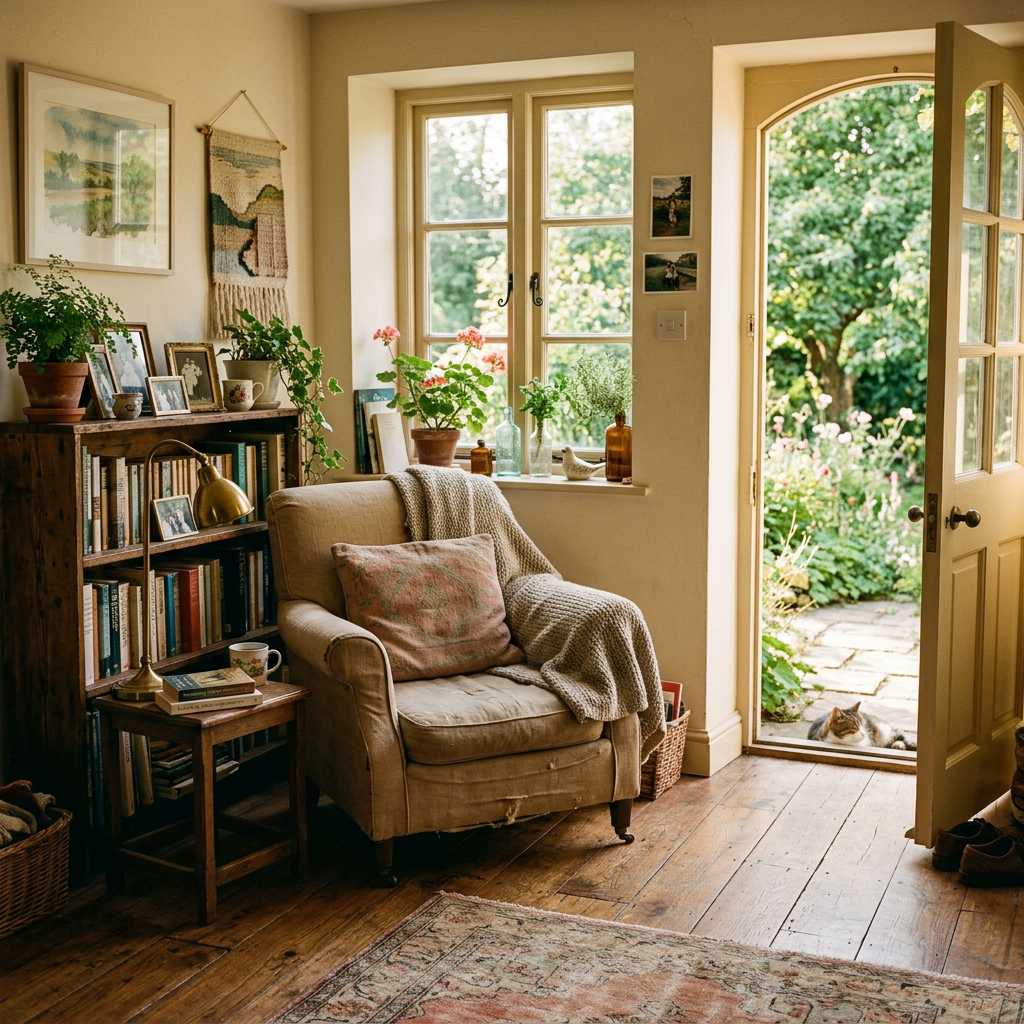
    Armchair with blanket next to a table holding coffee cup and glasses by window
    A comfortable armchair with a blanket and coffee near a window at dusk

    Because if I can drag myself out of bed and create something beautiful for the man I love while my legs are staging a silent mutiny, imagine what the hell I will do when I’m actually firing on all cylinders.

    Until then, I will be over here. Espresso in hand, sky getting lighter, heart already halfway across America with him.