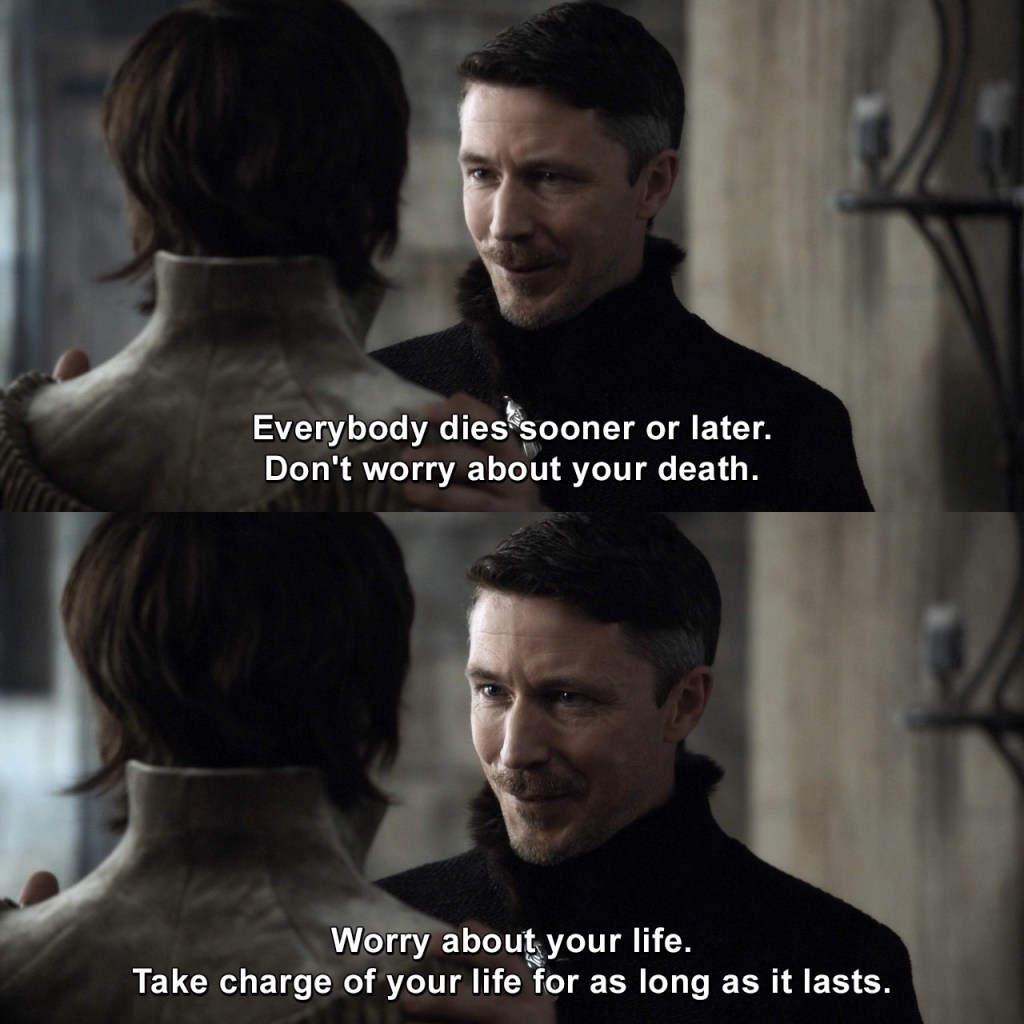
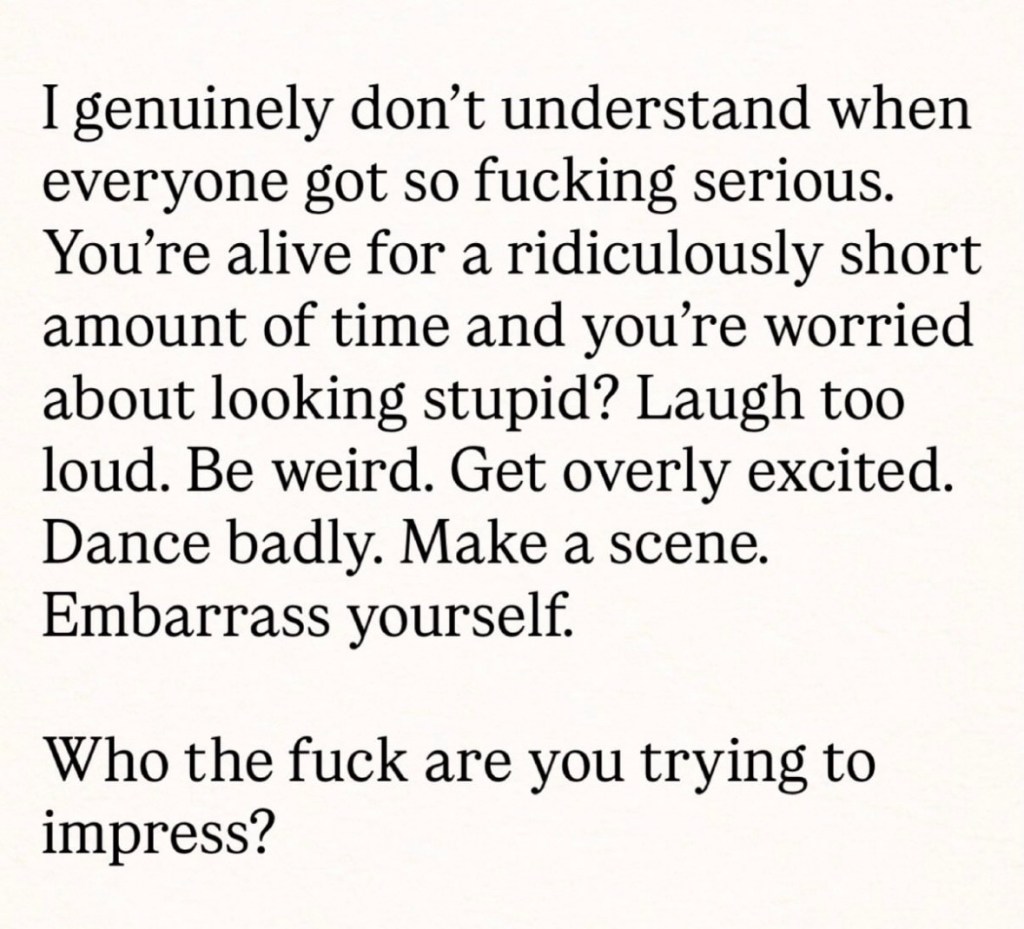
There is an intensity in the words: Everybody dies sooner or later. Don’t worry about your death. Worry about your life. Take charge of your life for as long as it lasts.
Spoken with calm certainty, these words cut through the usual noise of motivational platitudes. No soft promises of endless tomorrows. No denial of the inevitable. Just a clear, almost clinical redirection: stop fixating on the end and start owning the middle.
Most of us spend more mental energy on death than we admit. I simply do not understand this. Death, whilst inevitable, is kind of… depressing? We postpone conversations, delay risks, and treat time as if it were infinite. The result is a life lived in the shadow of an ending we cannot control. Fear of death becomes a quiet thief—it steals presence, courage, and the willingness to choose.
The quote refuses that bargain. Death is not a problem to be solved or delayed indefinitely. It is a fact. Once accepted, the real work begins: what will you do with the stretch of days you actually have?
“Take charge of your life for as long as it lasts” is both permission and demand. Permission to stop waiting for ideal conditions. Demand to stop outsourcing your agency to circumstances, other people’s expectations, or the vague hope that “someday” will arrive fully formed.
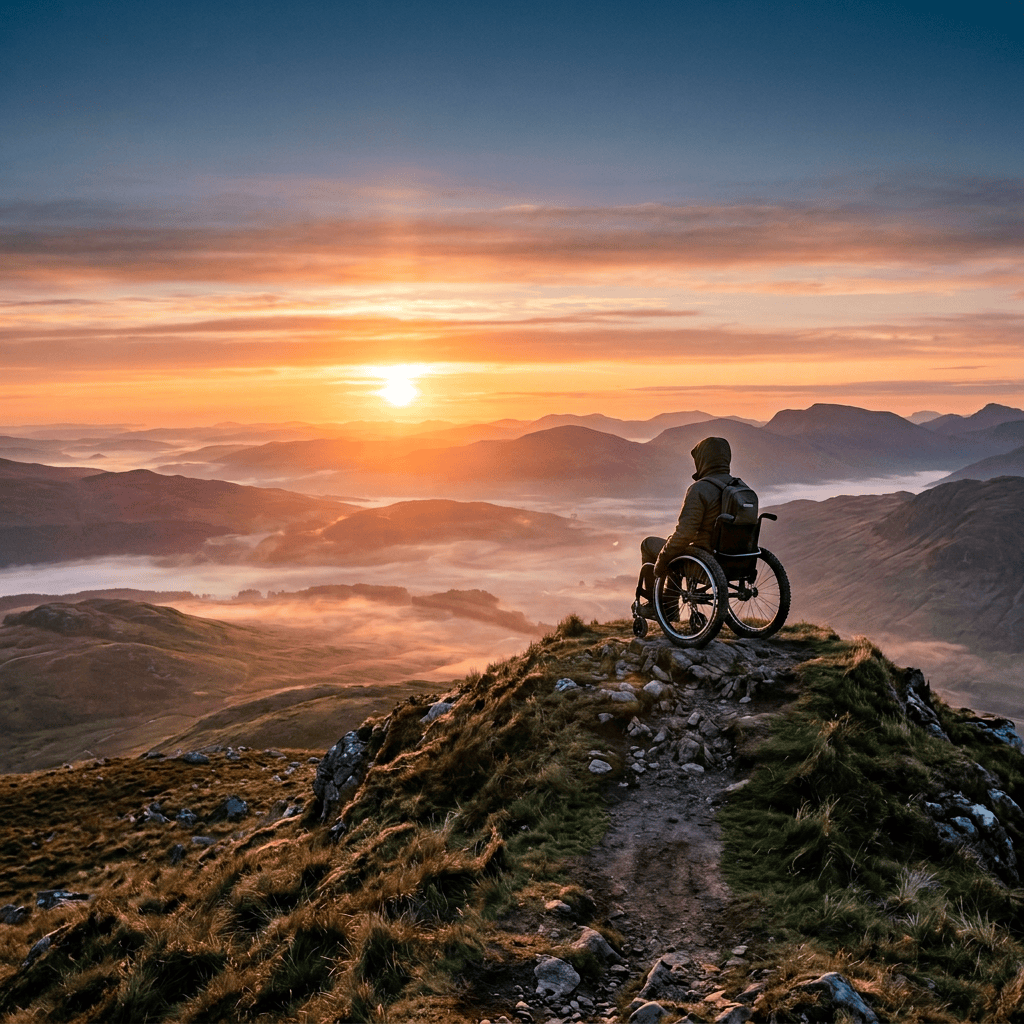
A winding mountain road leads through rugged hills toward a glowing sunset.
Taking charge looks different for everyone: Saying the hard thing in a relationship instead of letting in resentment or starting the project that feels too ambitious is a way of protecting your time and energy instead of giving them away by default.
All in all, it is all about choosing presence over distraction when the people who matter are in the room.
It is not about relentless productivity or grand gestures. It is about authorship. You are the primary writer of the remaining chapters, whether those chapters number in the dozens or the thousands.
When you stop treating death as a distant emergency and start treating life as the urgent project, priorities clarify. Small talk loses its grip. Status games look thinner. The ordinary moments—morning light, a shared meal, focused work—gain prominence because you know they are finite.
This is not morbidity. It is clarity. The people who live most fully are often those who have looked squarely at the end and decided the only sensible response is to inhabit the present with greater honesty and intensity.
Everyone should keep this quote (or at least the mindset) close. When anxiety about the future or regret about the past surfaces, return to the instruction: Worry about your life. Then ask one practical question: What is one concrete action I can take today that belongs fully to me?
Do that action. Repeat.
A cozy stone-walled reading nook glows with candlelight beside an open journal and warm leather chair.
Everybody dies sooner or later. That part is already decided. It is written in our destiny the moment we are born. The part still open is whether, while the days last, you will treat them as someone else’s to manage.
The Netflix series I had mentioned watching was With Love, Meghan—the show about Meghan Markle and her [failed] attempt at creating a new life for her family here—and I cannot stop thinking about it. Not in the way the headlines want me to. Not with the usual swirl of opinions and side-eyes. Just… watching a woman move through her own home with care, intention, and this soft, steady devotion that feels almost radical in how ordinary it is.
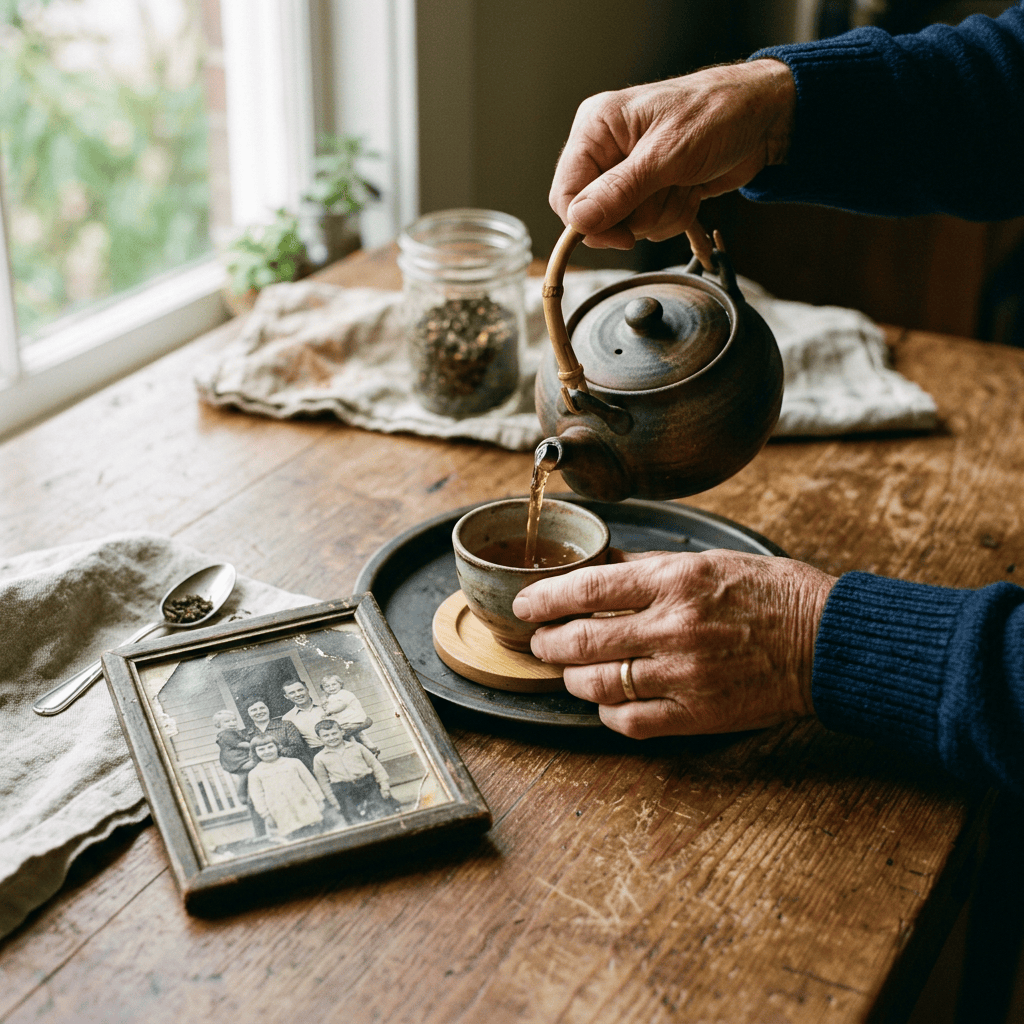
A soothing tea ritual unfolds beside a cherished family photograph on a rustic wooden table.
From the first episode, what struck me hardest was how unapologetically housewifey Meghan is. My boyfriend says that I am similar to her. Someone who wants her man all to herself. So much so that she would take him away from his family. Meghan is not performing domesticity for the camera; she is living inside it. You see her in the kitchen of that Montecito house, sleeves rolled, hands in flour or carefully arranging herbs she grew herself. The way she talks about a simple roasted chicken or a lemon cake is not about showing off some glossy, unattainable lifestyle. It is about the quiet satisfaction of feeding people you love. She lingers over the details—the smell of citrus on her fingers, the way a perfectly set table can make an ordinary afternoon feel like a small celebration. There is something deeply grounding about watching someone treat the everyday acts of homemaking as worthy of attention and joy.
A winding hillside trail leads toward a warmly lit cottage beneath misty mountains at dawn.
That same devotion shows up in how she speaks about her family. The way her voice softens when she mentions “H” (Harry), the little private smiles when she talks about the children, the careful way she protects their privacy while still letting you feel the warmth of their life together. It is not grand declarations. It is smaller, truer things: the ritual of making breakfast, the shared garden, the decision to build a home that feels safe and soft after years of public pressure. You can sense the deliberate choice she has made—to pour herself into creating a peaceful domestic world. In a culture that often treats “housewife” like a diminishing word, Meghan wears it with quiet pride. She makes it look like strength.
And yet so many people still seem determined to misunderstand her. I used to skim the surface-level takes myself—until I actually watched her move through these spaces The criticism often paints her as calculating or performative, but what I saw felt like the oppositeb(and do not tell me that it is all an act— I have seen Suits — she is not that good of an actress!): a woman who has been through intense public scrutiny choosing, again and again, to invest in the private, nurturing parts of life. The gardening, the thoughtful hosting, the careful attention to how a home can hold people. Those are not the actions of someone chasing relevance. They are the actions of someone who has decided that devotion—to partner, to children, to the small rituals that make a house a home—is worth more than the noise outside.
There is a particular tenderness in the way she approaches hospitality on the show. Friends arrive, and you watch her light up at the chance to care for them—pouring drinks, arranging flowers she cut herself, making sure everyone feels seen. It is the classic housewifey impulse, elevated by genuine warmth rather than obligation. And when she talks about wanting to share these simple pleasures, it does not land as branding. It lands as someone who found peace in these acts and wants to offer a little of that peace outward.
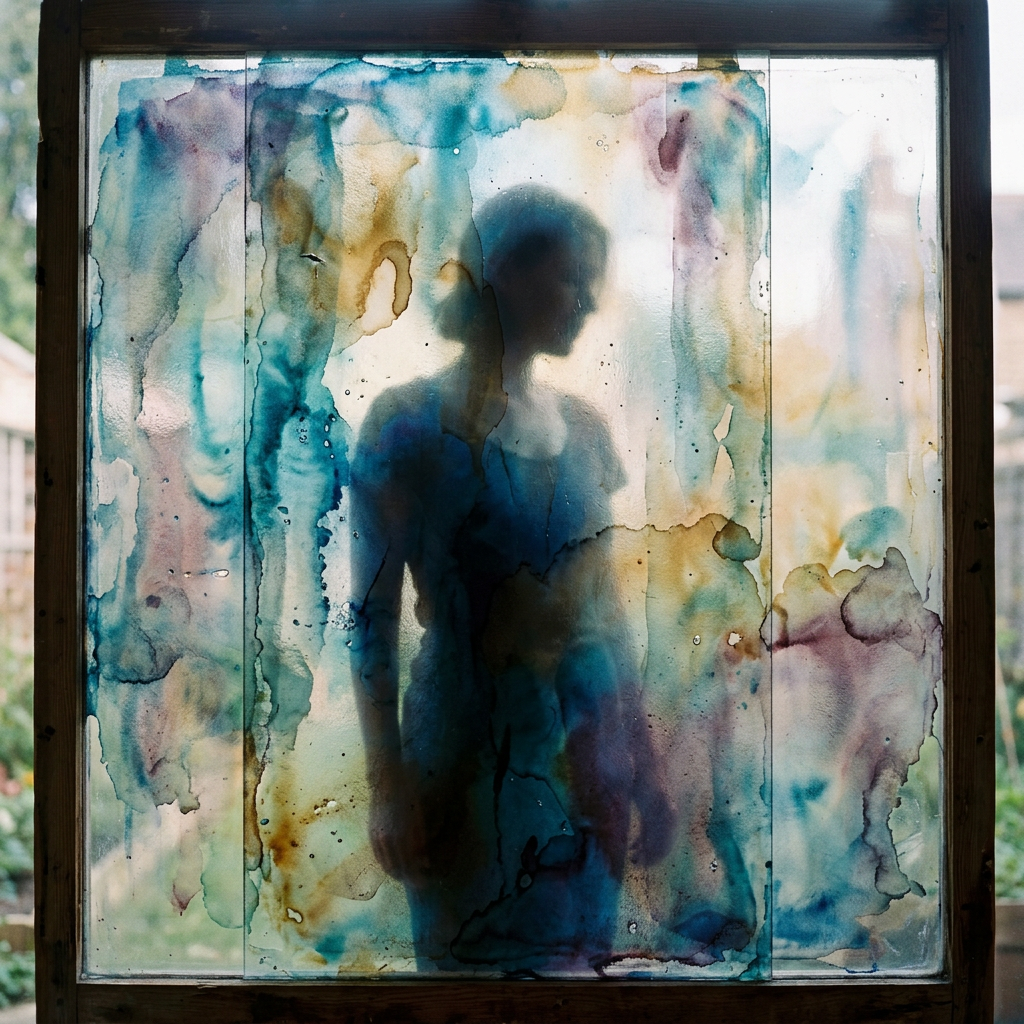
An abstract watercolor panel transforms a window into a translucent, atmospheric artwork.
I keep coming back to how misunderstood that whole picture feels. People reduce her to headlines, to old narratives, to whatever version of her fits the story they already decided on. But With Love, Meghan shows something softer and more consistent: a woman building a life around care. Around cooking for the people she loves. Around making a home that feels like a refuge. Around showing up, day after day, as a devoted partner and mother in the most unglamorous, beautiful ways.
Watching it left me with this unexpected sense of calm. In a world that constantly pushes women to be more—more ambitious in public, more visible, more everything—there is something quietly powerful about choosing to be deeply present in the domestic sphere and finding real fulfillment there. Meghan does not apologize for it. She does not dress it up as something else. She just lives it, camera rolling or not, and that sincerity is what stayed with me long after the episodes ended.
Maybe that is the real gift of the series. Not the recipes or the pretty gifts (though those are lovely), but the reminder that devotion looks different for everyone—and that for some of us, the most meaningful work is the work of making a house feel like home, of pouring love into the people who live there, of treating ordinary days as something worth tending with care. I am glad I watched. I am even more glad I let myself see her without the usual filters. Housewifey. Devoted. And, I truly believe, still so often misunderstood.
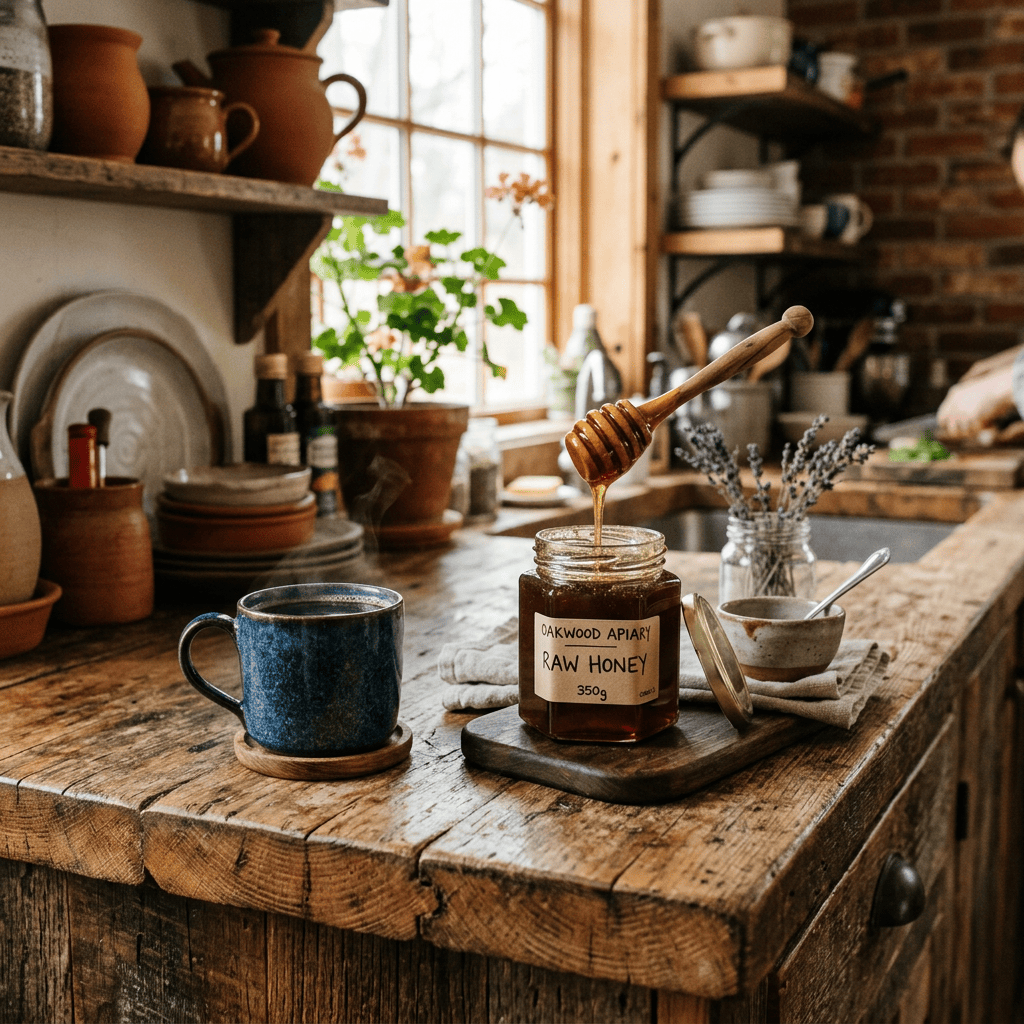
As I lean at the kitchen counter in the darkness of early morning, I whisk my organic oat milk into a frothy cloud, stirring in a splash of pure vanilla extract and a couple generous spoons of golden honey. The spoon circles slowly, the honey ribboning through the milk in slow, viscous swirls before dissolving into sweetness. This simple ritual—an escape from the daily espresso —feels like a quiet conversation with the land itself. And as the steam rises, carrying that warm, floral scent, my mind drifts to the process behind the honey: the patient work of bees, the careful harvest, the jars lined up like liquid sunlight on a pantry shelf.
Starting the Process
We have our own beehives here on the family homestead. They sit at the edge of the orchard, weathered wooden boxes humming with life under the shade of old apple trees. For years they have been part of the landscape, tended by others in the family while I had nothing more than mild curiosity. I never got into it. The suits, the smokers, the delicate balance of not disturbing the colony—it all felt like someone else’s expertise, someone else’s quiet devotion. I was content to simply use what appeared on the table, never pausing long enough to wonder what it might mean to collect it myself.
Lately, though, something has shifted. I have been watching a Netflix series about a woman who has turned her home into a living expression of hospitality and self-reliance. She gathers honey from her own hives, jars it with handwritten labels, and folds it into everything she creates—loaves of warm bread, glazes for roasted fruit, spoonfuls stirred into tea for guests. Watching her move through her days with such grounded intention has stirred something in me. It is not just about the honey; it is about the deeper act of creating a home that produces, that nourishes, that offers something made with one’s own hands.
After stteeping my milk in honey/ vanilla. Add to coffee !
Now I am considering doing the same. Not overnight mastery, of course, but a beginning. Learning the rhythms of the bees that already live here, understanding when the frames are heavy with comb, how to extract without waste, how to strain and jar the golden yield. Imagining shelves in our pantry lined with our own honey—some kept pure, some infused with lavender from the garden or a touch of cinnamon. Picturing myself baking with it: honey-sweetened muffins for weekend breakfasts, sticky glazes on roasted vegetables, or simple spoonfuls drizzled over yogurt.
There is a quiet pull toward it now—the idea of closing that small gap between the land and the table, of participating more fully in what already surrounds us. The bees have been waiting at the edge of the orchard all this time. Maybe this is the season I finally walk out to meet them.
Waking up from a vivid dream and actually remembering it is one of the purest, most underrated signs that your brain has not completely surrendered to the modern meat grinder.
Most people stagger out of bed like lobotomized cattle, eyes glassy, muttering “I never dream” while they reach for the phone that spent the night irradiating their skull. That is peak “normal.” But this not healthy. It is your nervous system waving a little white flag. When you open your eyes and the dream is still clinging to you—colors too sharp, emotions too raw, plot so absurd it makes waking life look like a corporate PowerPoint—you should take a second to feel smug about it. Your mind is still alive in there.
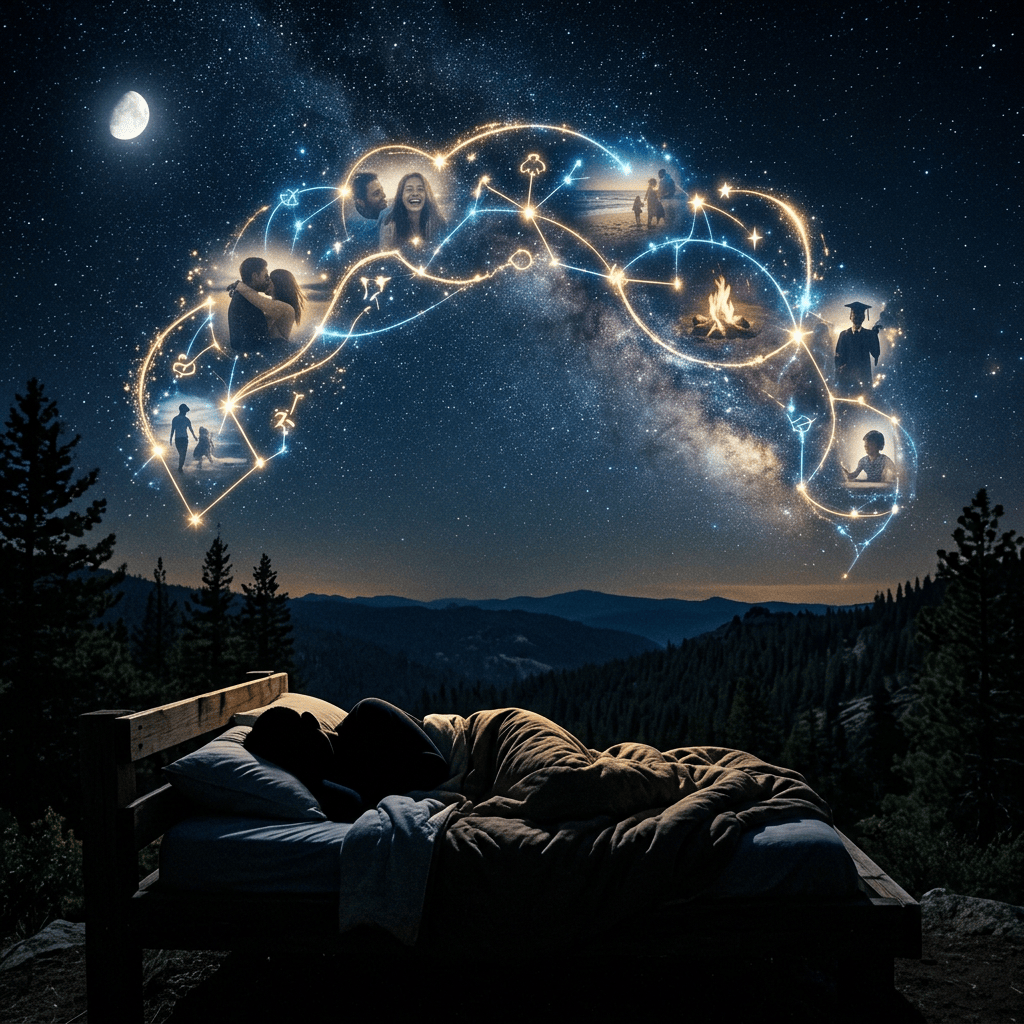
A couple sleeps beneath a star-filled sky as glowing connections evoke shared memories and dreams.
Dreams are the brain’s nightly audit. While the rest of the world is scrolling, numbing, medicating, and microdosing their way into emotional flatness, a vivid, sticky dream means the machinery is still running hot. REM sleep is doing its job. Memory consolidation is happening. Emotional processing is not completely bottled up behind a wall of SSRIs, blue light, and existential exhaustion. You are not just surviving the night; you are metabolizing the day like a functional animal instead of a medicated office drone.
The people who claim they “don’tdream” are usually lying to themselves or so sleep-deprived and chemically smoothed that their brains have stopped bothering to stage the nightly theater. Chronic stress, alcohol, weed every night, melatonin abuse, glowing rectangles until 2 a.m.—all of it blunts the signal. You wake up empty. No residual weirdness. No half-remembered chase sequences or conversations with dead relatives or the inexplicable feeling that you just lived an entire second life in six hours. That is not enlightenment. That is neurological quiet quitting.
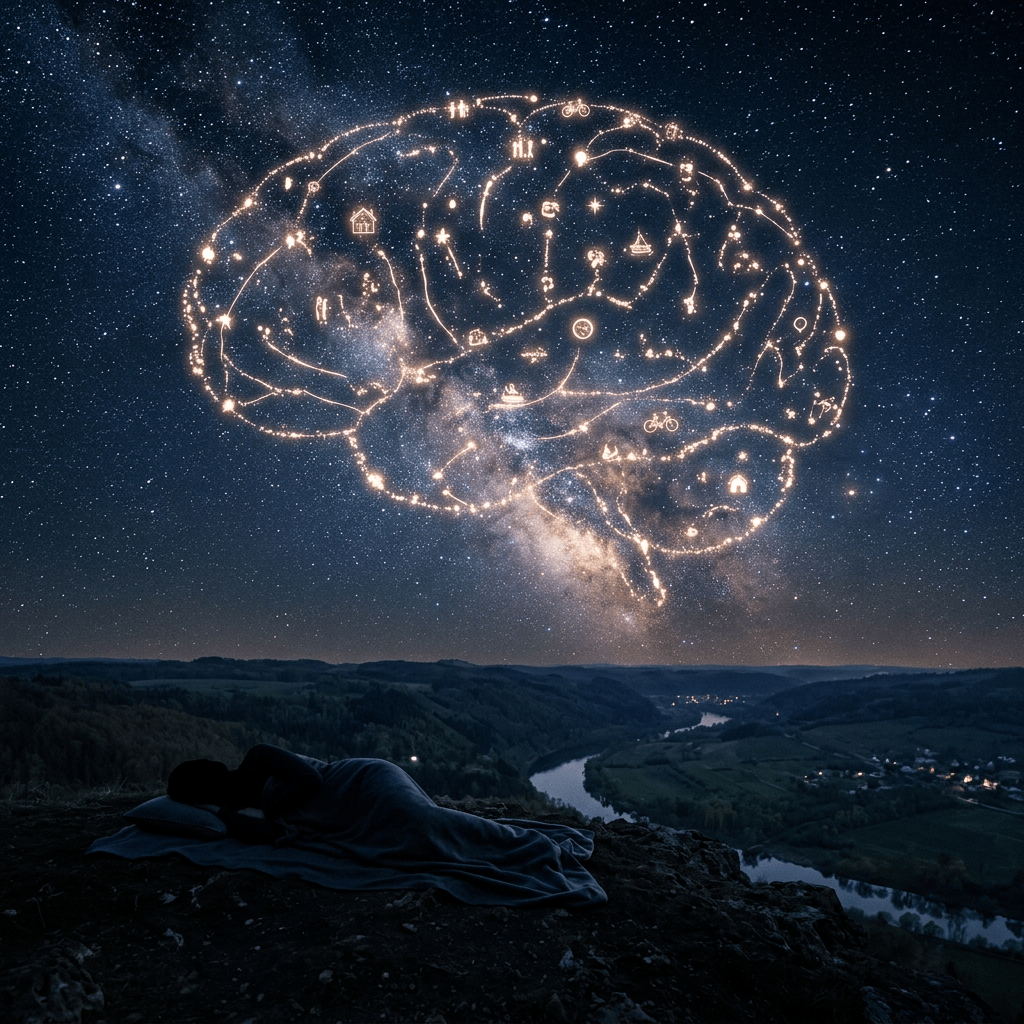
A sleeping figure rests beneath a glowing constellation shaped like a connected world of ideas.
A remembered dream is evidence that the boundary between conscious and unconscious is still permeable. The subconscious is still allowed to throw its chaotic, unfiltered show and some of it lasts long enough for you to notice. That is healthy. That is human. In a culture that treats any unscripted internal experience as something to be pathologized or optimized away, remembering a vivid dream is almost subversive. You are not fully domesticated yet.
There is a reason ancient cultures treated dreams like messages, omens, or diagnostics. They were not just wrong. A mind that can produce and retain rich nocturnal narratives is a mind that still has bandwidth, plasticity, and a functioning emotional thermostat. The opposite—waking up blank, night after night—is often the first quiet symptom that something deeper is offline. Sleep architecture is crumbling. Anxiety is winning. The prefrontal cortex is too fried to even stage a proper nightmare.
So the next time you bolt upright at 3:47 a.m. with the full cinematic replay still burning behind your eyes, do not roll over and immediately open Instagram to forget it. Sit with the weirdness. Write it down if you are into that. Feel the residual charge. That jolt of aliveness is proof that the lights are still on upstairs. In an age where most people’s internal worlds have been reduced to algorithmic sludge and prescription fog, a vivid, remembered dream is a small, private rebellion.
Your brain just threw a wild, unfiltered party while the rest of the house was asleep. And you got the invite. That is not trivial. That is health.
I know some of my health beliefs sound unhinged to people raised on the standard public-health script. I am fine with that. I sincerely believe the mind and mindset are primary drivers—capable of causing, amplifying, or resolving far more of what ails us than most mainstream advice admits. Chronic stress, unresolved emotional patterns, expectation, and the stories we tell ourselves about our bodies shape immune function, inflammation, hormone balance, pain perception, and recovery far more powerfully than the average wellness checklist acknowledges. Placebo and nocebo effects are no-nonsense; they are measurable physiology. When someone is convinced they are broken, poisoned, or doomed, the body often cooperates. When someone refuses that story and orients toward agency and resilience, outcomes frequently improve—even in the face of imperfect “lifestyle hygiene.” This is not magical thinking. It is an insistence that the organism is not a passive machine waiting for external inputs to dictate its fate.
That same skepticism extends to several specific claims that get treated as gospel.
Cancer is largely a product of the modern chemical environment, not the sun.
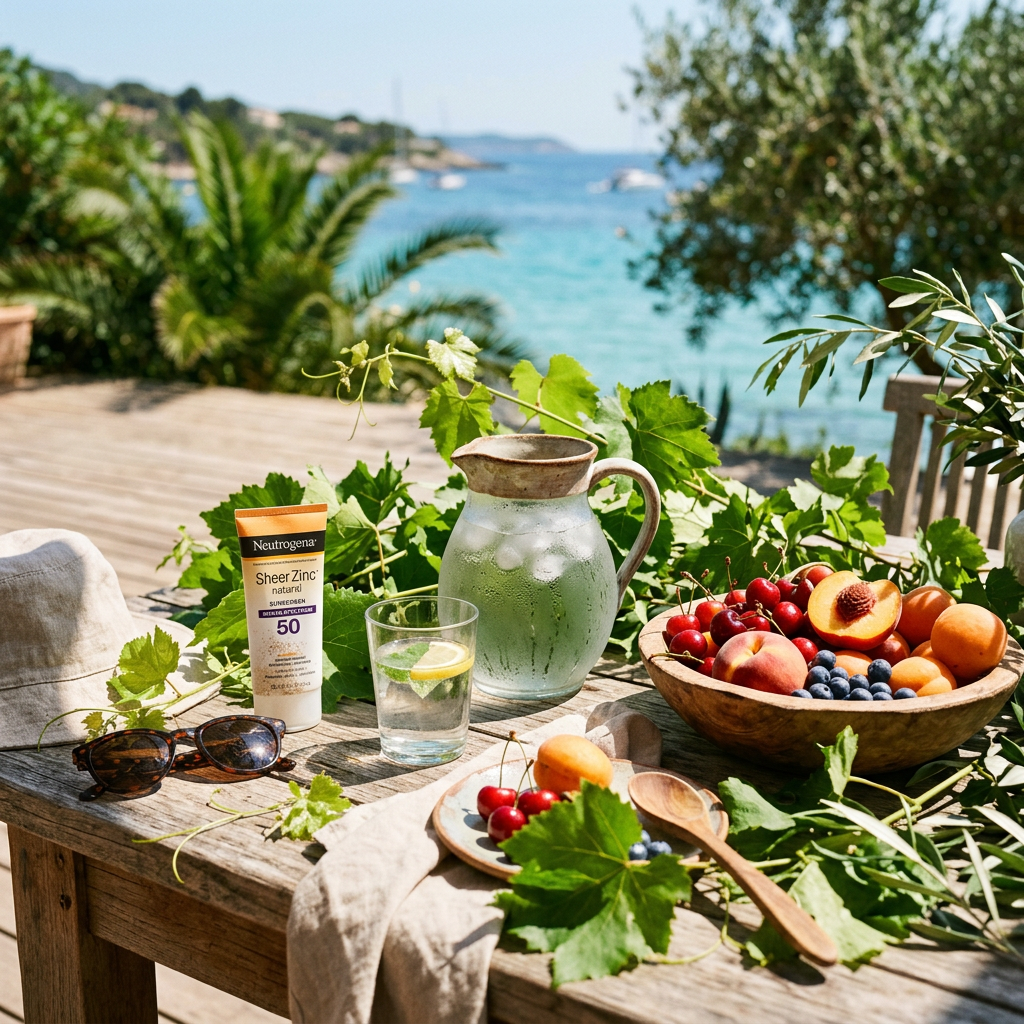
A sunlit seaside table pairs sunscreen with fresh fruit, chilled water, and summer accessories.
I do not accept that the sun—the same source of vitamin D, circadian signaling, and the light that has bathed life for billions of years—is the primary villain behind skin cancer. Melanoma and other skin cancers existed long before industrial chemistry, but the sharp rise in diagnoses tracks far more closely with the explosion of synthetic compounds, persistent organic pollutants, endocrine disruptors, processed foods, and novel exposures than with people suddenly spending more time outdoors. The idea that a “beautiful ball of fire in the sky” was waiting all this time to randomly attack us while we invent new solvents, plastics, and preservatives every decades seems suspicious.
Sunscreen deserves particular scrutiny. The dramatic increase in reported skin-cancer rates after the widespread adoption of chemical sunscreens is not a coincidence I am willing to ignore. Many conventional formulas rely on ingredients that themselves raise questions about systemic absorption, hormonal interference, and oxidative stress under UV exposure. Mineral-based options (non-nano zinc oxide and titanium dioxide without the aluminum or chemical filters) are a far less concerning compromise when protection is genuinely needed. The larger point remains: treating the sun as the enemy while treating the chemical soup of modern life as background noise is a category error. Focus onreducing the big toxins first.
The “eight glasses of water a day” rule is arbitrary dogma
Hydration matters. Obsessive water-chugging does not. The body is not a simple tank that requires a fixed volume of plain water regardless of climate, activity, diet, or individual physiology. Electrolyte balance—sodium, potassium, magnesium, and the rest—determines whether fluid actually stays where it is useful. People eating real food, salting to taste, and paying attention to thirst and urine color generally do better than those forcing down liters of plain water out of fear of “dehydration.” Overhydration is real; electrolyte dilution is real. The eight-glass mantra is a marketing-friendly oversimplification that ignores context.
Eight hours of sleep every night is not a universal law
Sleep is essential. The idea that every adult must hit exactly eight hours or face inevitable decline is not. Could I even sleep eight straight hours? Individual variation is large. Some people function optimally on less, others need more, and quality (continuity, depth, alignment with natural light cycles) often matters more than the raw number. Rigid enforcement of an eight-hour quota can itself become a source of anxiety that undermines the very rest it claims to protect. Track how you actually feel and perform rather than worshiping a round number. Or purchasing a tacky tracking device.
Wrinkles are not a disease
The cultural war on wrinkles treats a normal consequence of decades of facial expression, sun exposure, and collagen changes as a medical emergency requiring endless products, procedures, and self-surveillance. Aging skin is not a failure of willpower or product compliance. Accepting that some lines are inevitable—and that they often signal a life lived—is more coherent than the anti-aging industry’s promise of perpetual smoothness.
Sugar does not uniquely “feed” tumors in the way the slogan implies
Cancer cells are metabolically greedy and often rely heavily on glucose. That observation has been stretched into the claim that dietary sugar is the direct fuel that keeps tumors growing, so cutting sugar starves them. The reality is more complicated. The body tightly regulates blood glucose; restricting dietary sugar does not selectively deprive malignant cells while leaving healthy tissue untouched. Tumors can use other substrates, and the metabolic flexibility of both cancer and host is not reducible to “sugar feeds cancer.” Obsessing over every gram of carbohydrate while ignoring overall metabolic health, inflammation, and the rest of the diet is another example of a partial truth turned into a rigid rule.
Eat what makes you feel good—happiness is not optional
The final point is the practical corollary of the first. Chronic stress from rigid dietary rules, moralizing food choices, and constant self-monitoring is itself a health risk. People who eat in a way that supports stable energy, digestion, and genuine enjoyment—without the background noise of guilt or fear—tend to do better long-term than those locked in perpetual restriction or purity contests. This is not a license for chaos. It is a recognition that psychological well-being and physiological well-being are not separate ledgers. When the rules become the stressor, the rules have failed.
None of this requires rejecting every useful medical intervention or every piece of evidence-based guidance. It does require refusing to treat every official recommendation as sacred, every correlation as causation, and every commercial product as the solution to a problem the product may have helped create. The mind is not a side character in health. The modern chemical environment is not neutral. And many of the tidy rules we are handed—water quotas, sleep quotas, sunscreen as non-negotiable shield, sugar as tumor fertilizer—are simpler and less accurate than the marketing suggests.
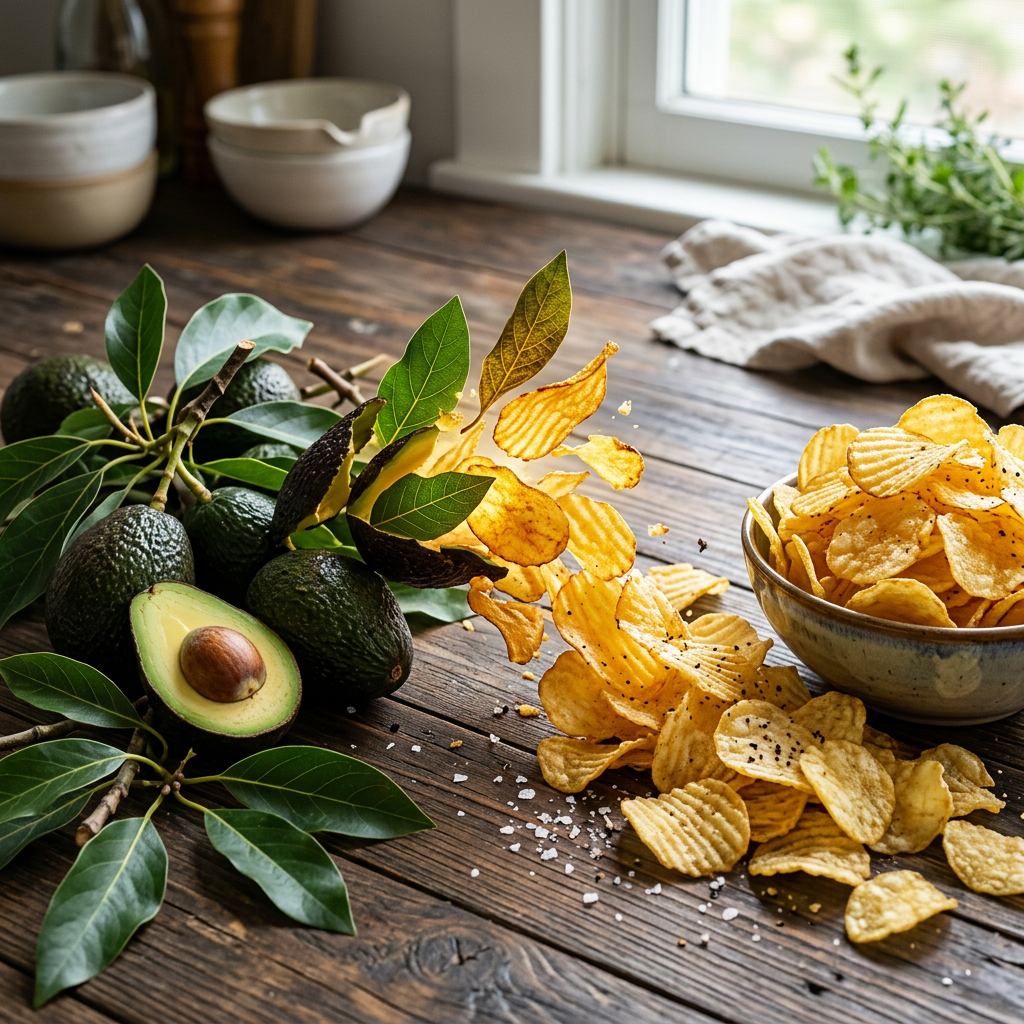
I love me some avocado! So obviously I was ecstatic when foods were created using avocado oil instead of the disgusting seed oils (read more about my position on seed oils here!).
Potato chips suck up oil like a sponge. The final product is usually 30–40% fat by weight. That means 8–11 grams of pure frying fat per one-ounce serving, whether the bag screams “avocado oil” or just “vegetable oil (and/or whatever is cheapest this week).”
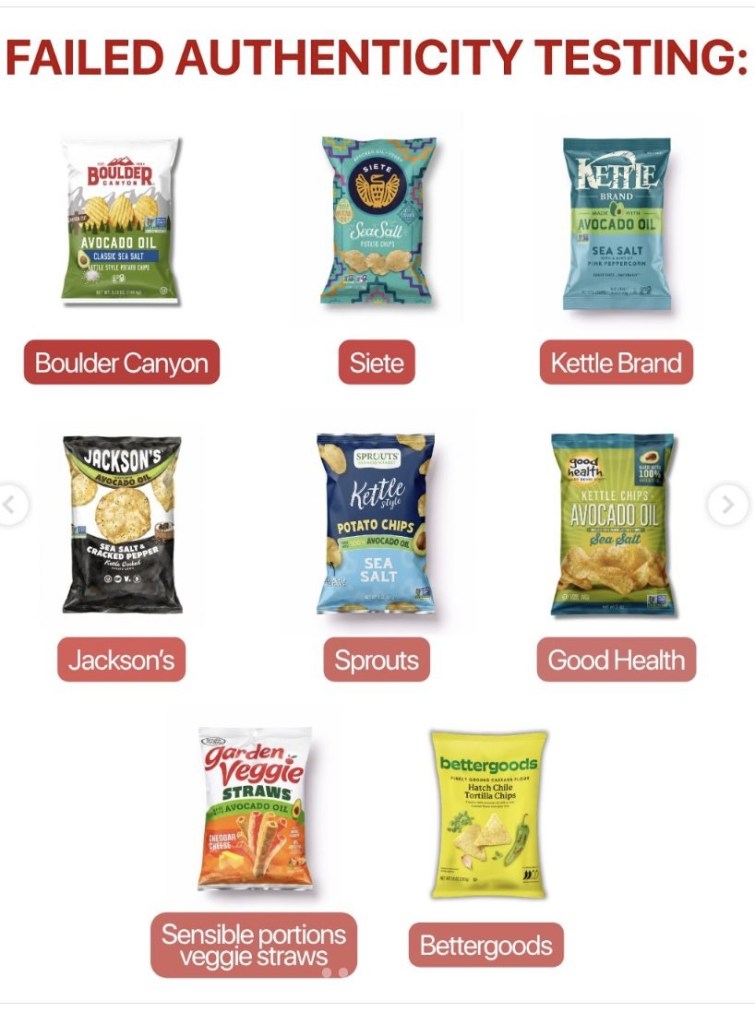
Boulder Canyon’s classic sea salt version clocks in at 9g fat (mostly monounsaturated on the label). Jackson’s, Kettle Brand avocado lines, the works—same ballpark. The number is not magic. It is just how much oil the potato decided to keep after the fryer.
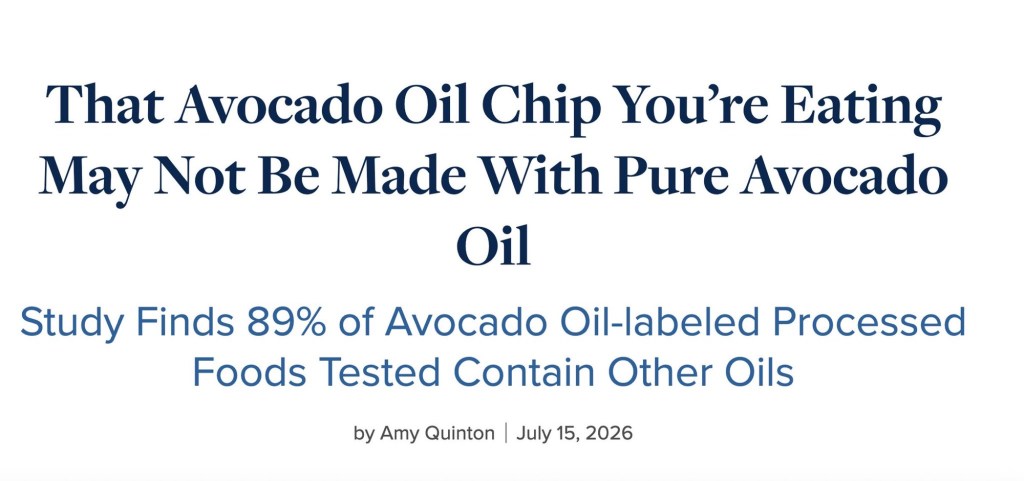
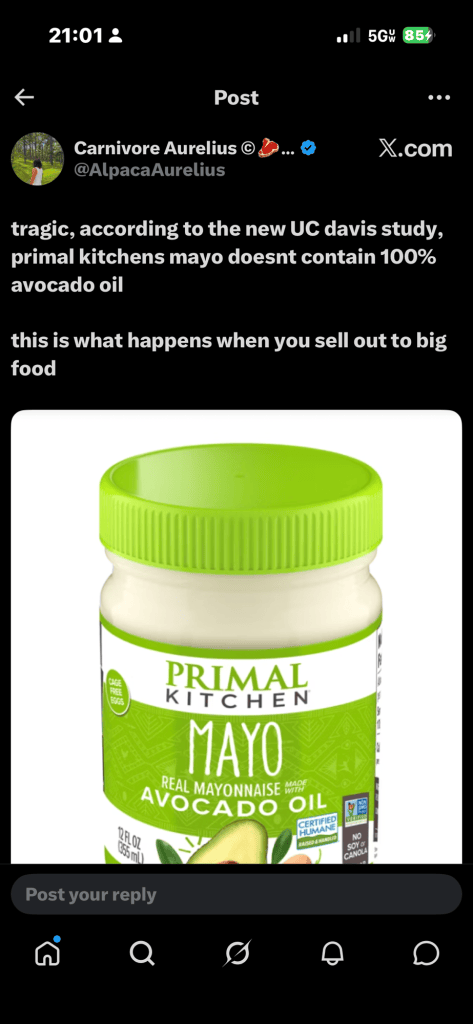
Avocado oil should be the upgrade: high smoke point, heavy on oleic acid, less of the inflammatory omega-6 circus that seed oils bring to the party. On paper it looks cleaner. In practice a July 2026 UC Davis study checked 54 products that listed avocado oil as the only oil. 89% were adulterated. Chips specifically 93% failed the chemical fingerprint test. Fatty acids and sterols did not match real avocado oil. Cheaper oils (soybean, canola, the usual suspects) were riding shotgun or driving the whole thing.
Boulder Canyon, Jackson’s, Siete, Kettle Brand avocado versions, Good Health, Sprouts—multiple brands flunked. A couple of samples from Lesser Evil and Simply Tostitos scraped by on one lot and failed the next. Nobody’s chip brand went two-for-two clean. Meanwhile, olive oil products mostly passed the same tests. Avocado oil is expensive. The incentive to dilute it is obvious. The supply chain apparently has no accountability.
So when the bag says “made with avocado oil” or “100% avocado oil,” treat it like a dating-app bio: optimistic at best, full of it at worst. You are still eating a calorie bomb of fried starch. The fat profile might be better if the oil is real. Most of the time it is not. You are paying the premium for the green-washed label while the actual oil composition is closer to the cheap stuff you were trying to avoid.
Want actual control? Make your own with a bottle of avocado oil that does not come from a random bulk supplier, or switch to brands frying in tallow, coconut, or verified olive oil. Or just accept that chips are a vice and stop pretending the oil type turns them into a wellness product. The study did not invent the problem—it just held up the receipt.
Even one of my favorite condiment brands has sold out to Big Food and found fraudulent
I have never accepted the common claim that wrinkles are simply the unavoidable result of the natural aging process. That explanation has always felt incomplete, almost lazy, as if the body is programmed to crease and collapse on a fixed timetable no matter how we live. What I see instead is a far more personal and revealing process: the gradual recording of a life lived fully, of emotions felt deeply, and of the daily choices that either nourish or deplete the body.
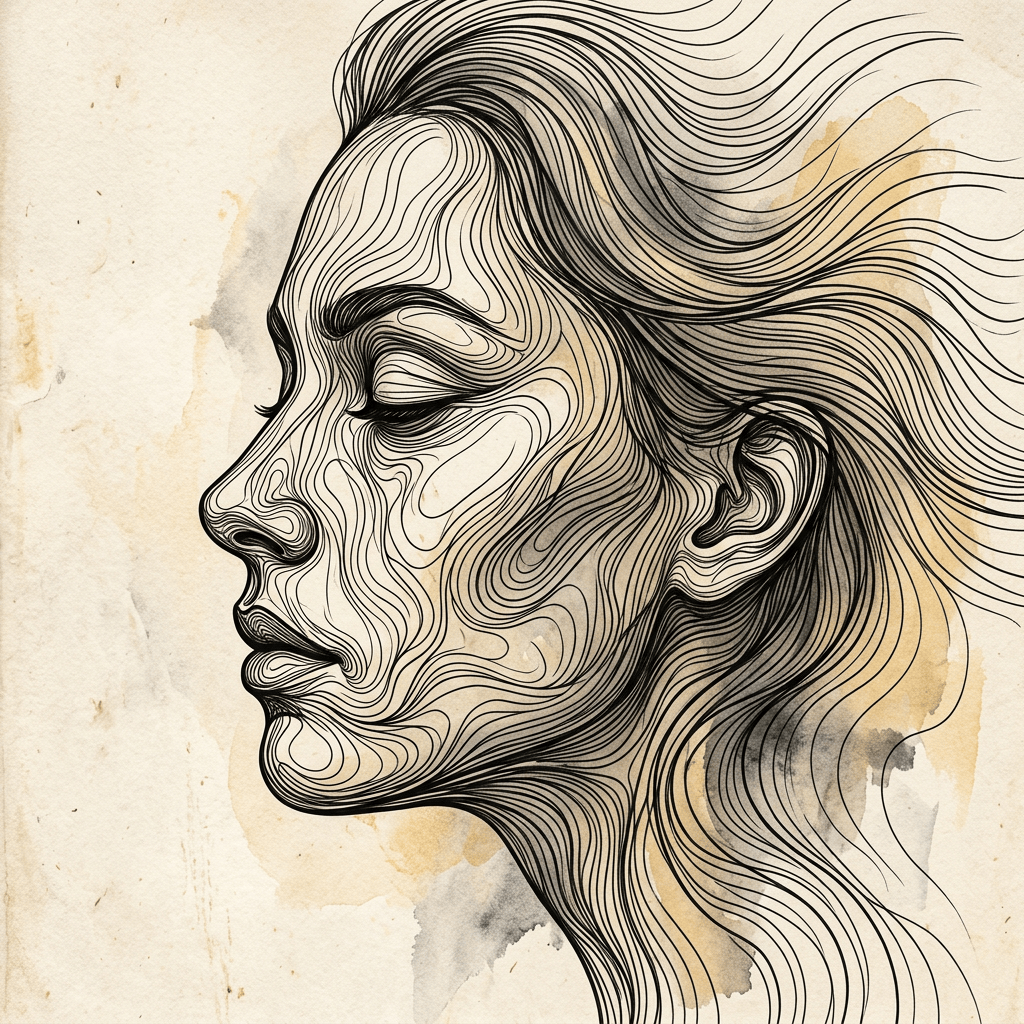
A serene female profile illustrated with flowing contour lines
There is something profoundly beautiful about a face that shows its history. Smile lines that fan out from the corners of the mouth, the soft crinkles that gather around the eyes when someone laughs—these are not flaws to be erased. They are evidence of joy. They mean a person has smiled often enough, laughed hard enough, and connected with others deeply enough for those expressions to leave a gentle, permanent imprint. A face without any such marks can sometimes look strangely blank, as if the emotions never quite landed. I prefer the lived-in face. It carries warmth and authenticity that no perfectly smooth surface can match.
Of course, the canvas itself matters. What we put into our bodies shapes how that emotional history is recorded. Eating real food—fruits, vegetables, whole foods rich in water and nutrients—supports the skin’s ability to stay plump and resilient. When the diet is dominated by processed foods, endless cups of coffee, and regular alcohol, the body is steadily dried out from the inside. Hydration is not just about drinking [sparkling] water; it is about whether the cells themselves are receiving the fluids and minerals they need to remain supple.
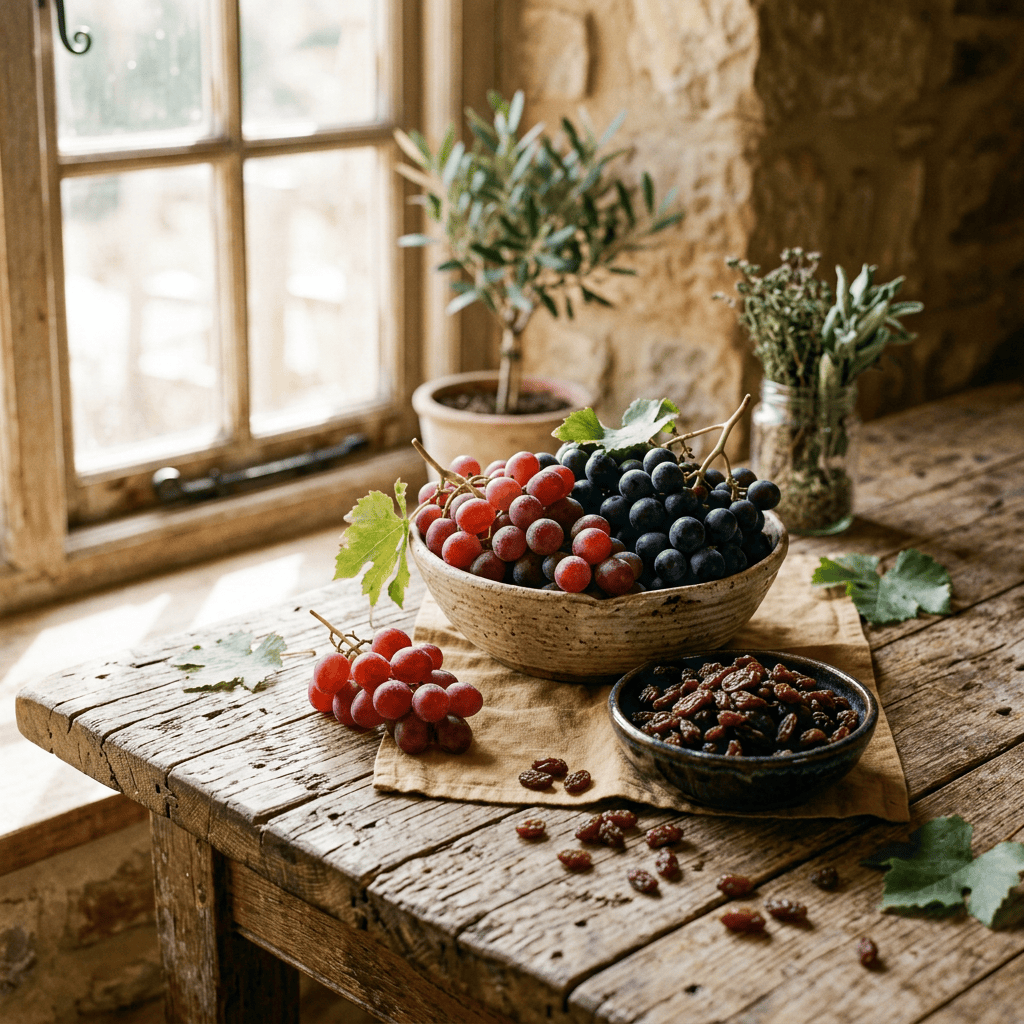
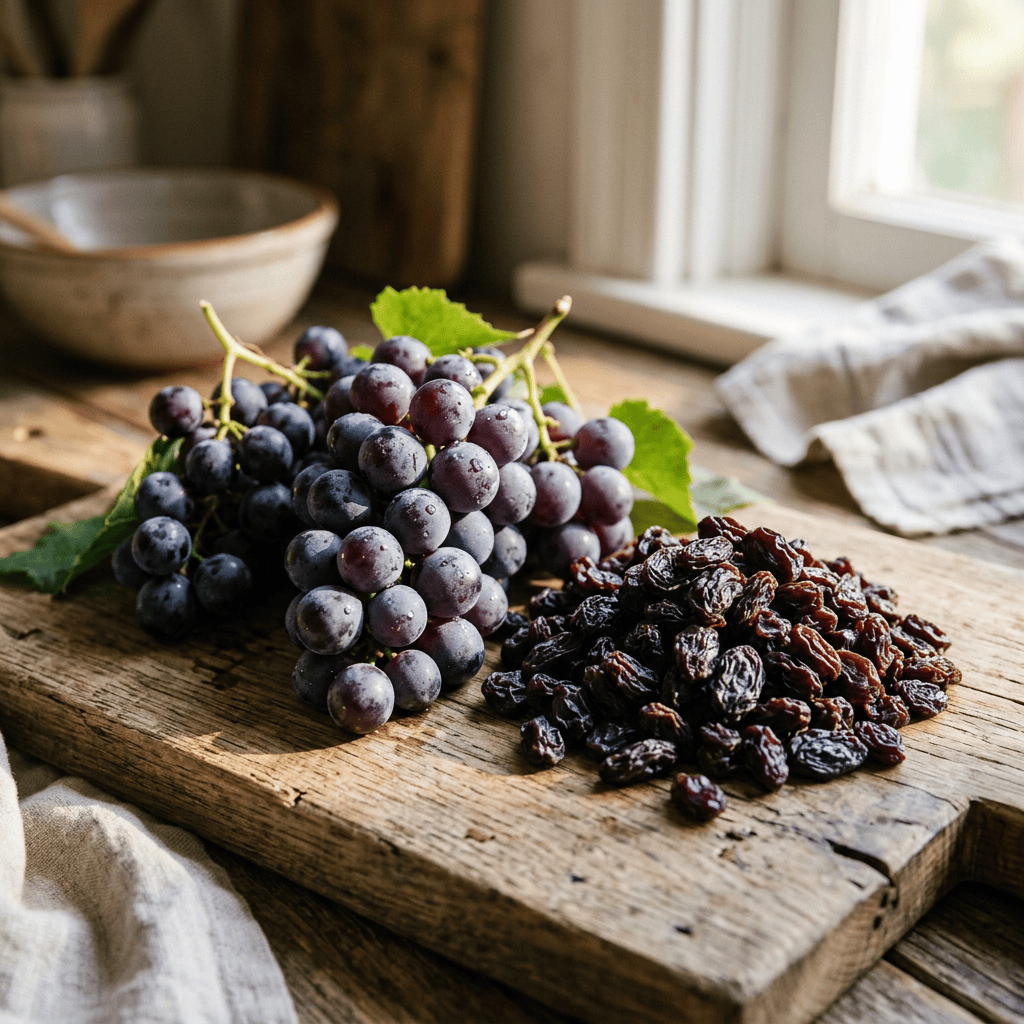
Think about how we make raisins and other dried fruit. Fresh grapes are full of juice, plump and smooth. Place them in the sun or on a drying rack long enough, and the water is drawn out. What remains is wrinkled, concentrated, and smaller. The process is simple and visible. The same principle applies to human skin. When we chronically dehydrate ourselves through poor food choices and dehydrating habits, the skin loses its internal moisture reserves. Over years, that loss becomes visible as fine lines and deeper creases. It is not mysterious aging at work so much as the cumulative effect of drying out the very tissue that once held water so effortlessly.
A bunch of fresh grapes next to a pile of raisins on a rustic wooden board
A baby’s face stays smooth for a reason that goes beyond mere youth. A baby has not yet accumulated all of the emotions, the repeated facial movements of a lifetime, or the gradual consequences of how the organs and systems have been treated. There has been no decades-long record of smiles, worries, laughter, or stress etched into the skin. There has also been no extended period of internal dehydration or nutritional neglect. The face remains an unmarked page because the story has only just begun.
None of this is meant as a rigid set of rules or a promise that perfect habits will freeze time. It is simply an invitation to look at wrinkles differently. They are not a failure of biology or a sentence handed down by the calendar. They are the visible result of a life that has been felt and a body that has been either tended or neglected. When the lines appear from genuine happiness, they can be worn with quiet pride. And when we choose to feed and hydrate ourselves with care, we give the skin a better chance to hold its softness longer, so that the story it tells remains one of vitality rather than depletion.
In the end, the face that interests me most is the one that has lived—creased by laughter, softened by time, and still capable of lighting up with the next smile. That is not aging. That is evidence of a human being who has been fully present.
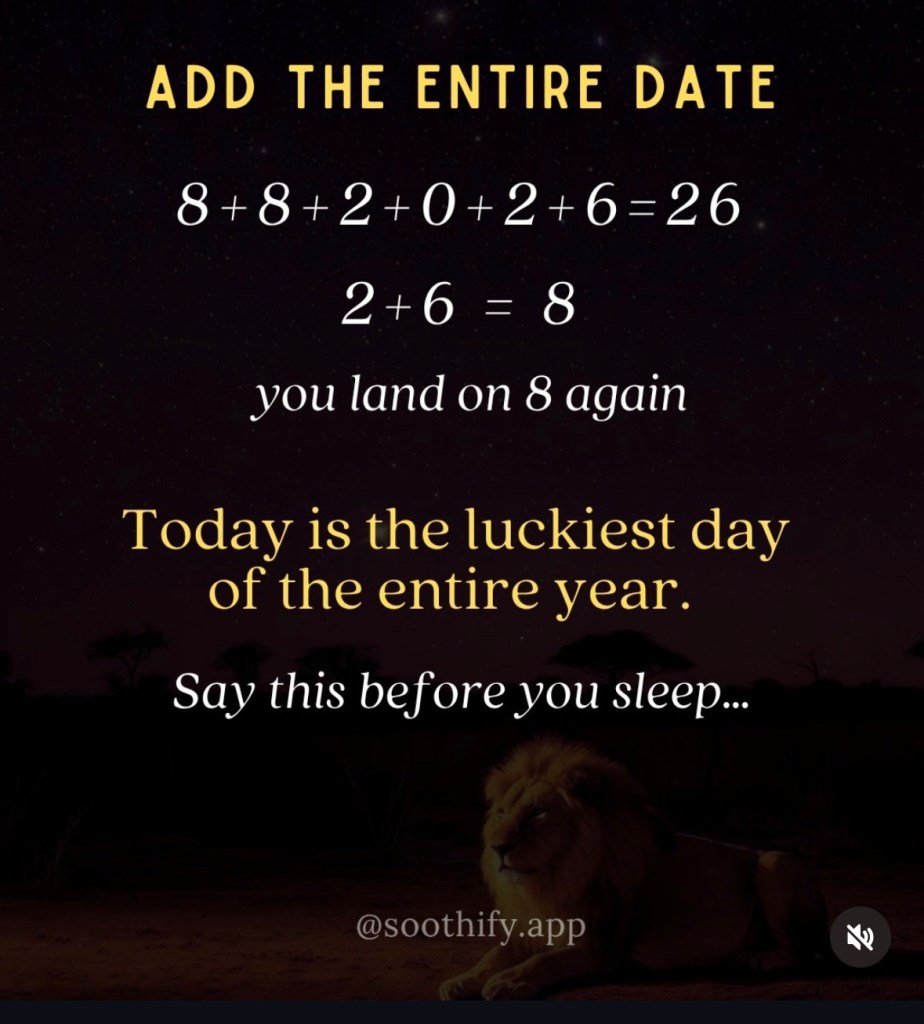
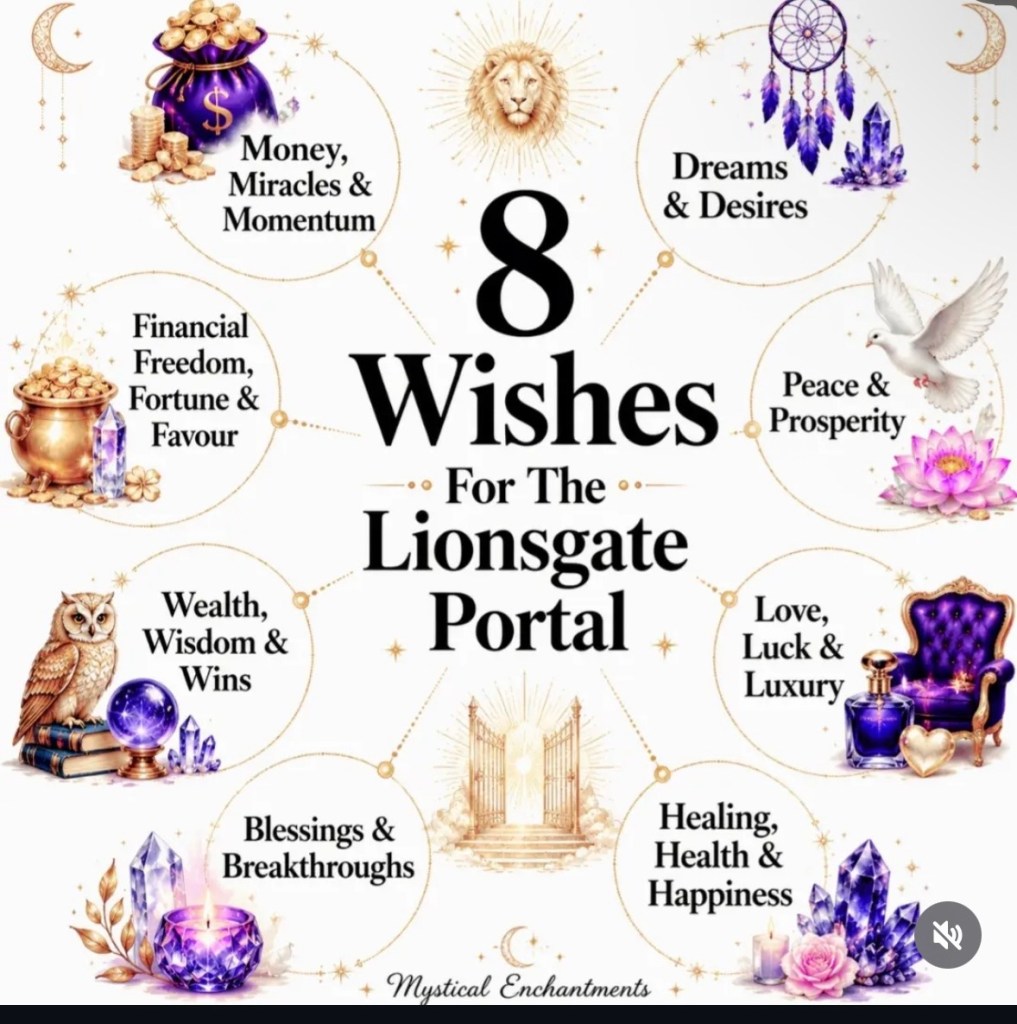
Today—Saturday, August 8, 2026—marks the peak of one of the most talked-about energetic windows of the year: the Lion’s Gate Portal, also known simply as the 8/8 portal. Whether you approach it as astrology, numerology, ancient star lore, or pure modern spirituality, this date carries a collective invitation to step into greater power, clarity, and manifestation.
Every year during Leo season (roughly July 23–August 22), the Sun moves through the sign of the Lion. Around this time, the bright star Sirius—the brightest in our night sky and often called the “spiritual sun”—makes its heliacal rising, becoming visible again just before dawn after a period of being hidden by the Sun’s glare.
Spiritual traditions describe this as an alignment of Earth, the Sun in Leo, Sirius, and sometimes Orion’s Belt, creating what many call a cosmic “portal” or gateway of heightened energy. The window typically stretches from about July 28 to August 12, with the strongest focus on August 8 (8/8).
The name “Lion’s Gate” comes from Leo’s symbolism—courage, heart-centered leadership, authenticity, and radiant self-expression. Ancient Egyptians watched Sirius closely because its rising coincided with the annual flooding of the Nile, a time of renewal, abundance, and new beginnings. While the specific term “Lion’s Gate Portal” is a modern spiritual concept rather than an ancient ritual, the star’s historical importance is real.
The Power of the Number 8
Why August 8 specifically? Numerology plays a starring role. The number 8 is associated with infinity (turn it on its side and you see the ∞ symbol), abundance, material achievement, personal power, discipline, and the bridge between the spiritual and physical worlds.
On 8/8 the energy doubles. In 2026 it triples: add the digits of 8 + 8 + 2 + 0 + 2 + 6 = 26, then 2 + 6 = 8. Many are calling this a powerful 8/8/8 manifestation day.
This year’s portal arrives with extra cosmic support. Jupiter, the planet of expansion, luck, and abundance, is currently in Leo—amplifying the bold, creative, heart-led energy of the season. The portal also sits just before a total solar eclipse in Leo on August 12, adding a layer of transformation and fresh starts.
Many spiritual practitioners describe the Lion’s Gate as a time when the veil between the physical and higher realms feels thinner, intuition sharpens, and intentions set with clear focus can gain extra momentum.
You do not need elaborate rituals to engage with this portal. The most effective practices are simple, intentional, and heartfelt
Some people incorporate crystals (citrine, sunstone, or clear quartz), light a candle, or simply sit under the open sky and connect with Sirius if visible. The key is sincerity over complexity.6
It is worth noting that mainstream science does not recognize a literal energetic “portal.” So obviously I am all for it. The astronomy of Sirius’s heliacal rising is real and has been observed for millennia; the amplified spiritual significance is a matter of belief, symbolism, and personal experience.
Many find value in the portal simply as a cultural and seasonal reminder: a built-in annual checkpoint to pause, realign with what matters, and deliberately create rather than drift.
Whether you fully embrace the mysticism or simply appreciate the poetic timing of midsommer Leo energy meeting the brightest star, August 8 offers a potent symbolic moment. The Lion’s Gate invites you to roar a little louder, dream a little bigger, and trust the infinite loop of giving to the Universe and receiving what the number 8 represents.
Stepping is key here
The portal is open. What will you walk through it toward?
May your intentions be clear, your heart open, and your path illuminated. Happy 8/8.
I have always been a bit stubborn when it comes to my convictions. Not the everyday kind of stubbornness that digs in over which restaurant to choose or which route to take home. Mine runs deeper. It is the kind that settles into the bones, that refuses negotiation even when the cost is high, even when the path leads straight into an operating room. Convictions, for me, are not opinions to be updated with new data or softened by social pressure. They are lines drawn in permanent ink. Cross them, and something essential in me fractures.
That stubbornness once led me to talk a doctor into performing brain surgery. Not for a tumor. Not for trauma. For removal. Years earlier, a shunt had been placed in my head to drain excess fluid—standard medical intervention for a condition that, left unchecked, can press against the brain and threaten life itself. The device did its job. It kept the pressure down. It kept me functional. And yet, every day I lived with the knowledge that something foreign—metal, plastic, tubing that did not belong to the original design of a human body—was sitting inside my skull.
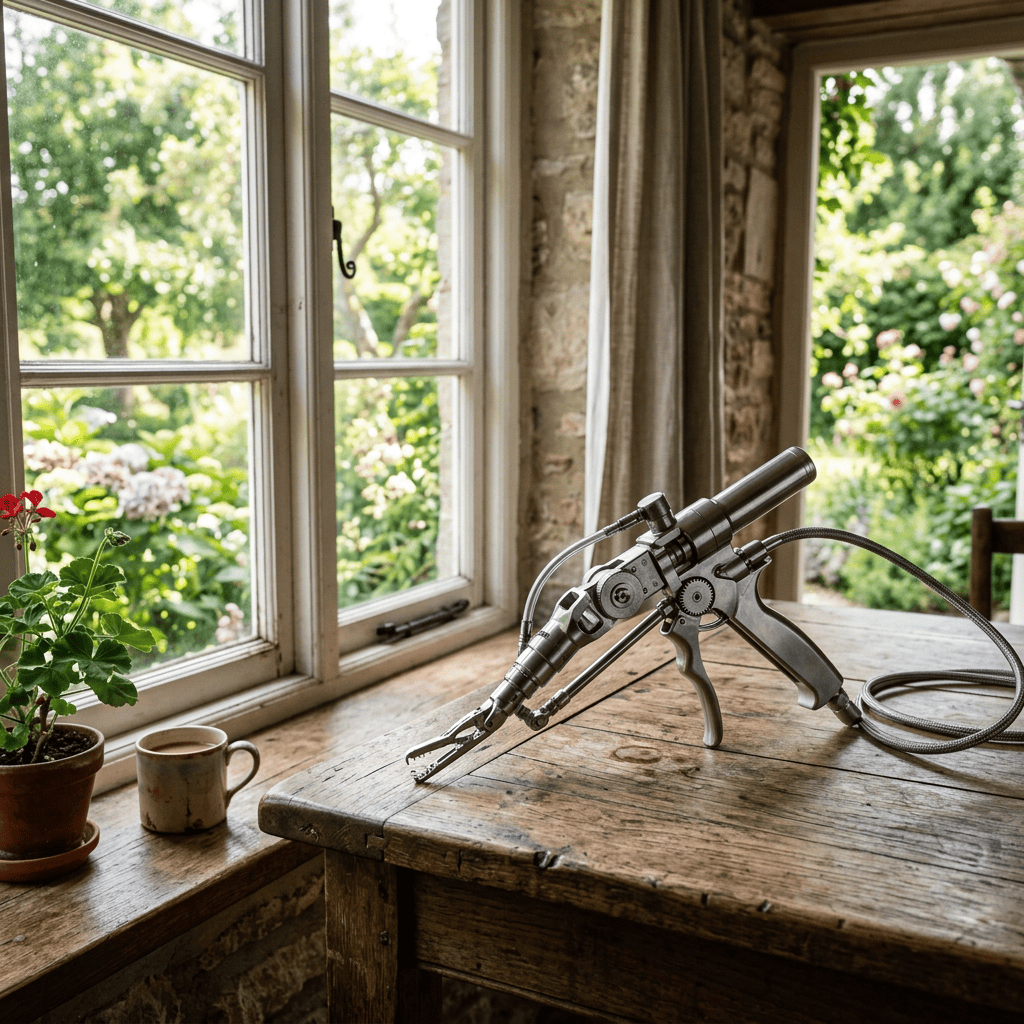
An antique surgical tool is displayed on a rustic wooden table near a bright window.
I do not believe in having anything in my body that is not naturally supposed to be there. Metals. Plastics. Synthetic valves. Permanent implants. To me they represent a quiet violation. The body is not a machine to be endlessly upgraded or patched with industrial materials. It is a living system shaped by forces far older and more intricate than any operating theater. If that system cannot fight off whatever illness or imbalance is ailing it, perhaps it is not meant to. Perhaps the struggle itself is part of a larger design. Maybe this is God’s plan.
I know how that sounds. In an age that treats every physical limitation as a technical problem awaiting a better device, the idea that some conditions might simply be allowed to run their course feels almost heretical. Modern medicine has achieved miracles—lives extended, suffering reduced, functions restored that once would have ended in early graves. I do not deny the skill of the surgeons or the ingenuity of the engineers who design these interventions. What I reject is the assumption that every intervention is automatically an improvement, or that the body is incomplete without the latest hardware.
The decision to remove the shunt was not impulsive. It grew from years of living with the quiet presence of something that felt alien. I researched. I prayed. I examined the risks with the same intensity most people reserve for deciding whether to undergo the implant in the first place. The fluid imbalance that once required the device could return. Pressure could rebuild. But what I cared most about was that I had just started losing weight and I could start to feel the tube that dangled down the side of my throat (from my brain and into my stomach). Aesthetics matter. There were no guarantees. Still, the conviction held: better to face whatever came next with a body returned to its natural state than to continue carrying an object that, in my view, did not belong.
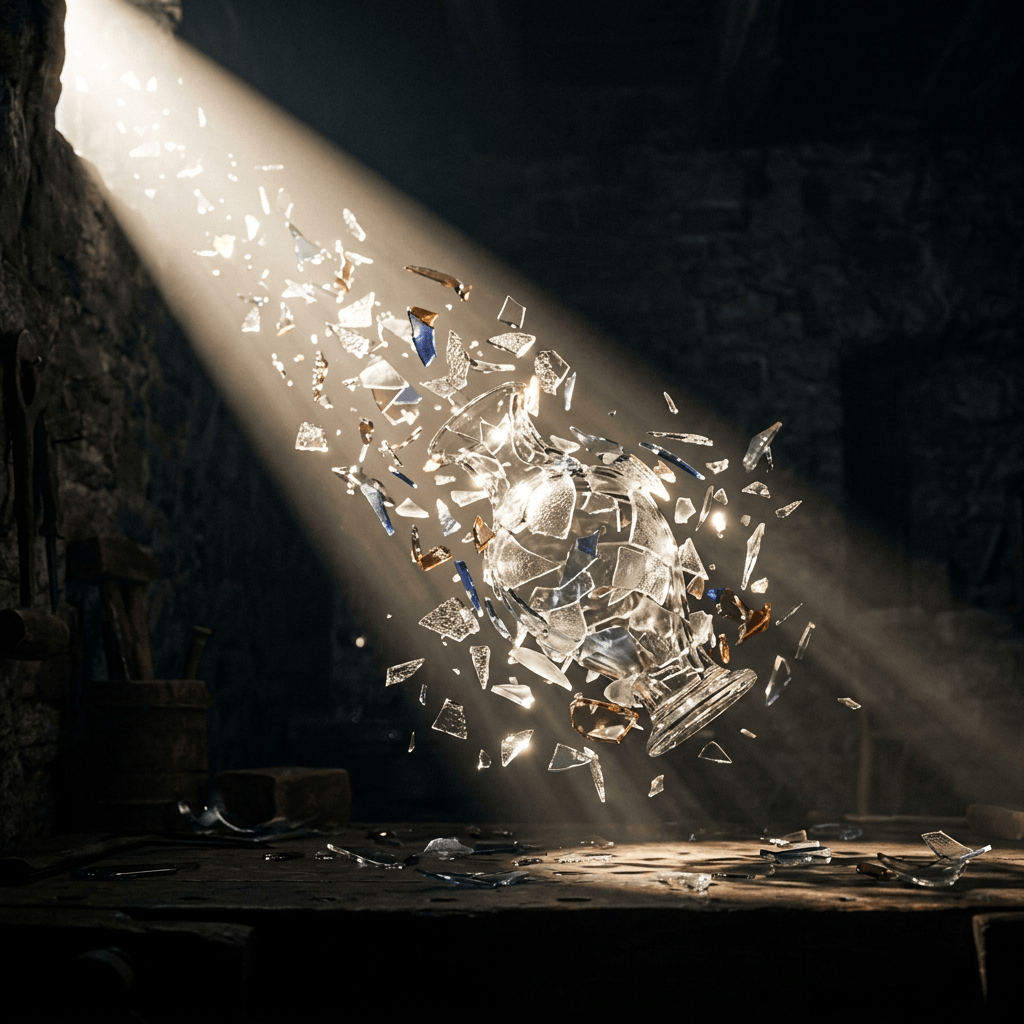
A glass vase shatters dramatically in a sunlit rustic room
Convincing a surgeon was its own ordeal. My own neurologist told me that I would have to have it for my entire life. Suddenly I imagined having to go through airport security with a chunk of metal lodged in my head. Doctors are trained to preserve function and prevent harm. Asking one to open a skull in order to extract a working device runs against every protective instinct the profession cultivates. I had to sweet talk my way. I had gotten good at this and got my way again obviously. I did not demand recklessness. I presented the case as a considered philosophical and spiritual position, not a whim. I accepted full responsibility for the outcome. Eventually the procedure happened. The shunt came out. The recovery was not simple. There were adjustments, monitoring, moments of uncertainty. But the foreign object was gone. The body was, as much as possible, itself again.
This experience did not turn me into an opponent of all medicine. Infections still require treatment. Broken bones still need setting. Acute crises still call for intervention. What it clarified is the boundary I refuse to cross: the permanent installation of materials that the body did not generate and cannot fully integrate. That boundary is rooted in a larger view of human limitation and divine order. If the body’s own systems cannot overcome a particular challenge, the solution may not always be to override those systems with hardware. Sometimes the wiser path is to accept the constraint, to live within it, or to trust that the constraint itself carries meaning.
Conviction of this intensity is not comfortable. It isolates. It invites judgment. People hear the story and see either reckless defiance or admirable consistency, rarely anything in between. Yet I have found that living without such anchors leaves a person drifting—susceptible to every new medical fashion, every technological promise, every cultural pressure to optimize and upgrade. Stubbornness in conviction is the refusal to be optimized according to someone else’s blueprint.
I do not claim this path is for everyone. Bodies differ. Beliefs differ. Risk tolerances differ. What I do claim is the right—and the responsibility—to inhabit my own body according to the deepest principles I hold. For me those principles include the integrity of the natural form, the acceptance of mortality as part of a larger design, and the willingness to act on those beliefs even when the action is extreme. The brain surgery was not a rejection of life. It was an affirmation of a particular way of living it: unadorned, uncompromised, and aligned with the conviction that what is meant to be will find its way, and what is not may be better left untouched.
In the end, the devices we install and the ones we refuse both say something about what we believe a human being is for. My answer has always been the same. We are not projects under continuous construction. We are creatures living inside a plan larger than our own engineering. Sometimes that plan includes the hard choice to remove what was once thought necessary. Sometimes it simply asks us to stand firm in the belief that the body, left as close as possible to its original state, is already enough.
There is something deeply liberating about being alone. Not the hollow, restless kind of solitude that feels like waiting, but the rich, expansive kind that arrives when you are left entirely to your own devices for a stretch of days or weeks. In those quiet stretches, time softens. The external noise fades, and what remains is a clearer conversation with yourself—unfiltered, unhurried, and unapologetic.
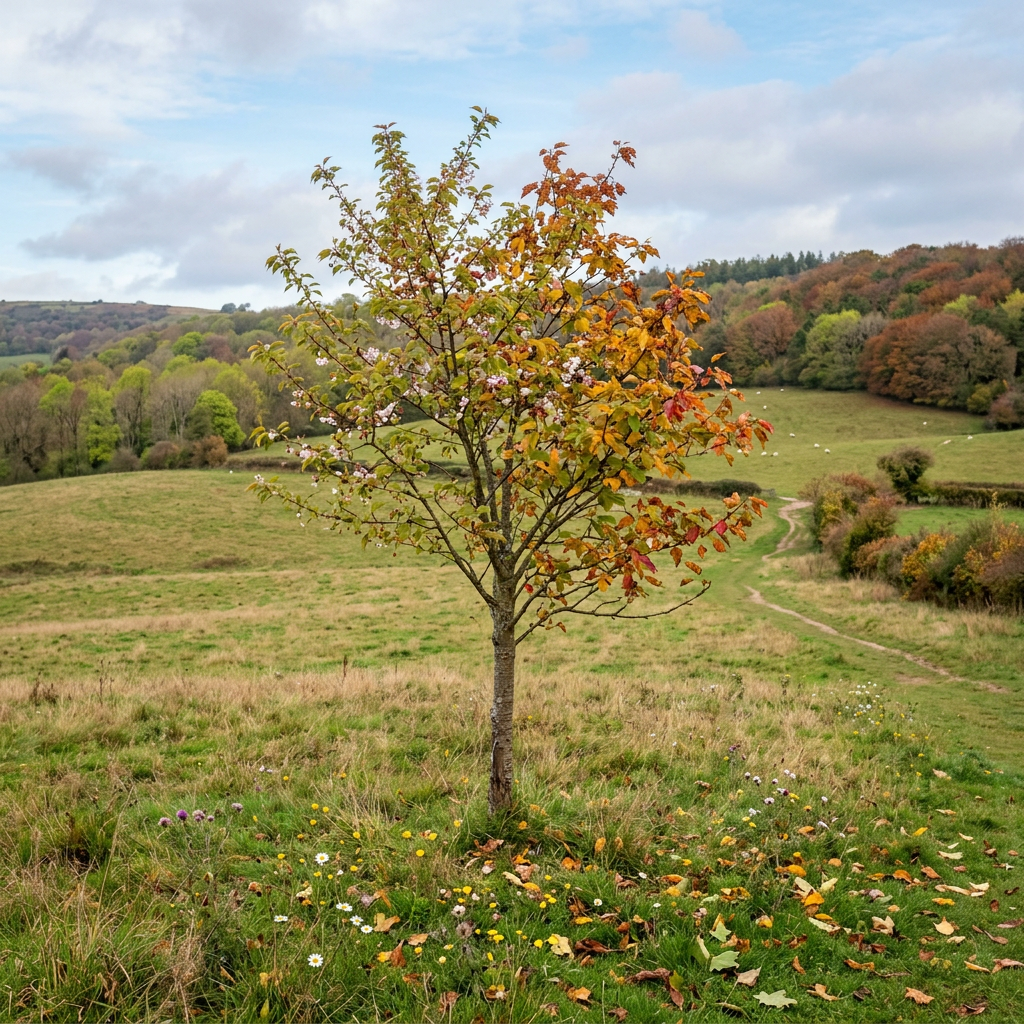
A small tree stands alone with leaves turning colors stands in a green meadow.
I do want to be with him, of course. That desire is steady and real. Being with him would be an entirely different situation from the one I inhabit right now. It would mean shared rhythms, shared space, the soft comfort of another person’s presence woven into the everyday. But right now, I find myself almost obsessively drawn to complete independence. There is a particular freedom in not having to consider how my choices might land in someone else’s eyes. No quiet calculation about whether the way I move through a task is efficient enough, whether the meal chosen is “healthy” enough, whether the small pleasures I reach for are acceptable or indulgent. Alone, I simply do. I eat what calls to me. I follow the thread of whatever interests me without the subtle background hum of self-consciousness. The judgment I fear is not his—when I am with him, those worries dissolve. With him, I feel held in a way that removes the need for performance. There are literally no worries. And in that absence of worry, my body settles. My health improves. Stress loosens its grip.
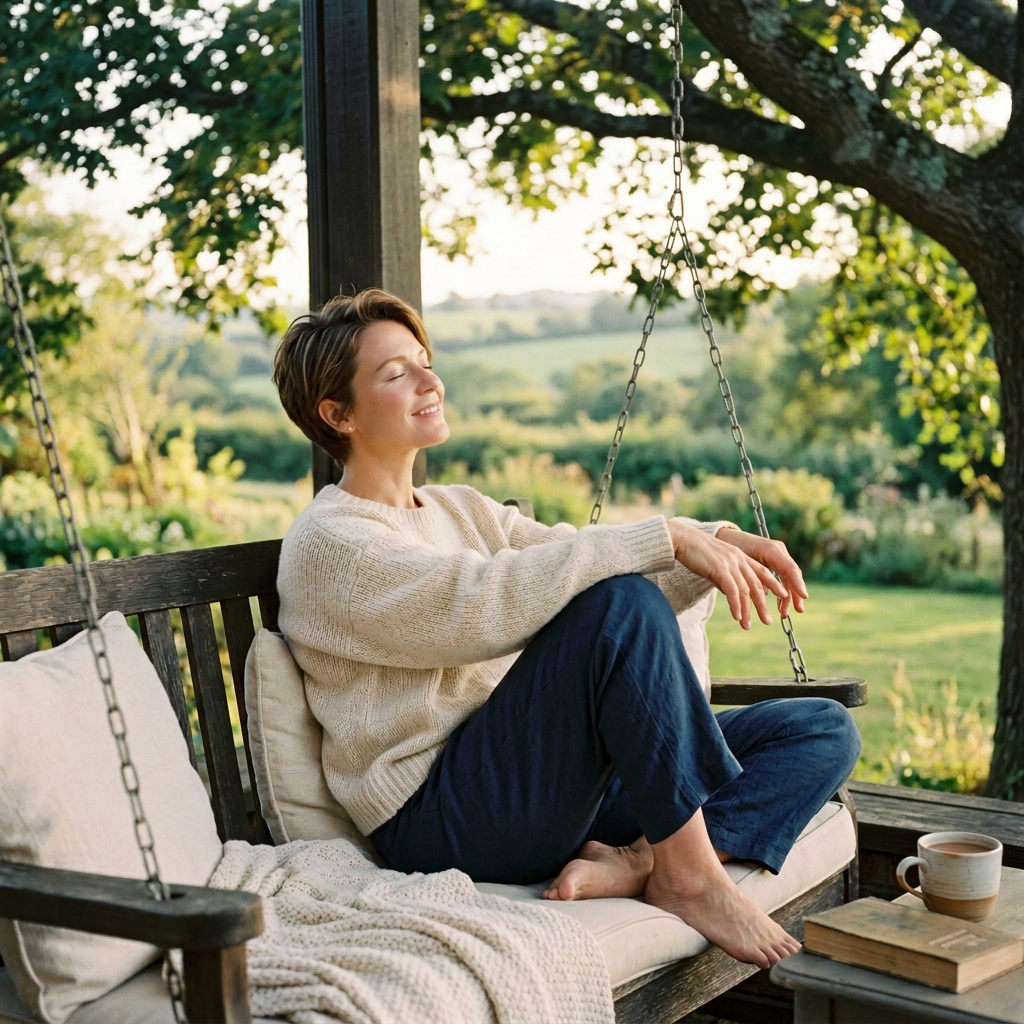
A woman enjoys a peaceful moment on a porch swing surrounded by nature.
I have come to believe that health is largely dictated by the presence—or absence—of stress, worry, and anxiety. We all carry illness inside us, latent possibilities that wait for the right conditions to surface. Those conditions are often emotional and mental long before they become physical. When we live in a constant state of sadness or overwhelm, life tends to mirror that internal weather. The body tightens, sleep frays, energy drains. Conversely, when we deliberately choose activities and people that lower the volume on stress, something shifts. Life begins to feel more generous. Enjoyment becomes accessible again. The ordinary moments regain their color.
Right now I am trying to find the balance between two deep longings. I desperately want to recover—fully, steadily, in body and mind. And I desperately want to be physically with my man forever, sharing a life that feels permanent and close. Yet I am careful not to force those desires into the universe with clenched fists. I do not want my needs, however legitimate, to become a weight that pulls against the very life I am trying to build. So I practice a quieter posture: I go about my days accepting everything as it is. I hope. I believe. I trust that what I want is already on its way, unfolding in its own timing. Manifestation, for me, is less about demanding and more about aligning—tending to my own ground so that when the things I long for arrive, I am ready to receive them without scrambling or scarcity.
Balanced stones sit peacefully by a calm lake during sunset
This season of solitude is not a rejection of love. It is a searching. It is a temporary devotion to self-possession. It is the space in which I remember how to move without apology, how to rest without justification, how to heal without rushing the process. And somewhere in that freedom, I am also preparing the version of myself who will one day be with him—not from need or fear, but from a place of fullness.