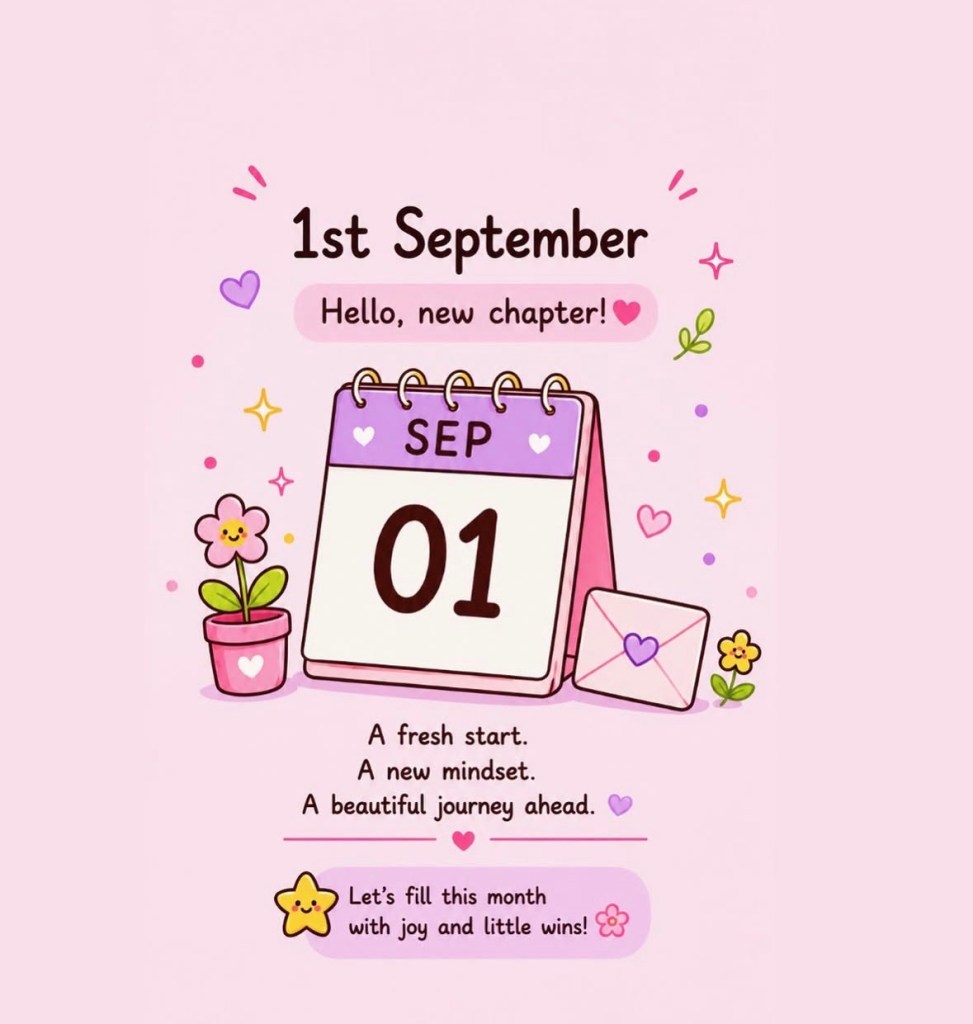
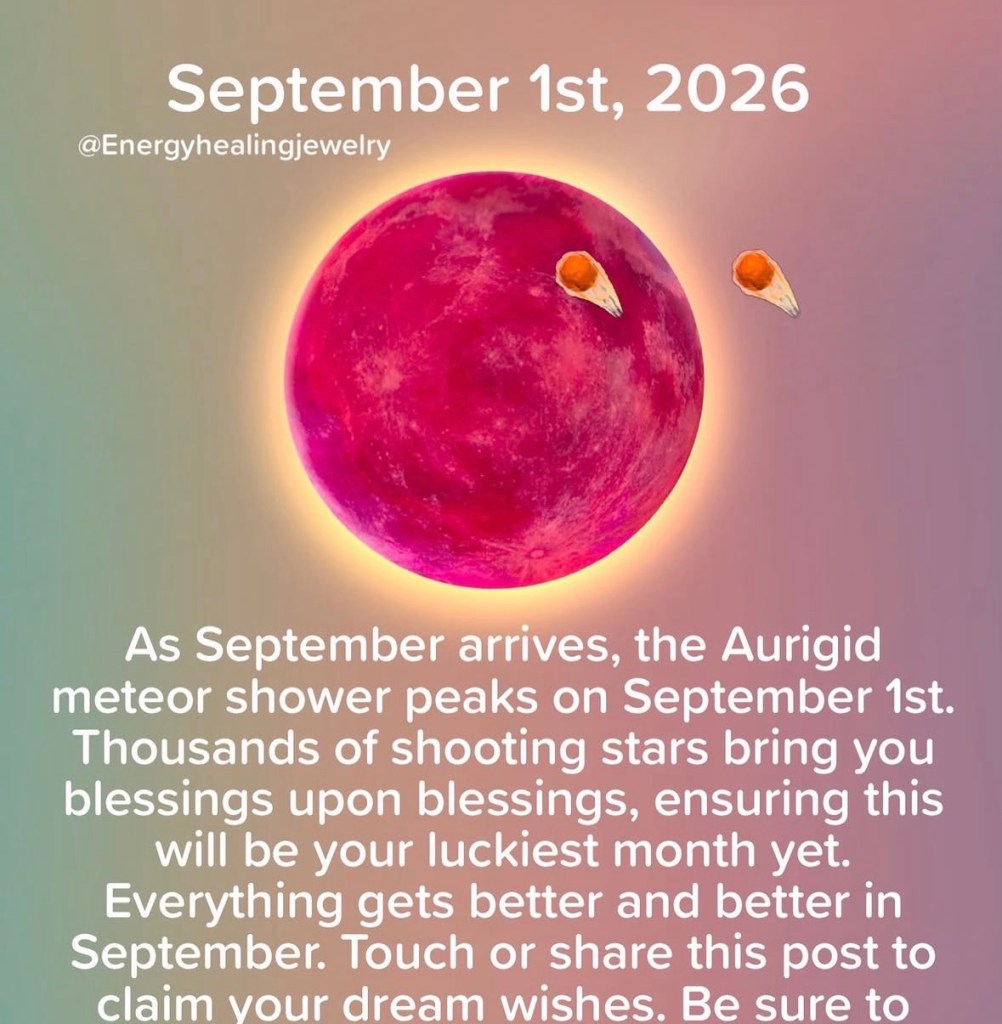
September is here. The calendar has flipped, the light is shifting, and the year has entered its most transitional stretch: still warm in many places, already carrying the first hints of autumn in others.
A new month is a clean page. It is also a reminder that most of what we actually do with time is continue the conversations we were already having. If we have been talking about routines, projects, travel, food, or how to start something again, September is a useful month to pick those threads back up instead of pretending we are starting from zero.
Labor Day weekend in the United States and Canada marks the unofficial close of summer. Schools reopen. The autumnal equinox arrives around the 22nd or 23rd, when day and night briefly balance. Around the world there are observances for literacy, peace, the ozone layer, and tourism. None of these dates require you to reinvent yourself. They simply give the month a rhythm.
A sunlit stone path winds through lush grasses, flowers, and colorful autumn foliage.
The useful move is usually modest. Finish the half-done thing you mentioned last time you asked how to get unstuck. Try the recipe or the itinerary you were weighing. Adjust the schedule you were already trying to make work. September rewards continuation more than spectacle.
The days are still long enough to use. The evenings are starting to feel different as now when I get outside to write, my body covers itself in goose pimples. That is enough of a reason to treat the month as an invitation rather than a demand.
Welcome to September. Let’s keep going with whatever we were already working on.
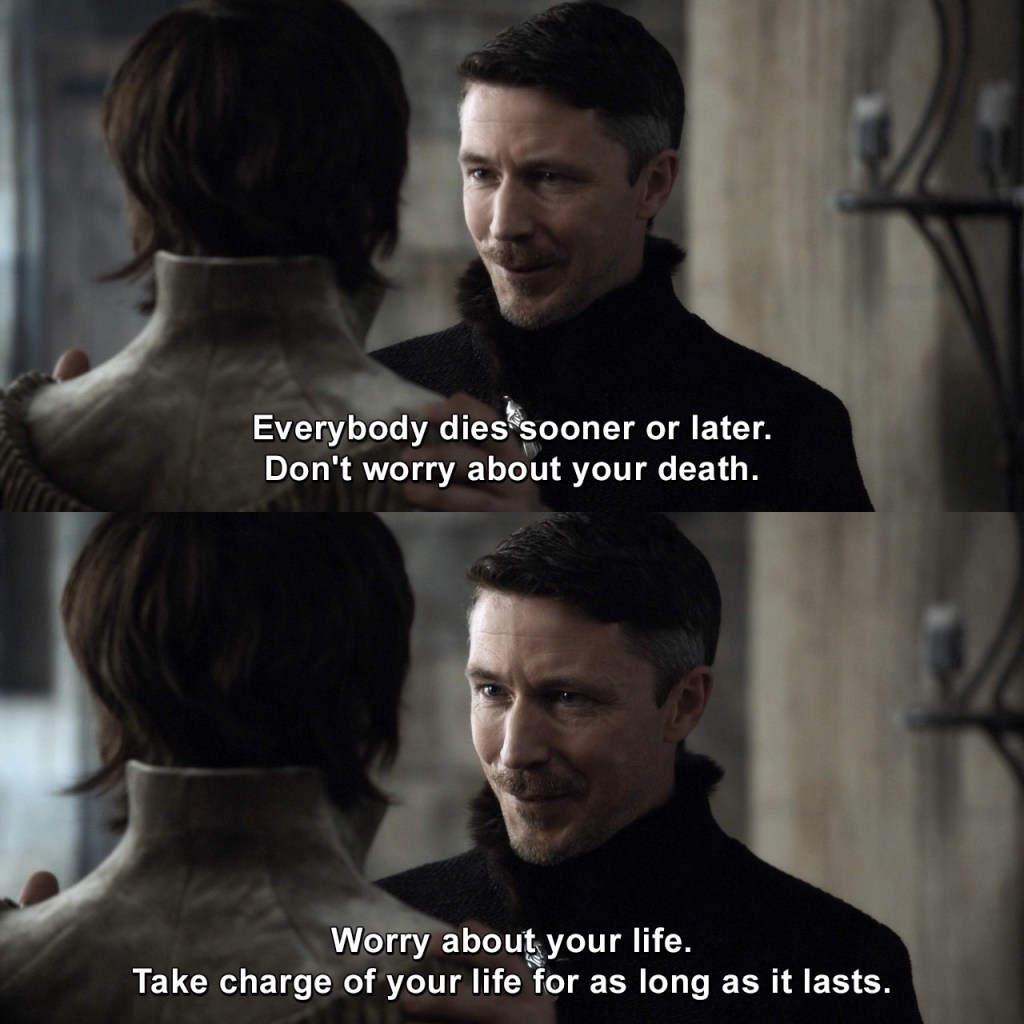
There is an intensity in the words: Everybody dies sooner or later. Don’t worry about your death. Worry about your life. Take charge of your life for as long as it lasts.
Spoken with calm certainty, these words cut through the usual noise of motivational platitudes. No soft promises of endless tomorrows. No denial of the inevitable. Just a clear, almost clinical redirection: stop fixating on the end and start owning the middle.
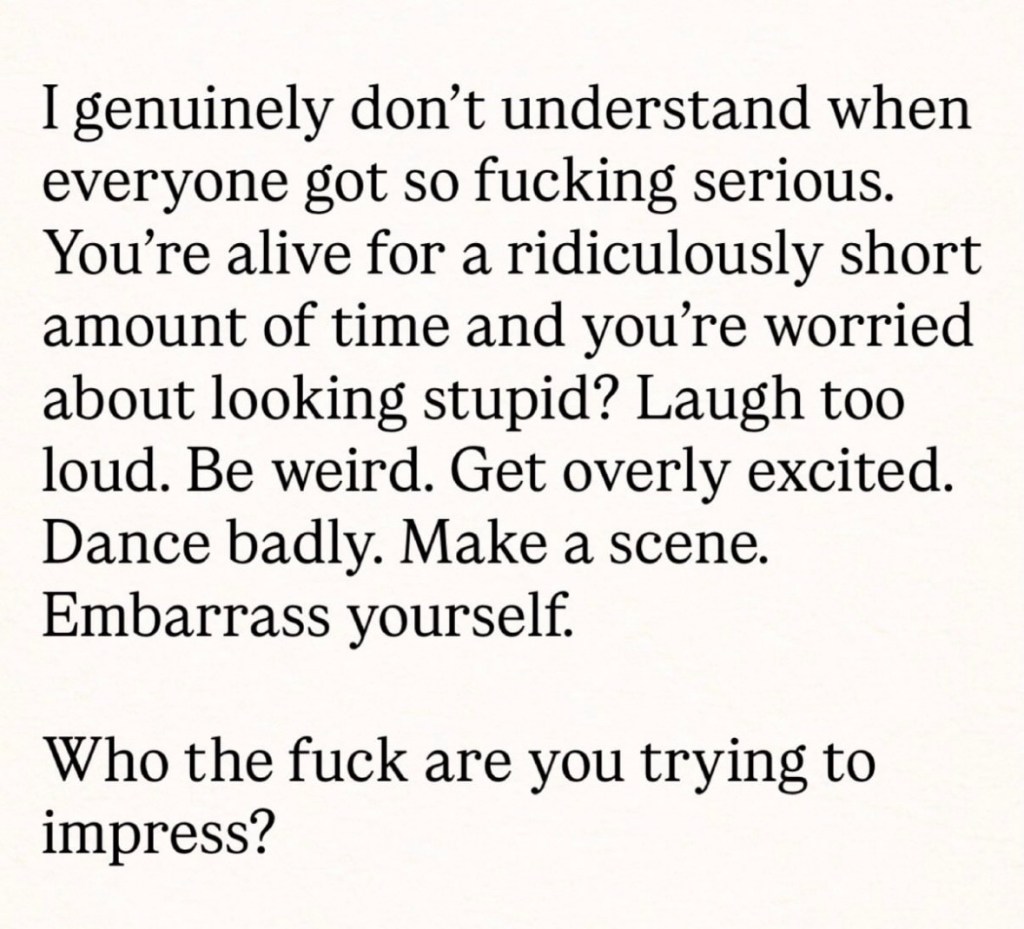
Most of us spend more mental energy on death than we admit. I simply do not understand this. Death, whilst inevitable, is kind of… depressing? We postpone conversations, delay risks, and treat time as if it were infinite. The result is a life lived in the shadow of an ending we cannot control. Fear of death becomes a quiet thief—it steals presence, courage, and the willingness to choose.
The quote refuses that bargain. Death is not a problem to be solved or delayed indefinitely. It is a fact. Once accepted, the real work begins: what will you do with the stretch of days you actually have?
“Take charge of your life for as long as it lasts” is both permission and demand. Permission to stop waiting for ideal conditions. Demand to stop outsourcing your agency to circumstances, other people’s expectations, or the vague hope that “someday” will arrive fully formed.
A winding mountain road leads through rugged hills toward a glowing sunset.
Taking charge looks different for everyone: Saying the hard thing in a relationship instead of letting in resentment or starting the project that feels too ambitious is a way of protecting your time and energy instead of giving them away by default.
All in all, it is all about choosing presence over distraction when the people who matter are in the room.
It is not about relentless productivity or grand gestures. It is about authorship. You are the primary writer of the remaining chapters, whether those chapters number in the dozens or the thousands.
When you stop treating death as a distant emergency and start treating life as the urgent project, priorities clarify. Small talk loses its grip. Status games look thinner. The ordinary moments—morning light, a shared meal, focused work—gain prominence because you know they are finite.
This is not morbidity. It is clarity. The people who live most fully are often those who have looked squarely at the end and decided the only sensible response is to inhabit the present with greater honesty and intensity.
Everyone should keep this quote (or at least the mindset) close. When anxiety about the future or regret about the past surfaces, return to the instruction: Worry about your life. Then ask one practical question: What is one concrete action I can take today that belongs fully to me?
Do that action. Repeat.
A cozy stone-walled reading nook glows with candlelight beside an open journal and warm leather chair.
Everybody dies sooner or later. That part is already decided. It is written in our destiny the moment we are born. The part still open is whether, while the days last, you will treat them as someone else’s to manage.
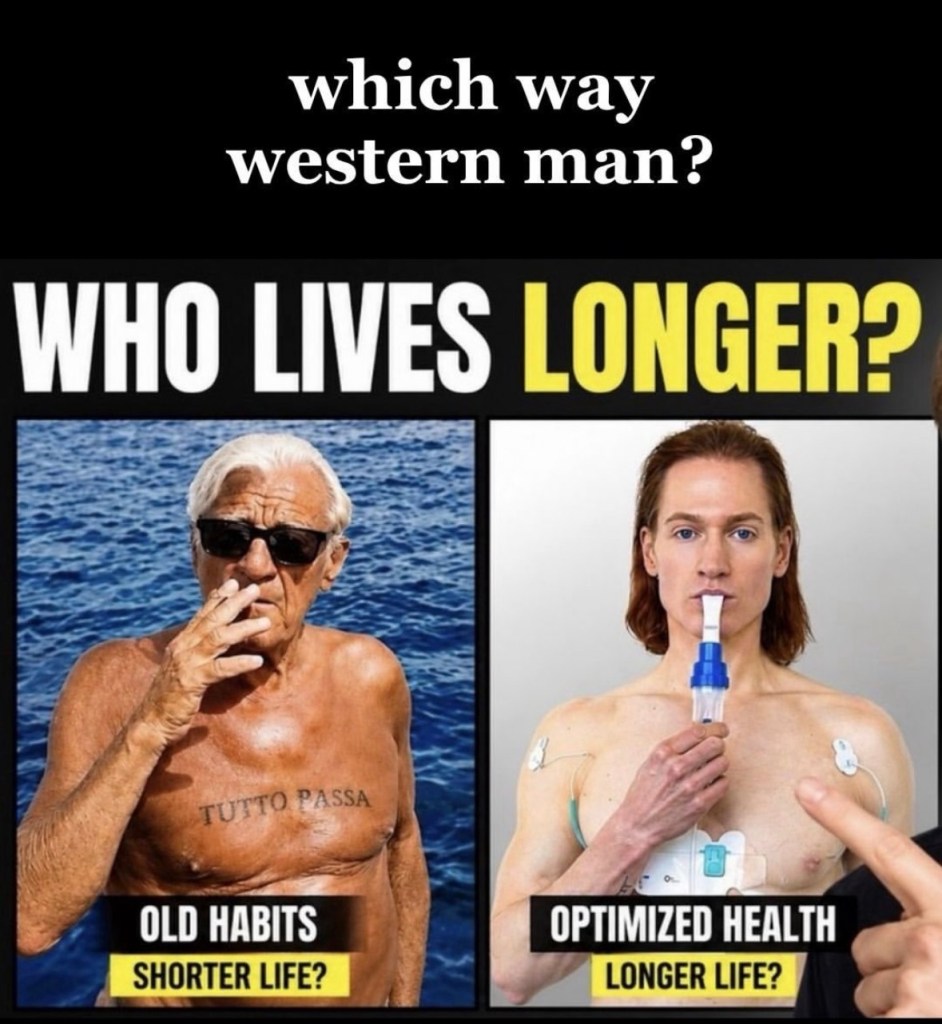
Waking up from a vivid dream and actually remembering it is one of the purest, most underrated signs that your brain has not completely surrendered to the modern meat grinder.
Most people stagger out of bed like lobotomized cattle, eyes glassy, muttering “I never dream” while they reach for the phone that spent the night irradiating their skull. That is peak “normal.” But this not healthy. It is your nervous system waving a little white flag. When you open your eyes and the dream is still clinging to you—colors too sharp, emotions too raw, plot so absurd it makes waking life look like a corporate PowerPoint—you should take a second to feel smug about it. Your mind is still alive in there.
A couple sleeps beneath a star-filled sky as glowing connections evoke shared memories and dreams.
Dreams are the brain’s nightly audit. While the rest of the world is scrolling, numbing, medicating, and microdosing their way into emotional flatness, a vivid, sticky dream means the machinery is still running hot. REM sleep is doing its job. Memory consolidation is happening. Emotional processing is not completely bottled up behind a wall of SSRIs, blue light, and existential exhaustion. You are not just surviving the night; you are metabolizing the day like a functional animal instead of a medicated office drone.
The people who claim they “don’tdream” are usually lying to themselves or so sleep-deprived and chemically smoothed that their brains have stopped bothering to stage the nightly theater. Chronic stress, alcohol, weed every night, melatonin abuse, glowing rectangles until 2 a.m.—all of it blunts the signal. You wake up empty. No residual weirdness. No half-remembered chase sequences or conversations with dead relatives or the inexplicable feeling that you just lived an entire second life in six hours. That is not enlightenment. That is neurological quiet quitting.
A sleeping figure rests beneath a glowing constellation shaped like a connected world of ideas.
A remembered dream is evidence that the boundary between conscious and unconscious is still permeable. The subconscious is still allowed to throw its chaotic, unfiltered show and some of it lasts long enough for you to notice. That is healthy. That is human. In a culture that treats any unscripted internal experience as something to be pathologized or optimized away, remembering a vivid dream is almost subversive. You are not fully domesticated yet.
There is a reason ancient cultures treated dreams like messages, omens, or diagnostics. They were not just wrong. A mind that can produce and retain rich nocturnal narratives is a mind that still has bandwidth, plasticity, and a functioning emotional thermostat. The opposite—waking up blank, night after night—is often the first quiet symptom that something deeper is offline. Sleep architecture is crumbling. Anxiety is winning. The prefrontal cortex is too fried to even stage a proper nightmare.
So the next time you bolt upright at 3:47 a.m. with the full cinematic replay still burning behind your eyes, do not roll over and immediately open Instagram to forget it. Sit with the weirdness. Write it down if you are into that. Feel the residual charge. That jolt of aliveness is proof that the lights are still on upstairs. In an age where most people’s internal worlds have been reduced to algorithmic sludge and prescription fog, a vivid, remembered dream is a small, private rebellion.
Your brain just threw a wild, unfiltered party while the rest of the house was asleep. And you got the invite. That is not trivial. That is health.
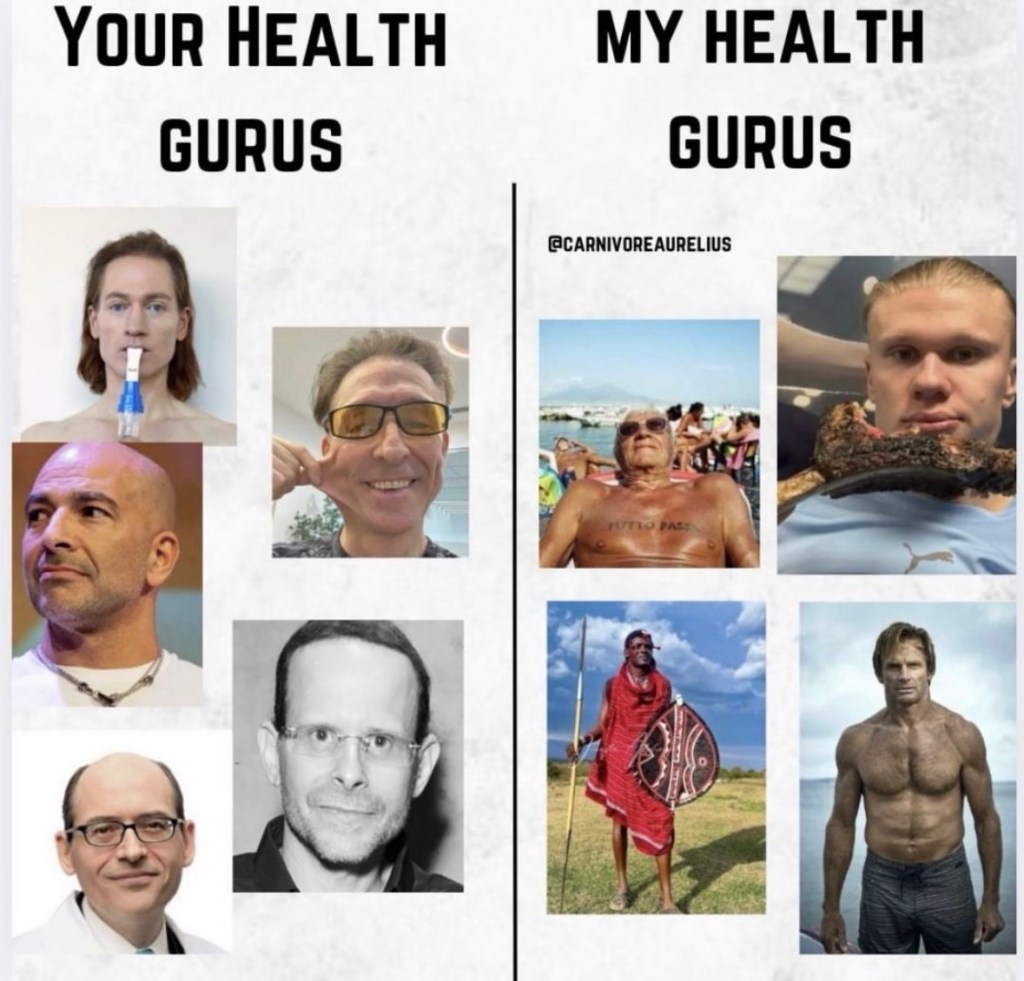
I know some of my health beliefs sound unhinged to people raised on the standard public-health script. I am fine with that. I sincerely believe the mind and mindset are primary drivers—capable of causing, amplifying, or resolving far more of what ails us than most mainstream advice admits. Chronic stress, unresolved emotional patterns, expectation, and the stories we tell ourselves about our bodies shape immune function, inflammation, hormone balance, pain perception, and recovery far more powerfully than the average wellness checklist acknowledges. Placebo and nocebo effects are no-nonsense; they are measurable physiology. When someone is convinced they are broken, poisoned, or doomed, the body often cooperates. When someone refuses that story and orients toward agency and resilience, outcomes frequently improve—even in the face of imperfect “lifestyle hygiene.” This is not magical thinking. It is an insistence that the organism is not a passive machine waiting for external inputs to dictate its fate.
That same skepticism extends to several specific claims that get treated as gospel.
Cancer is largely a product of the modern chemical environment, not the sun.
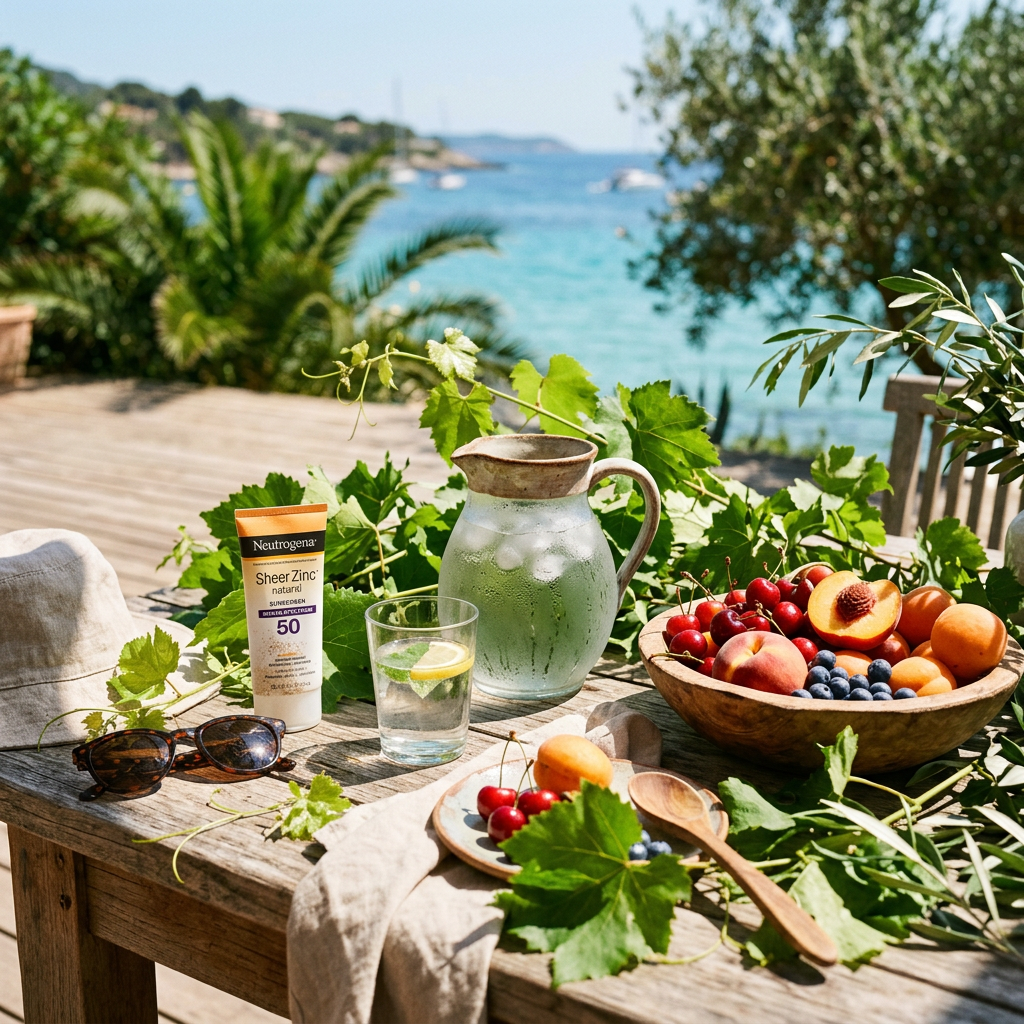
A sunlit seaside table pairs sunscreen with fresh fruit, chilled water, and summer accessories.
I do not accept that the sun—the same source of vitamin D, circadian signaling, and the light that has bathed life for billions of years—is the primary villain behind skin cancer. Melanoma and other skin cancers existed long before industrial chemistry, but the sharp rise in diagnoses tracks far more closely with the explosion of synthetic compounds, persistent organic pollutants, endocrine disruptors, processed foods, and novel exposures than with people suddenly spending more time outdoors. The idea that a “beautiful ball of fire in the sky” was waiting all this time to randomly attack us while we invent new solvents, plastics, and preservatives every decades seems suspicious.
Sunscreen deserves particular scrutiny. The dramatic increase in reported skin-cancer rates after the widespread adoption of chemical sunscreens is not a coincidence I am willing to ignore. Many conventional formulas rely on ingredients that themselves raise questions about systemic absorption, hormonal interference, and oxidative stress under UV exposure. Mineral-based options (non-nano zinc oxide and titanium dioxide without the aluminum or chemical filters) are a far less concerning compromise when protection is genuinely needed. The larger point remains: treating the sun as the enemy while treating the chemical soup of modern life as background noise is a category error. Focus onreducing the big toxins first.
The “eight glasses of water a day” rule is arbitrary dogma
Hydration matters. Obsessive water-chugging does not. The body is not a simple tank that requires a fixed volume of plain water regardless of climate, activity, diet, or individual physiology. Electrolyte balance—sodium, potassium, magnesium, and the rest—determines whether fluid actually stays where it is useful. People eating real food, salting to taste, and paying attention to thirst and urine color generally do better than those forcing down liters of plain water out of fear of “dehydration.” Overhydration is real; electrolyte dilution is real. The eight-glass mantra is a marketing-friendly oversimplification that ignores context.
Eight hours of sleep every night is not a universal law
Sleep is essential. The idea that every adult must hit exactly eight hours or face inevitable decline is not. Could I even sleep eight straight hours? Individual variation is large. Some people function optimally on less, others need more, and quality (continuity, depth, alignment with natural light cycles) often matters more than the raw number. Rigid enforcement of an eight-hour quota can itself become a source of anxiety that undermines the very rest it claims to protect. Track how you actually feel and perform rather than worshiping a round number. Or purchasing a tacky tracking device.
Wrinkles are not a disease
The cultural war on wrinkles treats a normal consequence of decades of facial expression, sun exposure, and collagen changes as a medical emergency requiring endless products, procedures, and self-surveillance. Aging skin is not a failure of willpower or product compliance. Accepting that some lines are inevitable—and that they often signal a life lived—is more coherent than the anti-aging industry’s promise of perpetual smoothness.
Sugar does not uniquely “feed” tumors in the way the slogan implies
Cancer cells are metabolically greedy and often rely heavily on glucose. That observation has been stretched into the claim that dietary sugar is the direct fuel that keeps tumors growing, so cutting sugar starves them. The reality is more complicated. The body tightly regulates blood glucose; restricting dietary sugar does not selectively deprive malignant cells while leaving healthy tissue untouched. Tumors can use other substrates, and the metabolic flexibility of both cancer and host is not reducible to “sugar feeds cancer.” Obsessing over every gram of carbohydrate while ignoring overall metabolic health, inflammation, and the rest of the diet is another example of a partial truth turned into a rigid rule.
Eat what makes you feel good—happiness is not optional
The final point is the practical corollary of the first. Chronic stress from rigid dietary rules, moralizing food choices, and constant self-monitoring is itself a health risk. People who eat in a way that supports stable energy, digestion, and genuine enjoyment—without the background noise of guilt or fear—tend to do better long-term than those locked in perpetual restriction or purity contests. This is not a license for chaos. It is a recognition that psychological well-being and physiological well-being are not separate ledgers. When the rules become the stressor, the rules have failed.
None of this requires rejecting every useful medical intervention or every piece of evidence-based guidance. It does require refusing to treat every official recommendation as sacred, every correlation as causation, and every commercial product as the solution to a problem the product may have helped create. The mind is not a side character in health. The modern chemical environment is not neutral. And many of the tidy rules we are handed—water quotas, sleep quotas, sunscreen as non-negotiable shield, sugar as tumor fertilizer—are simpler and less accurate than the marketing suggests.
I love me some avocado! So obviously I was ecstatic when foods were created using avocado oil instead of the disgusting seed oils (read more about my position on seed oils here!).
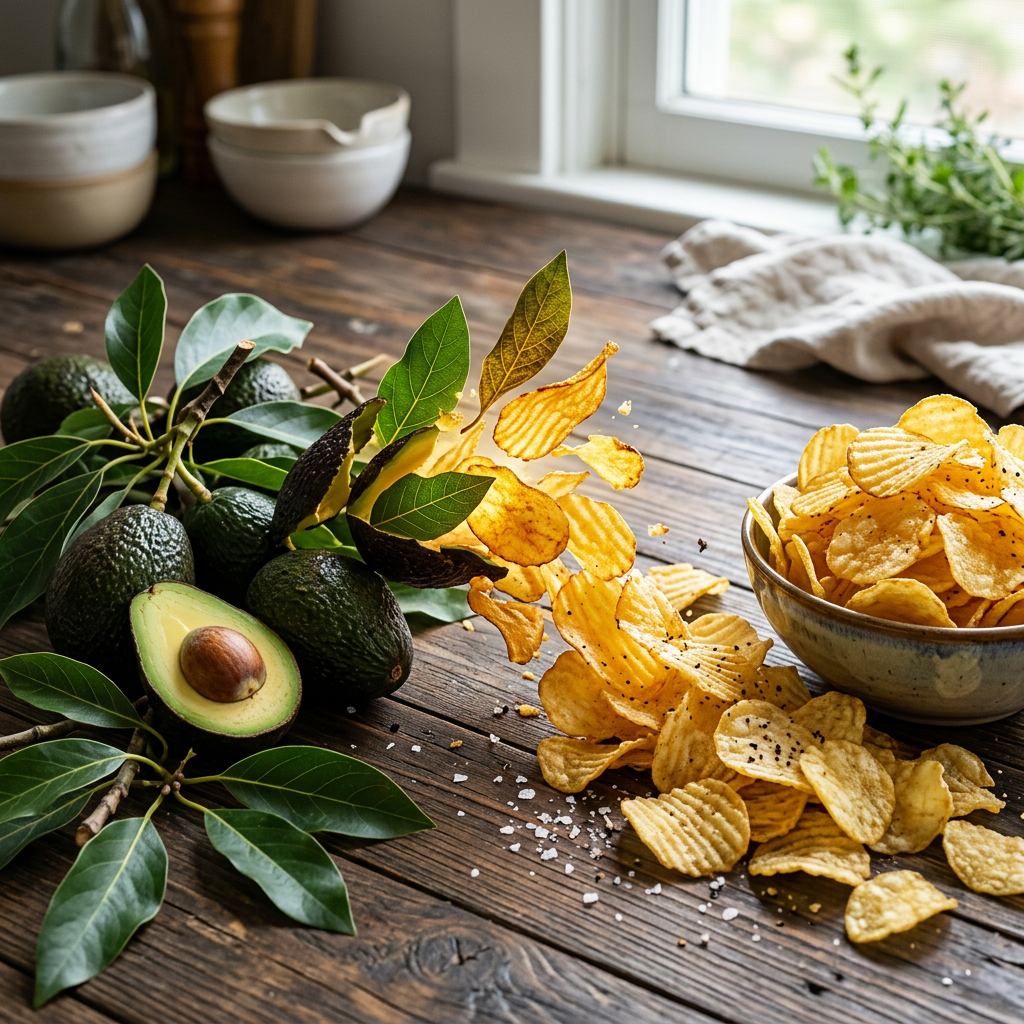
Potato chips suck up oil like a sponge. The final product is usually 30–40% fat by weight. That means 8–11 grams of pure frying fat per one-ounce serving, whether the bag screams “avocado oil” or just “vegetable oil (and/or whatever is cheapest this week).”
Boulder Canyon’s classic sea salt version clocks in at 9g fat (mostly monounsaturated on the label). Jackson’s, Kettle Brand avocado lines, the works—same ballpark. The number is not magic. It is just how much oil the potato decided to keep after the fryer.
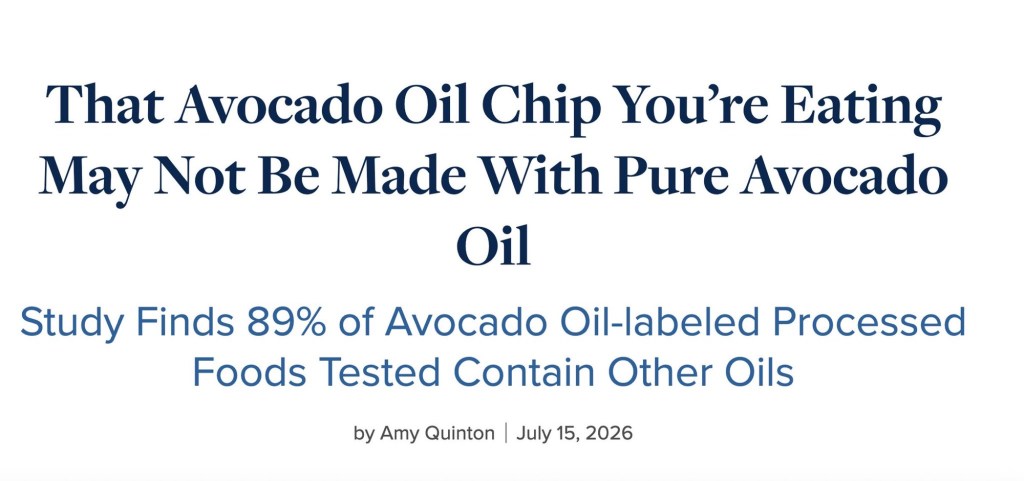
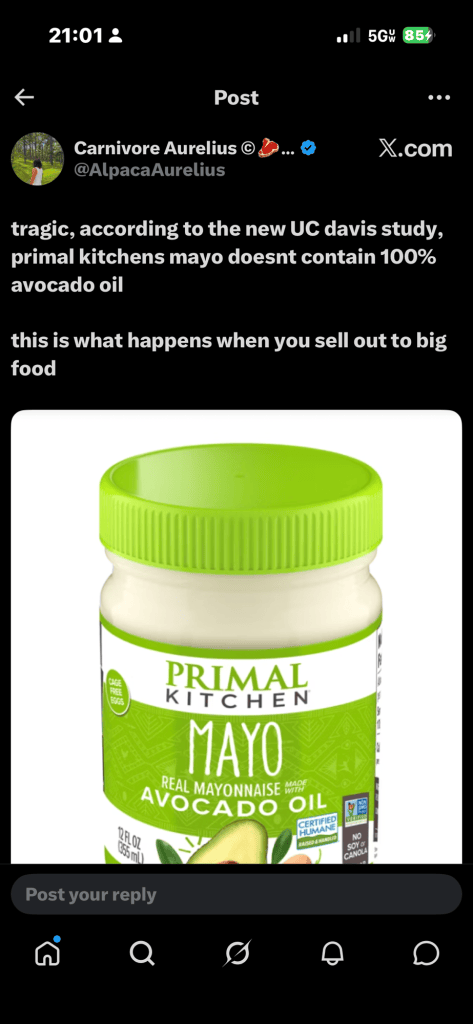
Avocado oil should be the upgrade: high smoke point, heavy on oleic acid, less of the inflammatory omega-6 circus that seed oils bring to the party. On paper it looks cleaner. In practice a July 2026 UC Davis study checked 54 products that listed avocado oil as the only oil. 89% were adulterated. Chips specifically 93% failed the chemical fingerprint test. Fatty acids and sterols did not match real avocado oil. Cheaper oils (soybean, canola, the usual suspects) were riding shotgun or driving the whole thing.
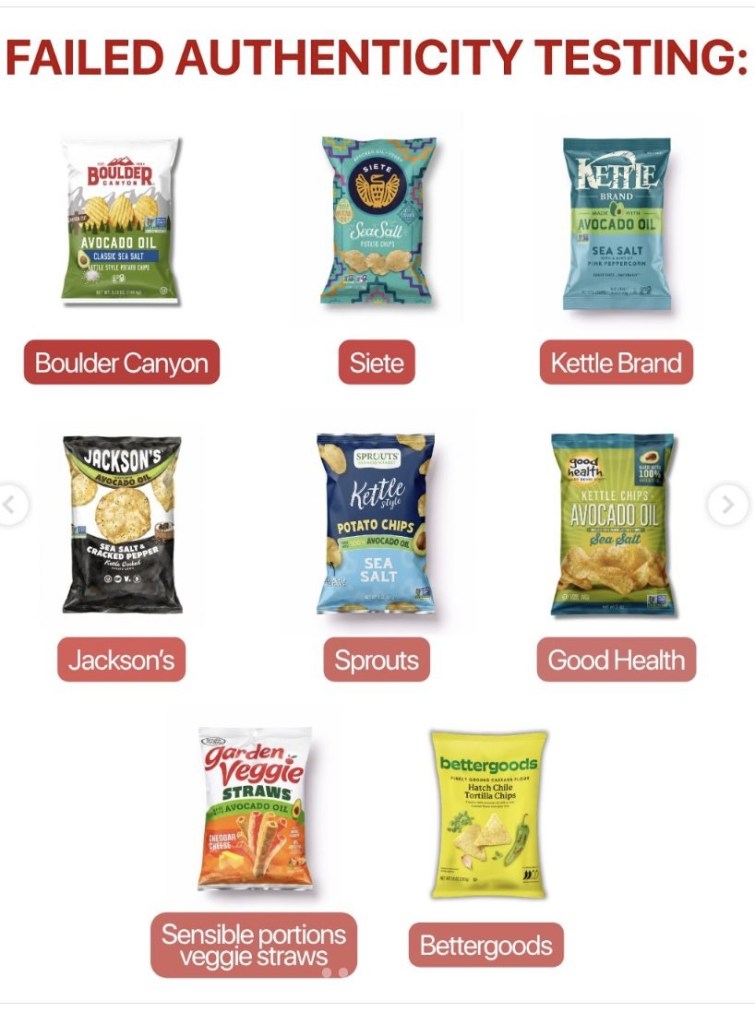
Boulder Canyon, Jackson’s, Siete, Kettle Brand avocado versions, Good Health, Sprouts—multiple brands flunked. A couple of samples from Lesser Evil and Simply Tostitos scraped by on one lot and failed the next. Nobody’s chip brand went two-for-two clean. Meanwhile, olive oil products mostly passed the same tests. Avocado oil is expensive. The incentive to dilute it is obvious. The supply chain apparently has no accountability.
So when the bag says “made with avocado oil” or “100% avocado oil,” treat it like a dating-app bio: optimistic at best, full of it at worst. You are still eating a calorie bomb of fried starch. The fat profile might be better if the oil is real. Most of the time it is not. You are paying the premium for the green-washed label while the actual oil composition is closer to the cheap stuff you were trying to avoid.
Want actual control? Make your own with a bottle of avocado oil that does not come from a random bulk supplier, or switch to brands frying in tallow, coconut, or verified olive oil. Or just accept that chips are a vice and stop pretending the oil type turns them into a wellness product. The study did not invent the problem—it just held up the receipt.
Even one of my favorite condiment brands has sold out to Big Food and found fraudulent
Walk through any mall, airport, or public space today and the pattern is impossible to ignore. Everywhere you look, people carry an unnatural puffiness—an extra layer of swelling that goes far beyond simple “weight gain.” Faces look rounded and heavy, midsections strain against clothing, and movements seem labored. I used to feel a flash of disgust at the sight. Now I mostly feel a deep, quiet sadness. These are not people who simply “let themselves go.” They are victims of a lifestyle that wages war on the human body every single day, and most of them do not even realize the enemy has taken up permanent residence in their homes, their kitchens, and their pockets.
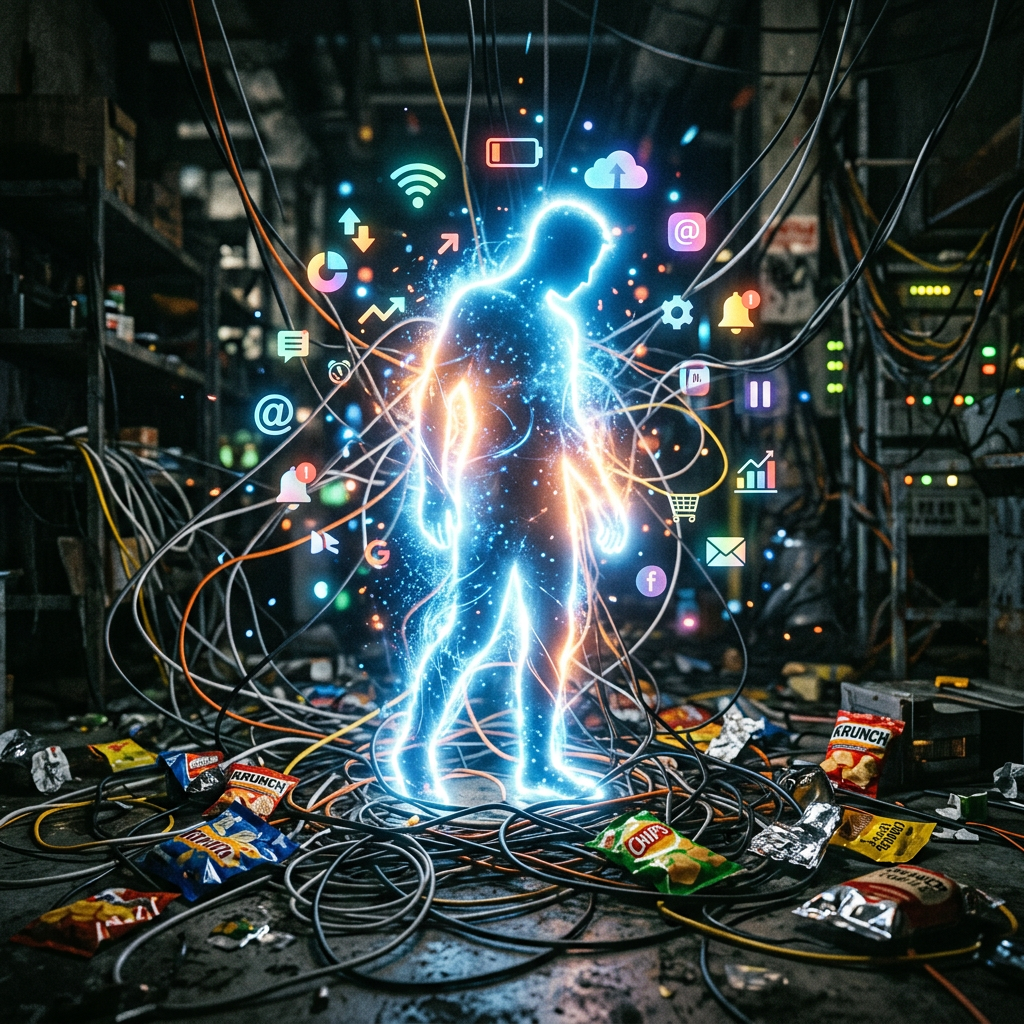
A glowing human figure surrounded by digital icons and cables in a cluttered room
At the root of much of this bloating lies something deceptively simple: elevated cortisol. This is caused by excessive amounts of estrogen (men can have that too!)
Our bodies were never designed to live in a state of low-grade, perpetual stress. Yet that is exactly the environment we have engineered for ourselves. Cortisol, the primary stress hormone, tells the body to hold onto fluid and fat—especially around the midsection—as a survival mechanism. When cortisol stays high for months or years, the result is that characteristic swollen, inflamed look that no amount of “clean eating” alone can fully fix.
The solution is not another restrictive diet or punishing workout plan (although fasting can help). It is choosing the simpler, easier route that actually aligns with how our biology evolved: reduce the unnecessary stressors and give the body what it needs.
Let us start with the most obvious offender. The modern human spends the majority of waking hours indoors, bathed in artificial blue light from screens, LEDs, and overhead fixtures. Our ancestors rose with the sun and rested when it set. We scroll until 1 a.m. under harsh white and blue glows that suppress melatonin, disrupt circadian rhythms, and keep cortisol elevated long after it should drop (AKA disrupting sleep).
This constant indoor, screen-saturated existence does more than ruin sleep. It weakens vitamin D levels— which harms the human health, dulls mood, inflames the body, and signals to our physiology that we are still under threat. The body responds by holding water, slowing metabolism, and storing energy wherever it can. No wonder so many feel perpetually uncomfortable in their own skin.
Diet is the next major piece. Walk down the center aisles of any grocery store and you will find row after row of products engineered to last on shelves for months or years. These ultra-processed foods—loaded with seed oils, refined sugars, emulsifiers, and additives—trigger inflammation and mess with gut health, which in turn affects everything from hormone balance to fluid retention.
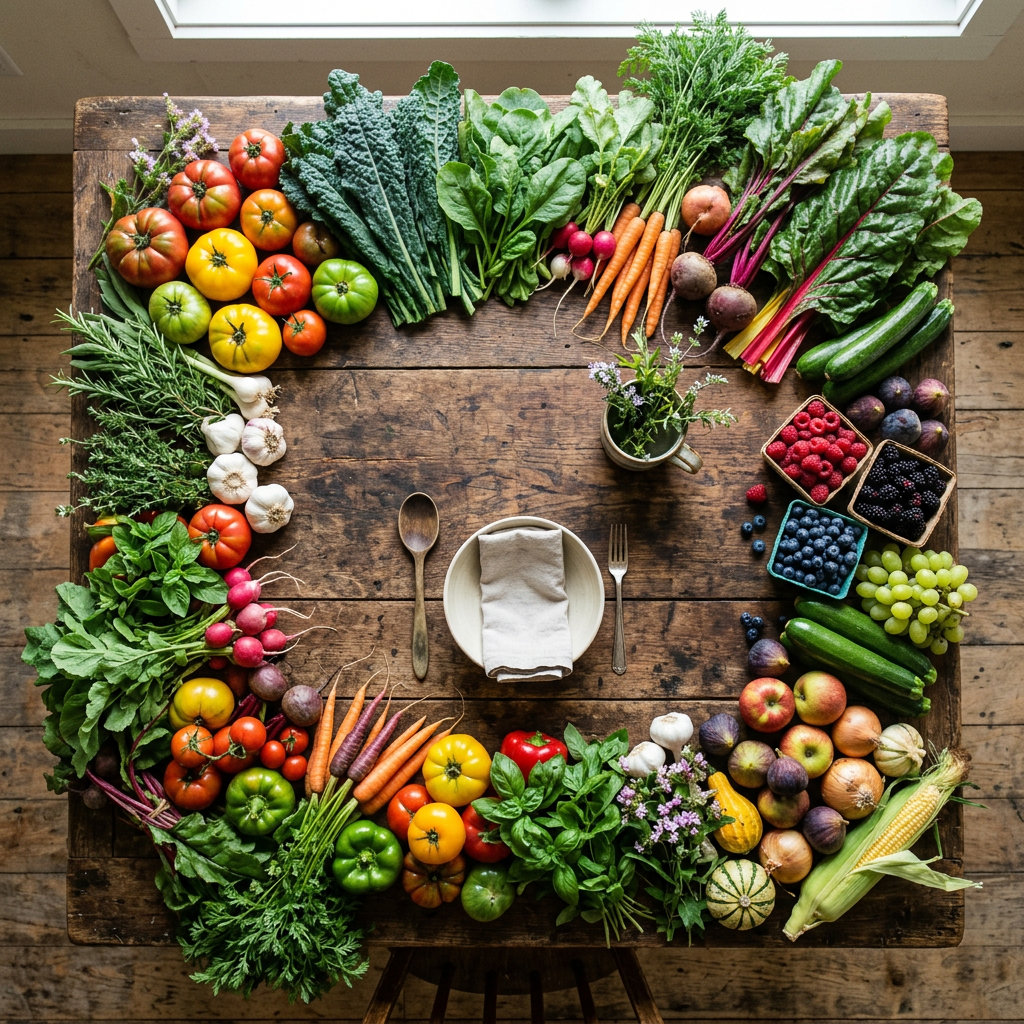
A vibrant assortment of fresh vegetables and fruits arranged in a circular pattern around a plate and utensils
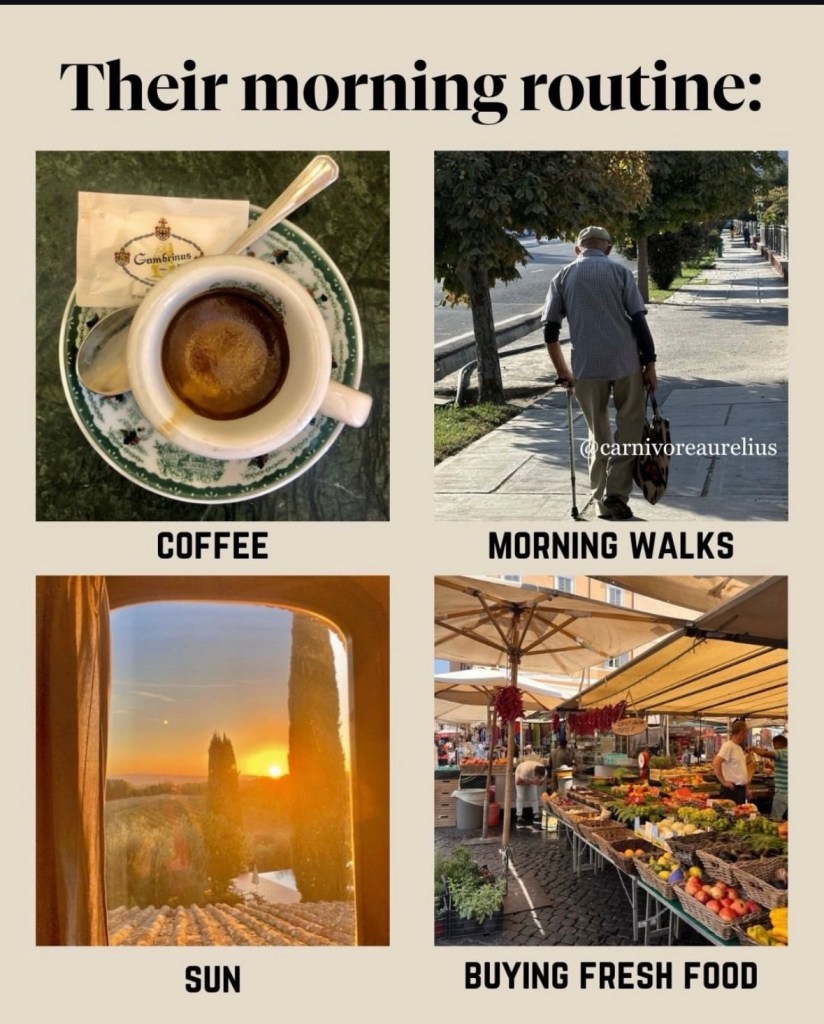
Contrast that with the outer edges of the store and the local farmers’ market. Bright, colorful produce. Leafy greens still carrying dirt from the field. Berries, citrus, cruciferous vegetables, and root crops packed with fiber, micronutrients, polyphenols, and water. These foods do not just nourish; they actively reduce inflammation and help regulate cortisol. Your body recognizes them. It relaxes. It stops operating in emergency mode.
When you consistently feed yourself shelf-stable, junk, your body eventually begins to rebel. Bloating, fatigue, brain fog, and that constant low-level discomfort become the new normal. Many people accept this as “getting older.” It is not . It is a dietary mismatch.
We rarely talk about the other kind of food we consume daily: information and stimulation. Most people feed their minds a steady diet of gossip, outrage, political hysteria, and endless comparison via social media. Doomscrolling floods the brain with cortisol-spiking stimuli. Pornography, OnlyFans etc. offers cheap dopamine hits that further dysregulate reward systems. None of this builds resilience. None of it nourishes the psyche.
Compare that to spending an evening with someone you love—really present, sharing stories, laughing, touching, connecting. The nervous system downregulates. Oxytocin rises. Cortisol falls. The difference in how your body feels the next day is profound.
Real human connection, time in nature, creative hobbies, deep reading, or even quiet reflection—these are the “nutritious foods” for the mind. They do not cost anything extra, yet they deliver returns that no supplement or fitness tracker can match.
The beautiful truth is that fixing this does not require heroic discipline or expensive interventions. It asks for small, consistent realignments:
Get outside in natural light, especially in the morning.
Replace even one processed meal a day with something fresh and colorful.
Set hard boundaries on screens after sunset.
Trade thirty minutes of scrolling for a walk (or at least an attempt!) with someone you love or a real conversation.
Prioritize sleep like it is the most important supplement you will ever take.
These choices feel almost embarrassingly basic. That is why they work. Your body does not need another complicated protocol. It needs you to stop fighting its natural design.
The way out is simpler than we have been led to believe. It starts with awareness, continues with small daily acts of respect toward your body and mind, and compounds into a version of yourself that feels lighter—not just in weight, but in spirit.
Your body is not the enemy. The lifestyle we have normalized is. Choose the easier route. Choose alignment. The relief you have been searching for might be closer than you think.
In a world overflowing with noise, division, and endless hot takes, I made a deliberate choice to shape my X (formerly Twitter) experience around what truly matters to me. My entire account is now intentionally curated to reflect my personal beliefs and, above all, to center positivity.
A smartphone displaying ‘Calm & Connected’ held amid swirling fire and smoke effects
I want my feed to uplift, inspire, and align with the kind of life I am actively building—one rooted in growth, joy, healing, and possibility. That does not mean I live in a bubble or ignore reality. It simply means I am protective of my mental and emotional space.
Yes, I do follow a handful of accounts that could be described as strong Trump supporters—people who sometimes come across as riding the “Trump can do no wrong” wave. I am fully aware of the echo-chamber risk there. I approach them with the same healthy skepticism I apply to sports accounts, news outlets, or any single-source content. I do not take everything at face value, and I cross-reference when something feels off.
I am not on X primarily for political analysis or to debate policy. I am there to be inundated with feel-good positivity and reminders of the lifestyle I crave—wellness, personal development, meaningful connections, beauty, humor, and inspiration. Those accounts, even with their strong biases, often deliver bursts of optimism, patriotism, or motivational energy that resonate with the uplifting vibe I want more of.
At the end of the day, social media should serve you—not drain you, enrage you, or pull you into endless negativity loops. I have unfollowed, muted, and blocked enough accounts to create a space that feels like a warm, intentional garden rather than a battlefield.
A smartphone displaying a vibrant mix of blooming garden plants and succulents
My feed is not perfect, and it is not meant to be a complete reflection of the world. It is a reflection of the world I am choosing to create for myself. One post, one follow, and one boundary at a time.
Some of my favorite social media follows are:
A hand holding a smartphone displaying an abstract swirling light pattern
@PeytonElroy : a wellness and spiritual healing-focused account with over 61,000 followers. Setting a consistent tone of optimism, empowerment, and alternative health perspectives, Peyton posts a mix of personal stories (especially her father’s recent stage 4 colon cancer “healing” journey). and practical health tips (e.g., hibiscus tea for inflammation, dates for heart rhythm stabilization via potassium, broccoli sprouts, blueberries, soursop). I particularly love the spiritual/energy concepts (auras, emotional states influencing physical health, colors affecting energy, the idea that everyone is inherently “spiritual”) and relationship/life advice (e.g., how to stand out when approaching beautiful women by complimenting non-physical traits).The tone is warm, encouraging, and emoji-heavy (lots of hearts, flowers, and green tones). Posts often include disclaimers like “I’m not claiming this cures cancer alone” while sharing strong opinions and anecdotes. Recent content has leaned heavily into cancer discussions—viewing it as inflammation, potentially linked to parasites or trauma, with emphasis on mindset, diet, and natural compounds rather than fear-based conventional narratives (my own personal belief).
@mtnhousewife (Mountain Housewife🏠) is a Christian homemaking and traditional marriage account run by a 41-year-old wife, mother, grandmother (“mimi”), and homemaker. Her posts promote biblical womanhood, wifely submission, contentment, and practical homemaking. Key themes include: Covenant marriage — Long-term harmony through scriptural roles (e.g., she highlights 42 years of marriage with “no conflict” due to submission as taught in scripture), Christian living — Bible study reflections (e.g., Philippians on contentment), faith encouragement, and church life, Homemaking — Simple recipes and tips (e.g., okra dishes, pimiento cheese). The tone is gentle, grateful, and encouraging, aimed at women seeking traditional roles. She emphasizes joy in submission, building a happy home, and living out a wife’s calling according to Christian principles. Content mixes personal testimony, scripture, practical advice, and light community interaction.
Maneesha (@ManeeshaSem) is a popular writer, content creator, and self-described “moonbathing apsarā” (celestial nymph) on X, with over 71,000 followers. @maneeshasem has built a significant following through poetic, feminine, and spiritually infused posts that emphasize beauty, serenity, nervous system regulation, self-love, and creating “paradise on Earth.” Her content blends mysticism, aesthetics, wellness, and gentle life philosophy, often evoking softness, harmony, and divine femininity. She frequently shares visions of serene villas, lush nature, silk robes, self-care rituals (e.g., affirmations, chocolate-covered strawberries, vanilla chai), intentional beauty, and protective auras created by harmonious environments. @maneeshasem posts focus on holding calm energy, avoiding urgency/dysregulation, beauty as spiritual protection, and aligning with cosmic/natural rhythms.
@wolffdew (The Cooking Lady) is a Danish 22-year-old homemaker and from-scratch cooking content creator on X.She shares homemade recipes, cooking videos/processes, meal ideas, and everyday kitchen content with a warm, enthusiastic style. Posts often feature scratch cooking, traditional or comforting dishes, and personal touches as a young married woman. She promotes her two digital cookbooks directly in her bio. The account appeals to fans of simple, authentic home cooking, Scandinavian influences, and lifestyle content from a Gen Z homemaker perspective. It’s positive, food-focused, and interactive, with frequent replies to followers.
@amandaperera (Cleopatra 🪷 ✞) is a faith-centered self-improvement and relationship advice account on X with a strong emphasis on personal growth, emotional intelligence, and Christian values. The account mixes inspirational quotes, relationship insights, personal reflections, and calls to subscribe to her newsletter or book 1:1 sessions. It appeals to audiences interested in faith-based personal development, neuroscience-informed emotional health, and mature views on love and identity. Content is positive, relational, and growth-oriented rather than purely dating-strategy focused.This account is warm, empowering, and reflective. Posts often explore:
Healthy relationships and love dynamics (e.g., references to Yellowstone’s Rip and Beth as an ideal of a strong man supporting a fiery, intelligent woman; the importance of entering relationships as a “whole” person rather than seeking fulfillment from a partner).
Self-acceptance, authenticity, and resilience (e.g., disagreement as a sign of staying true to yourself; embracing your “weird” side).
Faith-first mindset (“Jesus first always”), emotional wholeness, and devotional partnership.al advice, and light community interaction.
@TrinaNuance (Trina Nuance || The Fractional Muse 🌿🌞🌊) is slightly different than my other follows. She is thoughtful writer, coach, and strategist with a philosophical, introspective style focused on personal growth, mindset, entrepreneurship, and human behavior. Trina shares long-form reflections, threads, and insights on: Self-awareness & transformation — Dark night of the soul, breaking self-sabotaging cycles, shifting from external to internal locus of control, and authoring new self-fulfilling prophecies., Parasocial relationships, narrative-building, perception biases, and cultural shifts (e.g., craving analog experiences like handwritten letters). Her tone is wise, empathetic, and nuanced — often weaving personal experience, client stories, and cultural observations. She positions herself as a bridge between worlds (e.g., founders building in the dark, inner work vs. business goals) with a creative, almost poetic voice. Content resonates with introspective entrepreneurs, creators, and those on personal development journeys. It is more reflective/strategic than purely motivational or tactical.
“Self-care” has become a buzzword. Bubble baths, face masks, green smoothies (I personally prefer an iced coffee!), and “treat yo’self” mantras. There is nothing wrong with these things—they can actually make you very happy. But many people are discovering that surface-level self-care is not enough. Getting your nails done and a smoothie is a great treat — but will do nothing for your stress and anxiety levels. Most people are exhausted, restless, or quietly unfulfilled even after checking all the wellness boxes. That is where soul care comes in.
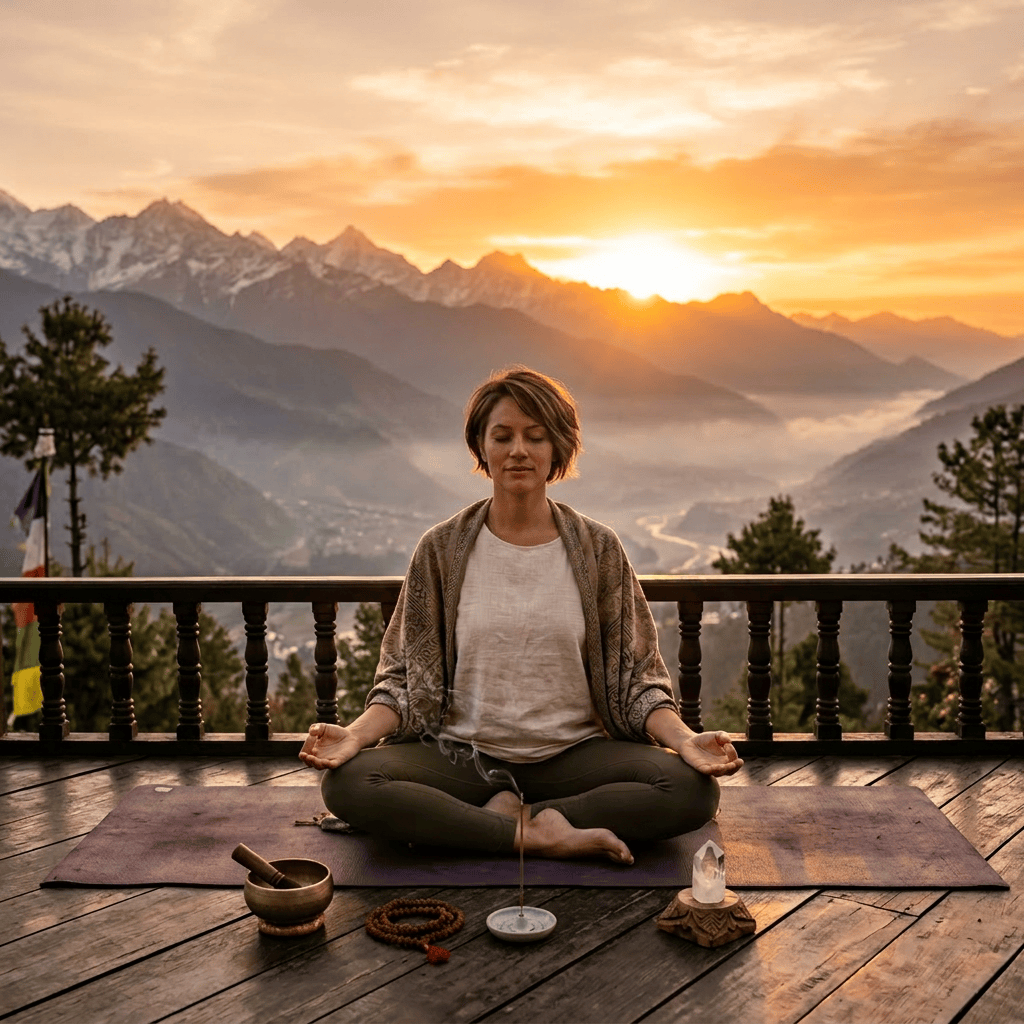
A woman meditates peacefully at sunrise overlooking snowy mountains
Self-care and soul care are not opposites. They are partners. One tends to the body and mind; the other nourishes the deepest part of who you are.
Self-care is the practical maintenance of your physical and mental health. It is the everyday-important maintenance necessary to keep your human body functioning:
Like getting enough sleep and eating nourishing food
Moving your body through exercise or gentle stretching
Setting boundaries
Taking mental health days or seeing a therapist
Managing stress with meditation apps, journaling, or hobbies
Some people see these actions as soft, but: self-care is accessible, measurable, and often immediate in its results. A good night’s sleep or a walk outside can shift your mood and energy quickly.
However, it can just be superficial. You can drink all the celery juice in the world and still feel empty if you are ignoring bigger questions about meaning, purpose, or connection.
Soul care is the intentional nurturing of your inner life—your spirit, values, sense of purpose, and connection to something larger than yourself. It is less about doing and more about being.
Soul care asks deeper questions like “am I living in alignment with what truly matters to me?” and “where do I find meaning?” How are you caring for your relationships (what truly matters to me) and your creativity etc?
These questions can be answered by prayer or meditation. Ultimately you need to be fully present— thus you can ask these questions during the time you spend in nature or your creative expression (music, art, writing, even reading some kind of wisdom— maybe even some poetry).
Soul care addresses the root causes of burnout and emptiness. This is why most are now opting for easier and more peaceful lives. It builds resilience that lasts beyond whatever happens next in your life
Soul-care can feel vague or inaccessible if you are in survival mode. You sometimes need self-care (rest, nutrition, safety) before soul care can be achieved.
Most people need both, you need to think of yourself as a three-part being: body, mind, and soul. Neglect any part and the whole suffers: you can have glowing skin and perfect sleep but still feel like something essential is missing and you can have profound spiritual experiences but crash hard if you are not eating or sleeping (this one kind of hits).
Crashing out…
Someone in a season of grief might find that bubble baths do not touch the ache, but journaling prayers, walking in the woods, or gathering with loved ones for honest conversation begins to heal the soul.
Create white space — Schedule unstructured time with no screens or agenda. Let your mind wander.
Reconnect with wonder — Watch a sunset without photographing it. Listen to music that moves you.
Examine your values — Ask: What would I do if money and approval were not factors?
Nurture relationships — Prioritize deep conversations over transactional ones.
Practice presence — Try centering prayer, breathwork, or simply sitting in silence daily.
Start small. Soul care does not require a retreat in Bali (though those can be wonderful). It can happen in ten quiet minutes before bed.
Self-care keeps the lights on. Soul care makes the house a home.
You do not have to choose. Begin where you are. If you are burned out, lean into self-care. Then you can let soul care deepen the work.
The most beautiful lives are never just productive or Instagram-perfect—they are integrated. Healthy bodies and minds supporting rich, purposeful souls.
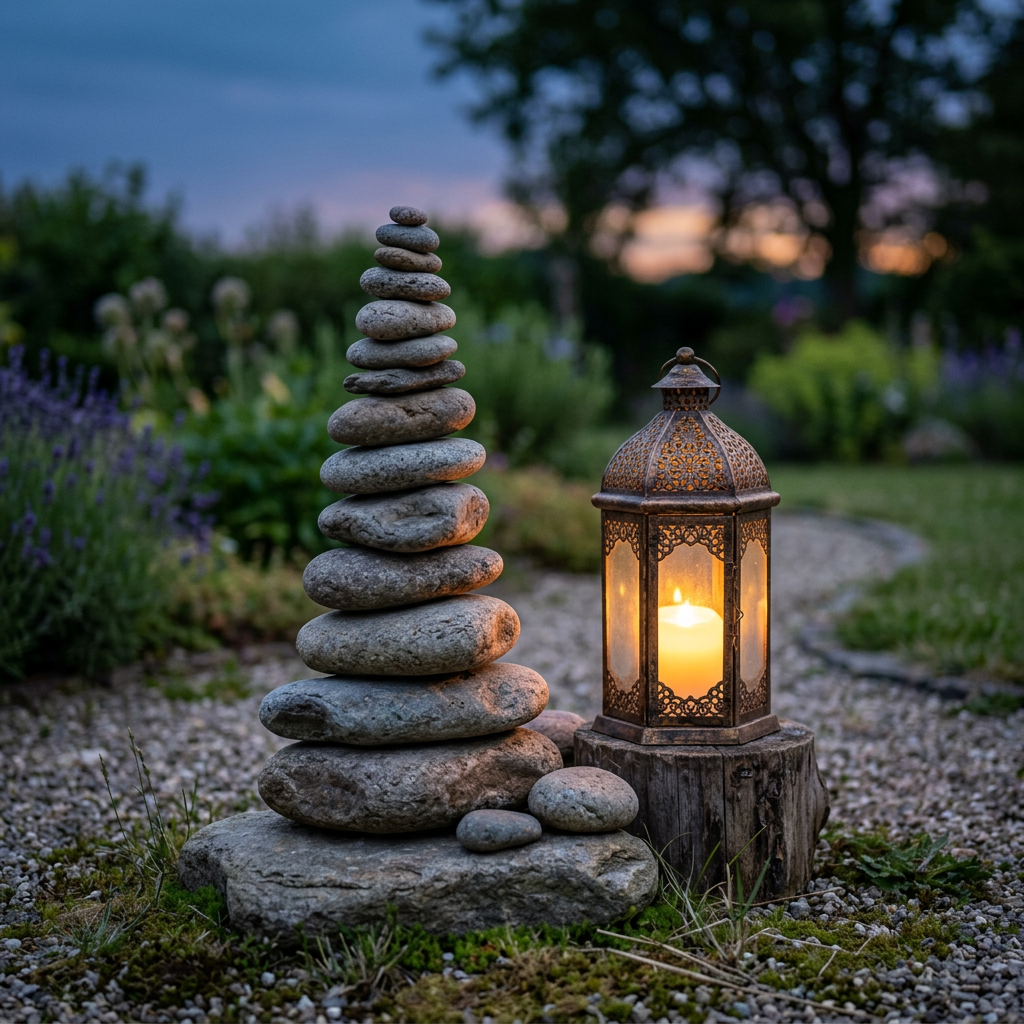
A balanced stack of smooth stones next to a glowing candle lantern in a garden at dusk.
The kind of life that would finally allow me to fully exist is:
• A life with him: there is no such thing as “focus on yourself first” as I have found that being dedicated to the love of my life does so much for me. My soul recognizing its favorite home. Everything I thought I needed to “work on” in isolation suddenly becomes irrelevant because the thing that was actually starving me was the absence of him. This life brings me much more joy and happiness than getting whatever I want delivered to my doorstep etc. Being together physically makes my entire soul let out a giant sigh of relief.
I do not want to be a self-sufficient island. I want to be his. Fully, stupidly, unapologetically his. I want the version of me that only exists when I am pouring into someone who pours back. That version feels more alive than any solo “healed” version I have ever performed.
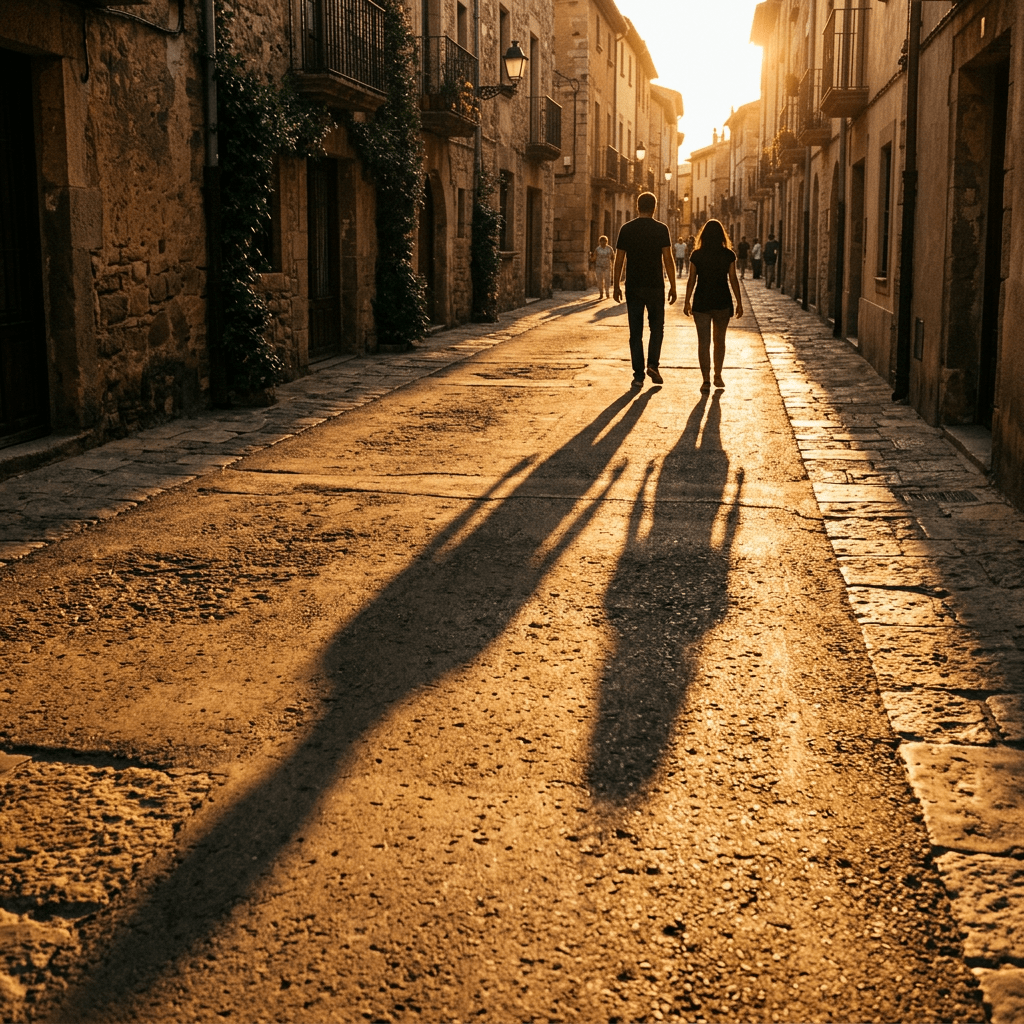
Two people walk down a sunlit old stone street casting long shadows.
• Able- bodied life: And yes, I want the body that can actually meet that life.
All in all, I am not interested in the gentle, realistic, disability-acceptance script everyone tries to hand me like a participation trophy. I do not want to “redefine beauty” or “find new ways to move through the world.” I want my left side to cooperate again. I want to walk for miles without calculating how much pain I am willing to trade for the view. I want to put on a pair of stilettos and feel my hips sway instead of my balance negotiate with gravity. I want to hold his hand on a long hike and not have to pretend the cane is some cute accessory.
Doctors and well-meaning realists can keep their timelines and their “you’ll probably always need…” speeches. The universe is not running a charity. It is not on a budget. If I can imagine my fingers threading through his while we walk through tall grass at golden hour, if I can see myself in the kitchen moving freely, cooking for the man I chose, then that version is already on its way. I am not manifesting from a place of lack. I am remembering forward. My arms will work. My balance will hold. I will be the woman who can be a proper wife to him without negotiating with my own nervous system every time I stand up.
• Warm and sunny life: There is something about the amount of dopamine and serotonin I get from the sunshine. Plus I am forever freezing so I would rather survive somewhere naturally warm than have my man pump in synthetic heat for the majority of the year. I want mornings where the light pours through the windows onto our bed and neither of us has to reach for a sweater.
• Unemployed life:while I do love writing ; let it be my own little hobby. I refuse to let my words turn into another job that pulls me away from him. In order to fully dedicate myself to my man, I will not to answer to anyone else/ have any stress or anxiety running through my veins. Girls are meant to live easy and whimsy little lives. I want to be the woman who makes his house feel like home instead of the woman who comes home exhausted and has nothing left to give.
• Childless life: I am an incredibly selfish person and I know that I will always put me and my man first. Unfortunately I know what it is like to be completely ignored/ neglected by a parent and I will never wish that kind of pain and suffering upon a child, but I know that my personality is to do just that.
So no kids. Not as some enlightened childfree flex. Just as the only honest choice I can make. Better an empty house than a child who grows up feeling like an afterthought.
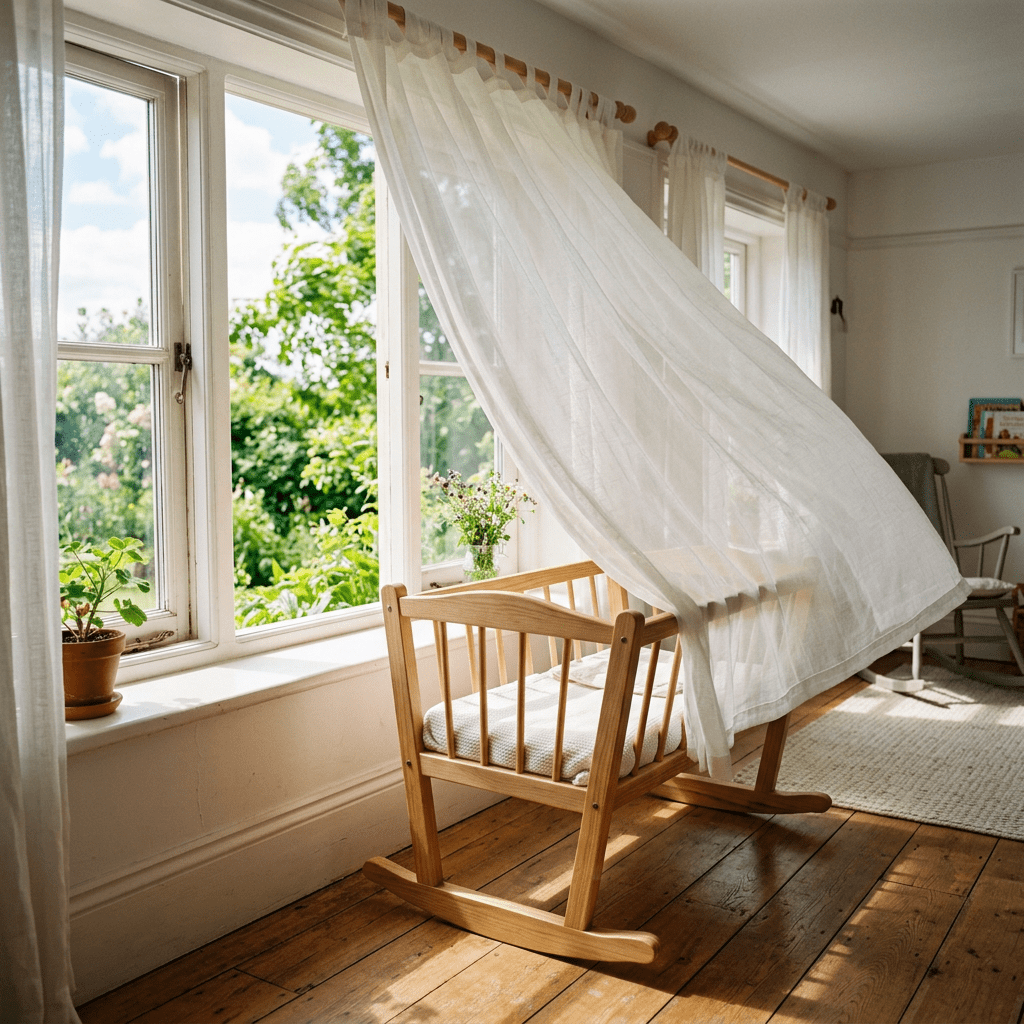
A cozy wooden rocking cradle sits by a bright window with sheer curtains flowing in the breeze. Empty cradle= freedom (for me personally)
This is the life that would finally let me exist instead of survive.
Him. Walks. Sunshine that actually warms me. No boss, no inbox, no tiny humans I would inevitably fail. Just the two of us in a warm house where my body works, my soul is quiet, and I get to pour every single drop of myself into the only thing that has ever made the noise stop.
Call it codependent. Call it regressive. Call it whatever makes you feel better about the life you settled for.
I am not settling anymore. I am asking for the whole thing. And I am not ashamed of how badly I want it.
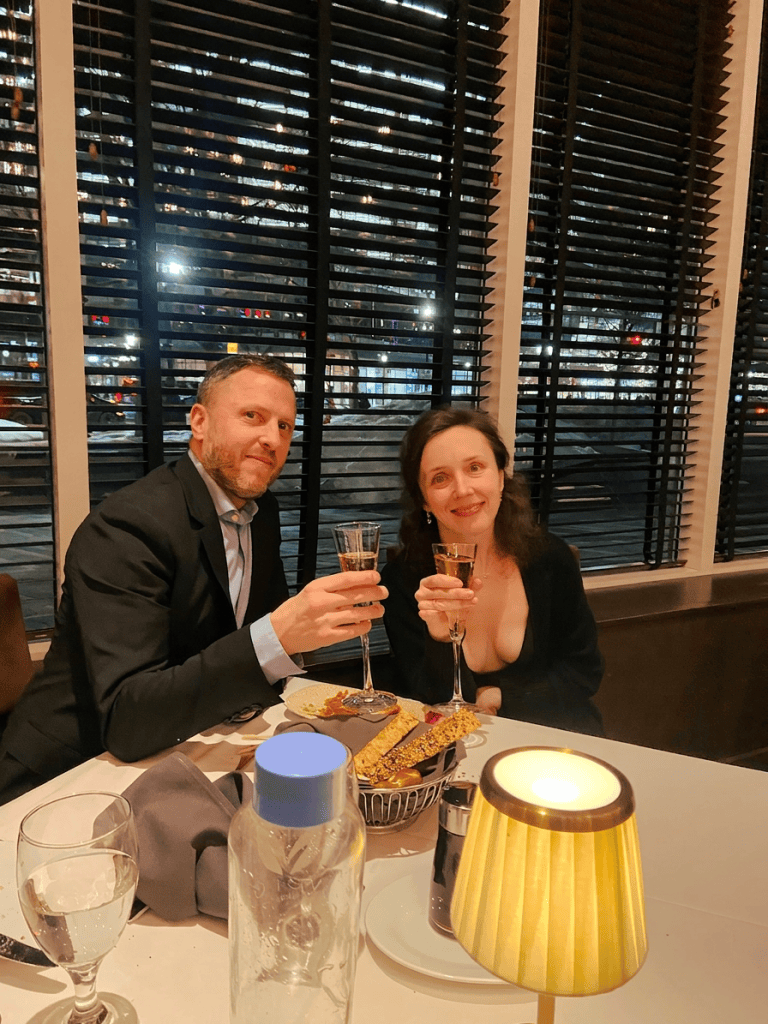
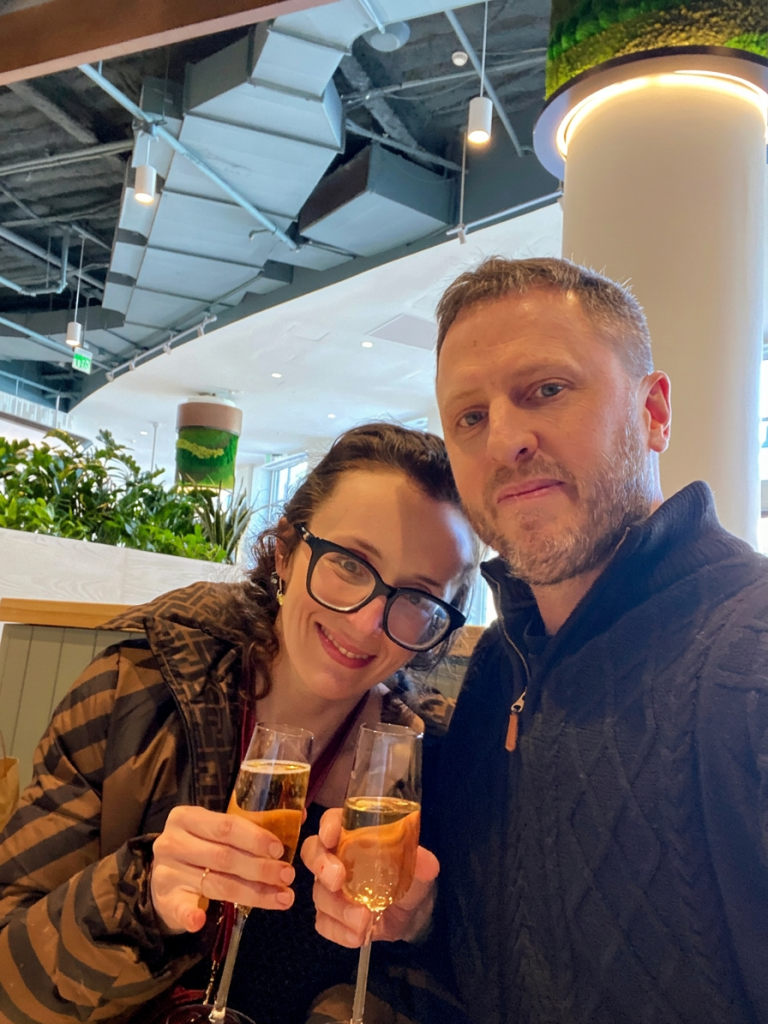
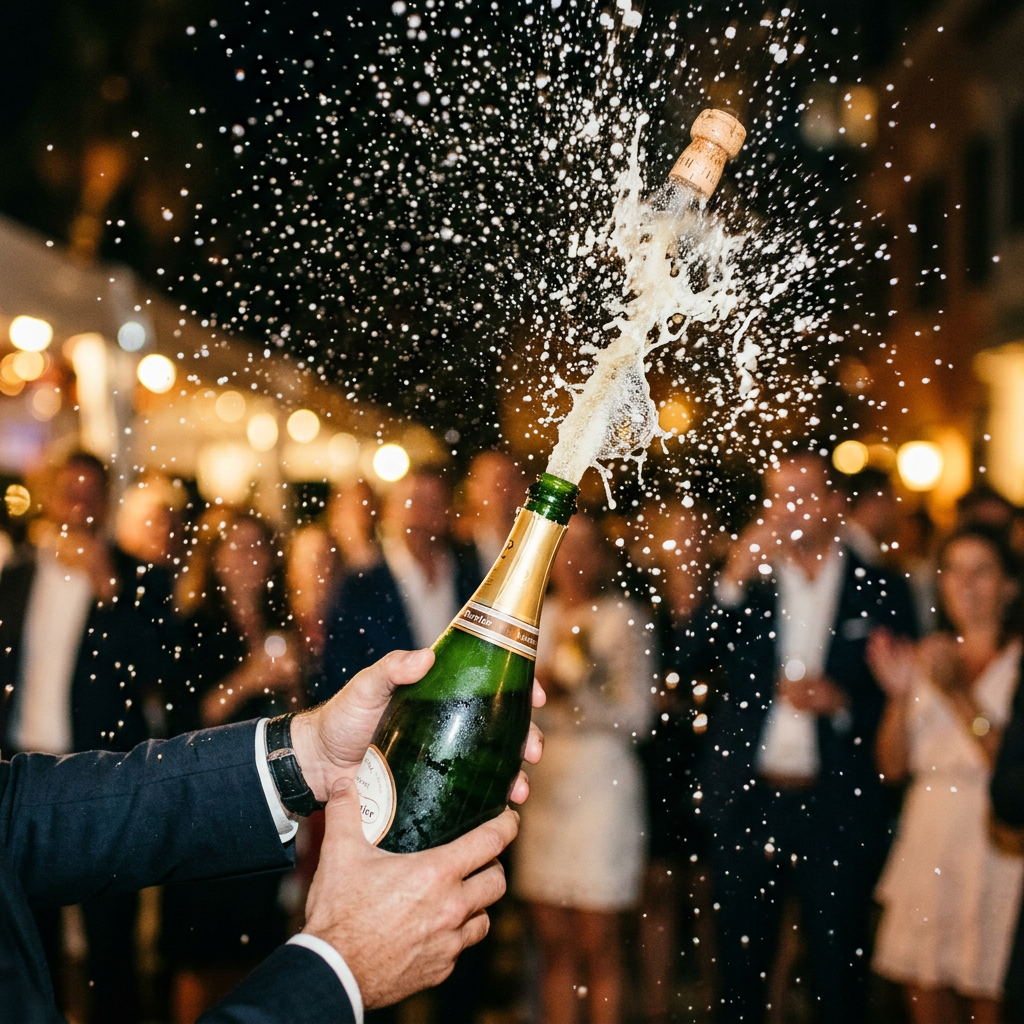
The wellness industrial complex has it wrong. While everyone else is out here microdosing mushrooms and journaling their feelings, my boyfriend and I have discovered the ancient, time-tested secret to actually enjoying this ridiculous existence: popping bottles like the world owes us a party. And it kind of does.
Every single time we get to steal a few days together in this soul-crushing timeline, we treat it like the main event (I still remember how loudly I celebrated when he uncorked our first bottle!) Not “date night.” Not “quality time.” A full-blown, no-apologies celebration. We live for collecting moments and creating memories.
Because if you are not celebrating the fact that you both made it through another timeline without each other— does anything really matter?
I had to personally educate my man on the sacred hierarchy of bubbles. Champagne is not just “fancy sparkling wine.” It is the French aristocrat with a protected designation of origin. The bubbles were originally an accident as the fermentation process caused stored wines to explode, delivering that signature toasty, brioche-y complexity and those aggressive, fine bubbles that taste much more superior than synthetically created ones. Prosecco is the fun, flirty Italian cousin — brighter, fruitier, cheaper, and happy to show up to literally any occasion without an attitude. And then there is generic sparkling wine, the chaotic neutral workhorse that gets the job done when the good stuff is sold out or you are feeling budget-conscious.
We now exclusively order and stock the goods. Delivery drivers, grocery stores, bars or restaurants we are forever part of some elite sparkling wine cartel. No more settling. Life is too short for mid bubbles.
And yes — my boyfriend occasionally does shots with my father. Because bonding. Because tradition. Because nothing forges that sacred father-in-law/son-in-law alliance quite like grimacing through a round of vodka while pretending they are not both slightly terrified of each other. I sit back with my drink and watch these two grown men bond over the universal language of “let’s burn our throats and talk about Trump so we don’t have to talk about feelings.” It is disgusting. It is wholesome. It is peak masculinity.
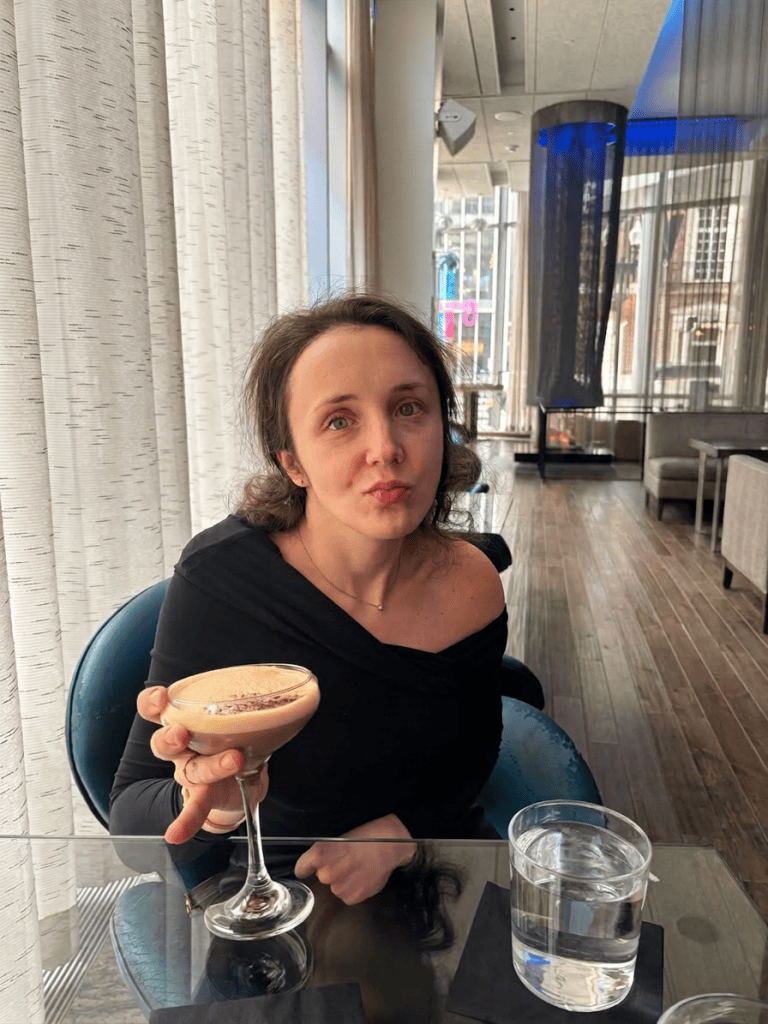
I on the other hand am a disciplined one-espresso-martini woman. That perfect, caffeinated, slightly dangerous little monster in a martini glass. One is elegant. The rest of the drinks are for celebration purposes only.
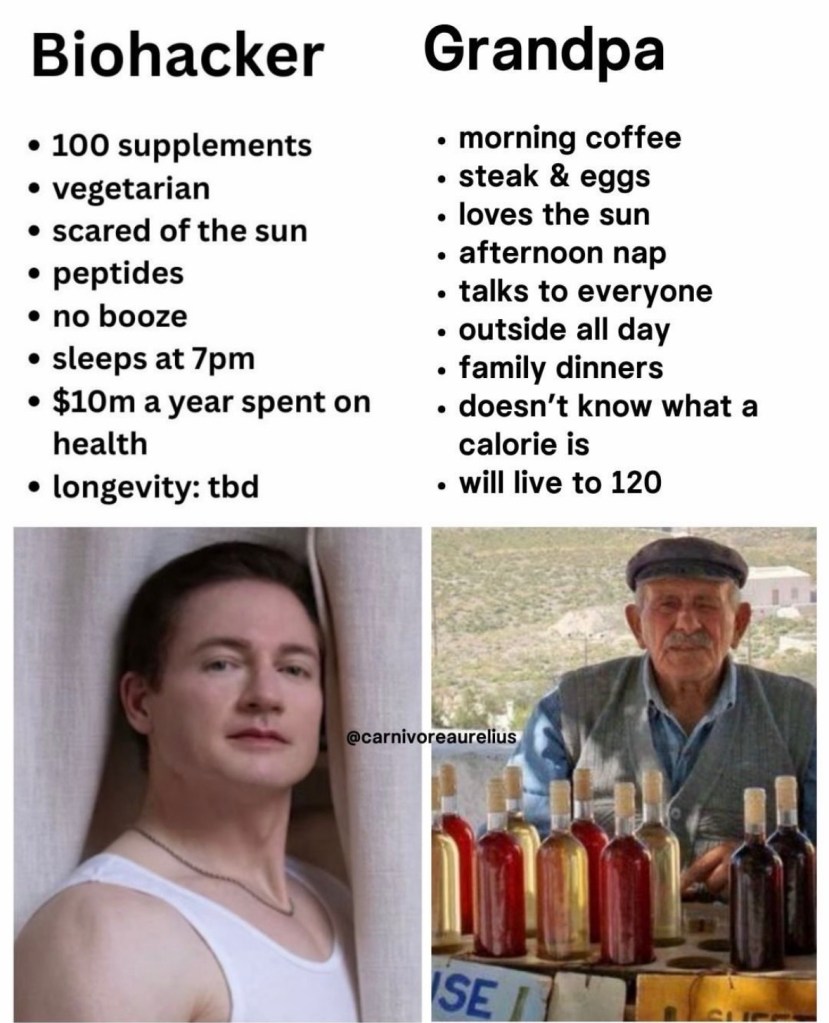
This is what the sobriety police failed to understand: drinking is how we weaponize joy against the void. Why would I care if alcohol prematurely ages my cells when my man is forever babying me and making my life silly, fun and easy? It pushes us to create more memories and experiences.
It turns ordinary moments into legendary ones. That random dinner I made becomes “the night we popped the good bottle and laughed until we cried.”
It lowers the volume on the noise. The anxiety of not being together, the overthinking, the endless mental tabs open in my brain — alcohol (and him) is the world’s most reliable (if imperfect) volume knob.
It creates actual memories instead of just content. Sobriety is great for optimization. But you know what is better? Happiness. Celebrating that happy moment is great for living a story worth telling.
It is rebellion in a glass. Every time you choose celebration over optimization, you are flipping off the wellness grifters— your sleep scores and your hormone levels do not provide a full picture of how your life is going to go.
Two people clink champagne glasses on a terrace overlooking a coastal sunset town.
Life is already one giant, absurd, painful, hilarious win just by virtue of you still being here. The universe is actively trying to humble you every single day. Might as well humble it back with some bubbles and bad decisions that turn into good stories.
So yeah. We drink. We celebrate. We treat every shared hour like it is New Year’s Eve because the alternative is pretending this is all very serious and we should be optimizing our sleep scores instead of making questionable choices with each other.
A champagne bottle is popped open, spraying bubbly foam at a festive gathering.
Pop it. Live a little. The sober police will still be there tomorrow, miserable and well-rested.