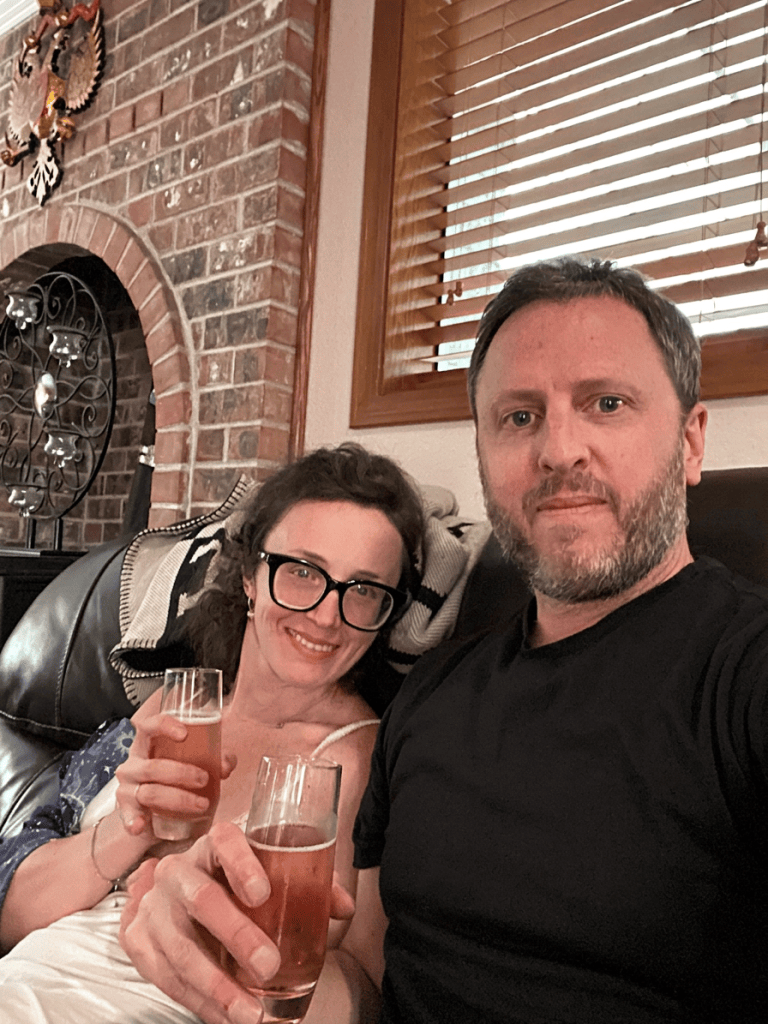
I spent the entire weekend alone—rotting on my chair while my boyfriend was up in Maine. Laptop open, Bridgerton on, snacks within reach, and almost no intention of moving. It was the kind of low-effort weekend that feels indulgent precisely because nothing productive happens.
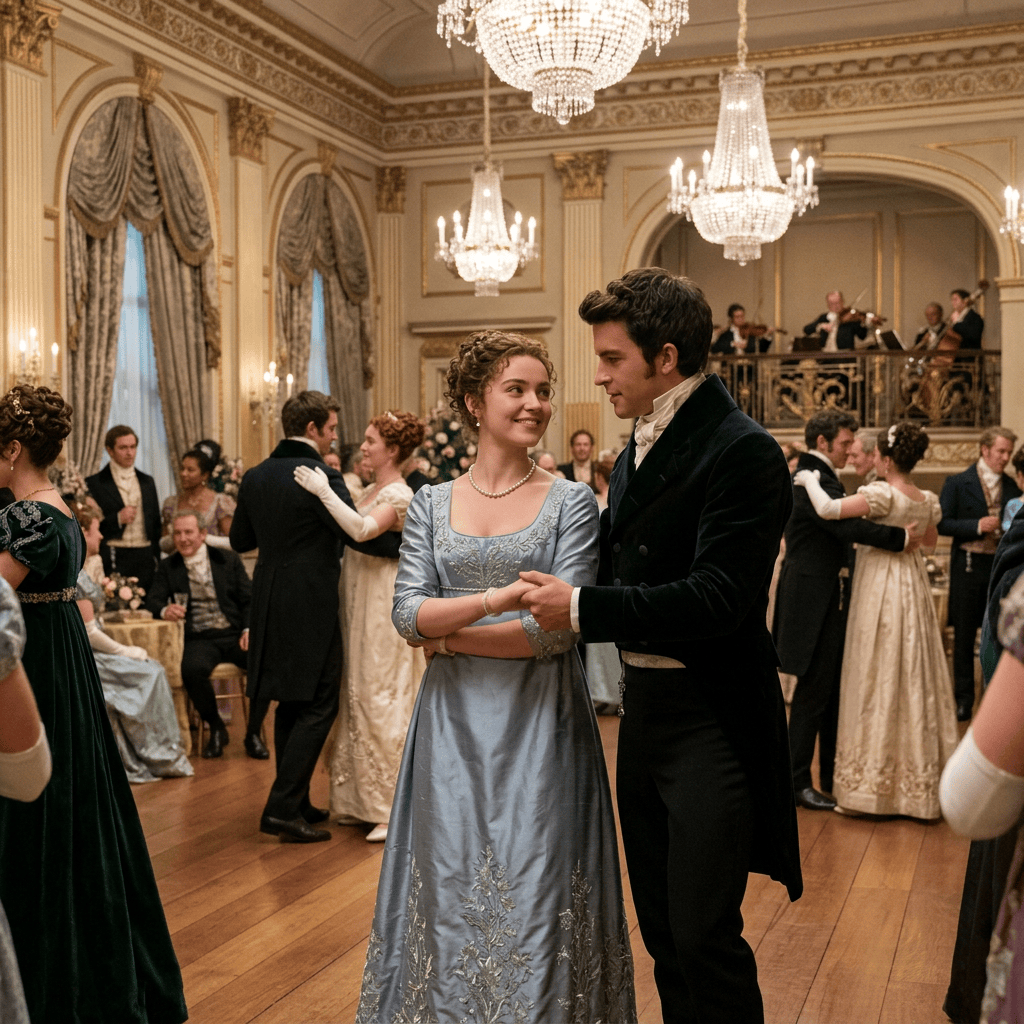
A young couple shares an elegant dance at a lavish Regency-era ballroom.
What pulled me in was the surface of the thing. The show sells an upscale world of ladies and gentlemen, drawing rooms, formal calls, gossip columns, and carefully managed reputations. I like that register. The costumes, the houses, the rules of the marriage market, the idea that desire has to move through manners—that is the lifestyle fantasy I actually wanted. Season 1, centered on Daphne Bridgerton and the Duke of Hastings, delivered the version of it I came for: a rake with a reputation, a debutante who is sharper than she looks, and a romance that spends a long time circling the tension before it pays off. That was the sexiest of the storylines to me, and the one I stayed for.
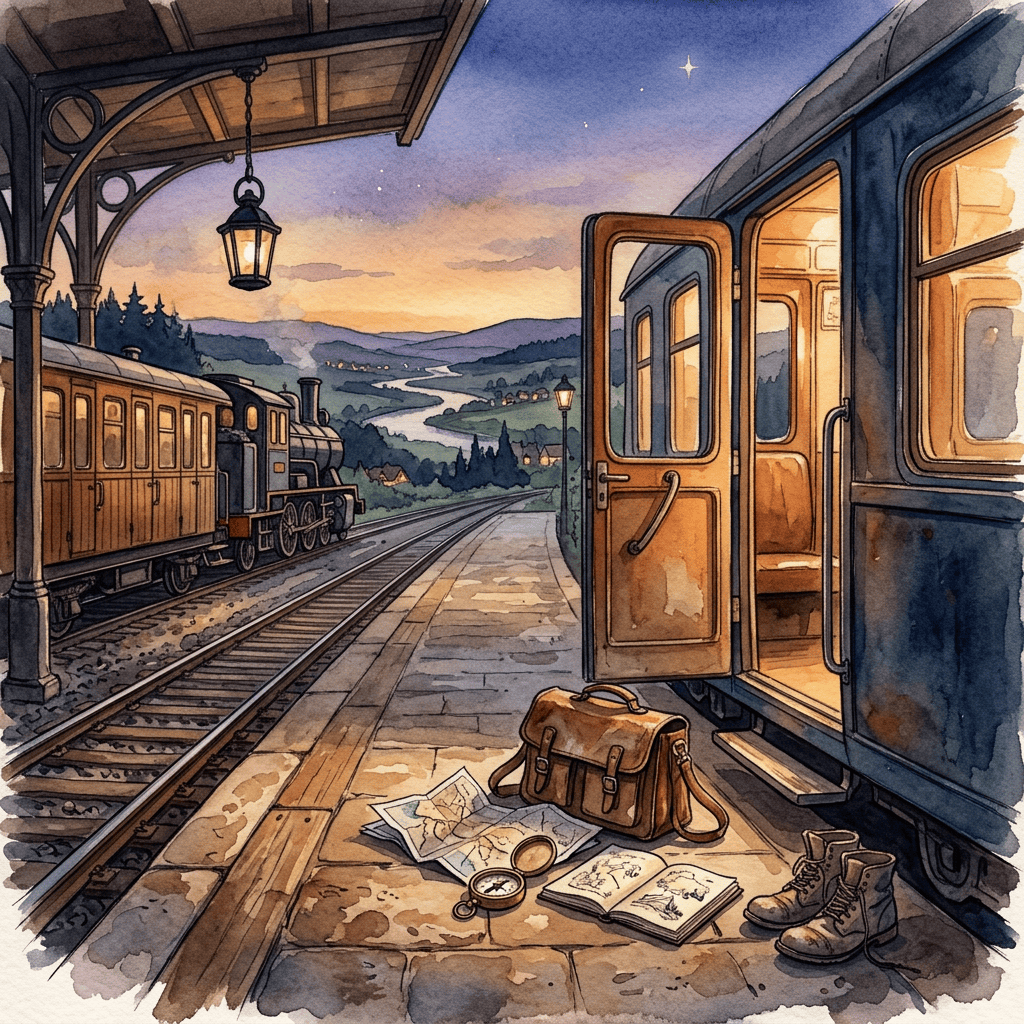
An open wooden door reveals a warmly lit sequence of rooms in an aged interior.
The rest of the framing was harder to ignore. The series is a Shonda Rhimes production, and it is very woke in the specific way her projects tend to be. The most obvious example is the decision to depict Black characters as royalty and members of the highest aristocracy in a Regency setting, without treating that as a departure from history or even as something the story needs to explain. The show wants the balls, the titles, the inheritance plots, and the social season, but it also wants a modern casting ideology laid over them. Even though the blacks were more likely slaves in the 1800s. Once you notice it, it sits on top of every scene. I was not looking for a lecture about representation inside a costume drama;I was looking for the rake and the love story.
That is also why I am not continuing. Each season shifts to a different Bridgerton sibling and a new central romance. The Duke’s arc was the one that held my attention, and once it resolved I had no particular reason to stay for the next set of characters. The aesthetic is still pretty, the snacks were still there, and the weekend still passed. Like in life,I do not need another season of the same world once the part I actually wanted is over.
What’s the most spontaneous thing you’ve ever done?
I believe in spontaneity—flying by the seat of your pants. You feel it. Then you do as Nike says and just do it.
There is a particular electricity in deciding before the mind has time to assemble a committee. Before you can overthink. The body knows first. A sudden urge to love someone, take a different road home, to say yes to a last-minute invitation, to start the thing you have been circling for months. Spontaneity is not chaos for its own sake. It is trust that the present moment contains more information than the spreadsheet you made last Tuesday.
Over-planning has its place. Maps are useful. Budgets matter. But when every decision is pre-approved by fear of looking foolish or wasting time, life flattens into a sequence of safe rehearsals. You end up living a well-organized version of someone else’s idea of a good life. The seat of the pants is less dignified and far more honest. It is the part of you that still remembers how to move before it has justified the movement.
Nike’s slogan works because it is almost insultingly simple. “Just Do It” does not promise a perfect outcome. It does not require a five-year vision board (although I make one every year) or a mood board or a detailed risk assessment. It assumes the feeling is already there and that hesitation is the only remaining obstacle. The phrase is a permission slip to act while the spark is still hot.
That spark is fragile. Wait long enough and the inner critic arrives with questions: Is this practical? What will people think? What if it fails? By the time those questions are answered, the original impulse has usually cooled into a memory of something you almost did. Spontaneity is a race against that cooling.
This does not mean every whim deserves obedience. Some impulses are hunger, boredom, or avoidance wearing a costume. The useful distinction is between the cheap thrill and the deeper yes—the one that arrives with certainty rather than a loud craving. You learn the difference by acting often enough to notice the aftermath. Some spontaneous choices leave you lighter. Others teach you what not to do next time. Both are data.
People who live this way collect stories instead of regrets about missed chances. They remember the night they stayed online and met someone who changed their trajectory. They remember booking the ticket before the price went up and before they talked themselves out of it. They remember starting the project on a Tuesday afternoon because the idea would not leave them alone. The planned life can be admirable. The improvised one tends to be more alive.
There is also a humility in it. Flying by the seat of your pants admits you do not have the full picture and that you are willing to find out by moving. Perfectionism pretends otherwise. It waits for certainty that never quite arrives. Spontaneity accepts that some of the best decisions look reckless from the outside and inevitable from the inside.
So when the feeling comes—clear, uninvited, a little inconvenient sometimes —treat it as information rather than an interruption. You do not need a manifesto. You need a small act of follow-through. Feel it. Then just do it. The rest of your life writes itself after you start moving.
My Red Sox lost in the Wild Card series—on the road to the World Series so let me focus on something else…
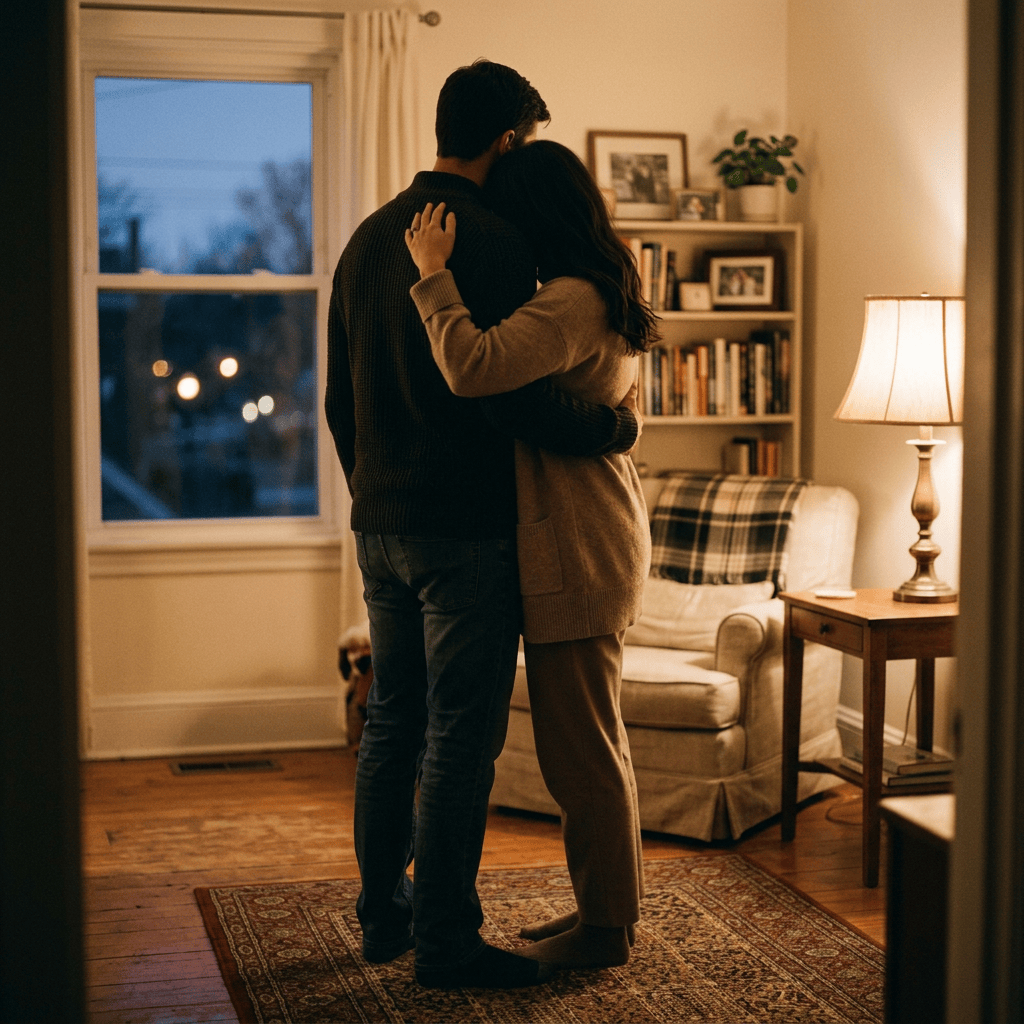
I feel at home in his arms.
Not the kind of home with the walls all scratched up via my wheelchair or the kind you decorate for the holidays. The kind that arrives after years of being in doorways that never quite opened. When he holds me, the rest of the world does not disappear so much as it loses its sharpness. The noise thins. My shoulders drop. My breath remembers how to land instead of hover. I actually smile. I am not performing calm. I am not bracing for the next disappointment. I am simply there, against him, and that is enough.
For a long time I dreamt of a love like this without knowing its shape. I only knew the absence of it. I knew the particular ache of lying awake and feeling too much and not enough at the same time. Anxiety has a way of making a person feel both crowded and abandoned. Loneliness does the same. I spent years searching for someone who could ease that double weight, not by fixing me, but by staying close enough that I no longer had to carry it alone.
I looked in the usual places and in the desperate ones. I learned how to hope carefully, which is another way of saying I learned how to protect myself with hope. There were nights I cried until my body felt wrung out, not because one particular person had failed me, but because I could not shake the suspicion that I was the problem. That I was too much. That I was not enough. That the kind of love I wanted existed only in stories written for other women.
Then we met online. I was not searching for anything. Neither was he.
It did not arrive like fireworks. It arrived like recognition. Conversation after conversation, something in me unclenched. He did not rush to complete me, and I did not have to shrink to be understood. I could tell him about the trembling parts of myself without watching him look for the exit. For the first time in years, the old story began to loosen: the story that said my loneliness was proof of my unworthiness, that my anxiety made me unlovable, that I would always be waiting just outside the warmth.
I started to believe, slowly and almost against my will, that the long season of crying might actually have an ending.
When we finally met in person, the body confirmed what the heart had already begun to trust. There is a difference between imagining a person and standing close enough to feel the heat of them. There is a difference between written affection and the moment a hand finds the small of your back and stays there. I had wanted this for so long that part of me expected to freeze, to second-guess it, to ruin it with my own fear. Instead I felt something simpler and more startling: relief.
Eventually he held me.
Not as a gesture. Not as a performance. He held me as if he had been waiting for the same thing, as if my body was not a question he needed to solve but a place he already knew how to inhabit. I melted. That is the only honest word for it. The tightness I had worn for years softened. The girl who used to apologize for needing comfort stopped apologizing. In his arms I was not a collection of old wounds trying to look presentable. I was a woman being received.
He feels like a cozy home.
Unfortunately, I still know what loneliness feels like. I still know the old reflex of bracing. But now I also know this: there is a kind of love that does not ask you to earn rest. There is a kind of holding that tells the nervous system, at last, you can come down from the watchtower. I dreamt of that love for years. Then I met him. Then he put his arms around me, and for the first time in a long time, I felt like I had arrived.
Have you ever liked a villain more than the hero? Who and why?
I have always preferred the villain.
Not in the cheap, poster-on-the-dorm-wall way. Not because of the dominatrix vibes— leather looks good in low lighting— or because a monologue about destiny is more interesting than a speech about believing in yourself. I prefer the villain because the heroine keeps asking me to pretend I am someone I am not.
You know the one. She sings to animals. Birds land on her finger as if they have been waiting all morning for the privilege. Mice stitch her a dress. Squirrels pause mid-scamper to receive her wisdom. She is luminous, unguarded, and permanently slightly out of breath from all the hope. My own mother talks to the squirrels we see out the window. She does it with genuine warmth, the way some people bless the mail. I would never. I watch the same squirrel, note that it is fat and opportunistic, and go back to whatever I was doing. That is the distance.
I am, for the record, extremely optimistic. A vibes gal. I am generally whimsical. I believe in second chances, late-night plans that should not work, and the possibility that something beautiful is still unfolding even when the evidence is mixed. I am not cynical. I am just not going to perform enchantment on command. You are far more likely to find me rolling my eyes and swearing under my breath about the thing that is actually happening than composing a verse about how the forest loves me.
The classic heroine often feels like a demand. Be bubbly. Softer. Be more grateful. Be astonished by ordinary animals. Let the world rearrange itself around your goodness. The villain, by contrast, rarely asks you to lie about your temperature. They are allowed to be irritated. They are allowed to want something specific and then pursue it with unpretty competence. They notice the machinery. They do not pretend the castle is kind just because the lighting is flattering.
That is the real seduction. Not evil. Attention.
Heroes in the old template are frequently written as if awareness itself were a moral failing. To see the cost of the system, to name the bargain, to refuse the song—that is framed as corruption. Villains get to keep their eyes open. They get strategy. They get a private language. They get the dignity of not having to make every feeling edible for an audience of woodland creatures.
I do not actually want to poison the kingdom. I want permission to be complicated without being recast as the problem. I want a character who can love the world and still find it faintly ridiculous. Who can be hopeful and still say, out loud, that this particular meeting, this particular speech, this particular expectation that I will melt at the sight of a deer is nonsense.
There is a version of “relating to the villain” that is just edgelord cosplay. That is not what I mean. I mean the relief of a figure who does not require me to flatten my voice. The heroine’s sweetness is often a costume the story needs her to wear so the plot can stay simple. The villain’s sharpness is frequently just the story admitting that people have interiors.
My optimism is not the singing kind. It is the kind that survives the eye-roll. It is the kind that swears, then keeps going. It looks at the squirrel and thinks: impressive little opportunist, truly, and also I am not having a conversation with you. That is not bitterness. That is proportion.
So yes. Give me the one in the darker coat. Not because I want the throne (although I do). Because I want the room to be a person who can see the joke, keep the hope, and still refuse to perform a duet with the wildlife. The forest can keep its chorus. I will take the character who notices the wiring.
I miss him in a way that settles into the bones. It is not a passing ache or a fleeting thought that comes and goes with the weather. It is the kind of missing that lives in the quiet hours, in the space between one day and the next, in the moment just after I close my eyes and just before I open them again. I wish more people understood how much it hurts every time I have to kiss him goodbye. Those goodbyes are never casual. They are small ruptures. Each one feels like tearing something tender that has only just begun to knit itself back together. The kiss is soft, familiar, full of everything we cannot say out loud in the time we have, and then it is over, and I am left in the aftermath of it, carrying the weight of the next stretch of distance.
For many years I lived with an extremely lonely and broken heart. That is not poetry. It is simply what it was. I was miserable in a deep, unshowy way that does not photograph well and does not invite easy comfort. The kind of misery that makes ordinary mornings feel like work. Everyone abandoned me when I got sick. I do not say that for drama. I say it because it happened. People I thought were permanent grew distant, then silent, then gone. Some left because they did not know what to do with illness. Some left because my world became smaller and less convenient. Some left because I changed.
Yes, I formed my own opinions. I stopped performing the version of myself that made other people comfortable. I became sharper in places, quieter in others, less willing to pretend that everything was fine when it was not. That may have alienated people. I accept that now with less bitterness than I used to. At the time I did not have the purpose or the desire to heal and get better. Healing requires a reason to stay in the fight, and I did not have one. Everything seemed worthless. The future felt like a hallway with no doors. Effort felt pointless. Getting out of bed felt like an argument I kept losing.
Until now.
It has been nearly four years since my man and I physically met. Three years before that were full of screens and voices and the strange intimacy of people who know each other’s silences before ever even touching. That number still surprises me when I say it out loud. We have not had the ordinary accumulation of shared rooms, shared meals, shared weather. What we have had instead is his constant support and his steady encouragement. He did not arrive with grand speeches or easy fixes. He stayed. He listened when I had nothing graceful to offer. He reminded me, again and again, that I was not as finished as I believed I was.
That kind of presence does not transform a life overnight. It works incrementally. A little more willingness to try. A little more belief that effort might not be wasted. A slightly firmer sense that my status in life is not fixed in the place where illness and loneliness left it. I am not writing this from a mountaintop. I am writing it from the middle of the climb, still missing him, still feeling the sting of every goodbye, still carrying the old loneliness in certain rooms of myself. But I am no longer living as if everything is worthless. That shift matters more than I once thought it would.
I miss him. I will keep missing him until the next time we can close the distance, however briefly. And when that time comes, I will kiss him knowing exactly what it costs to let go afterward. I will do it anyway. Some things are worth the ache.
If you could relive one year of your life, which one would it be?
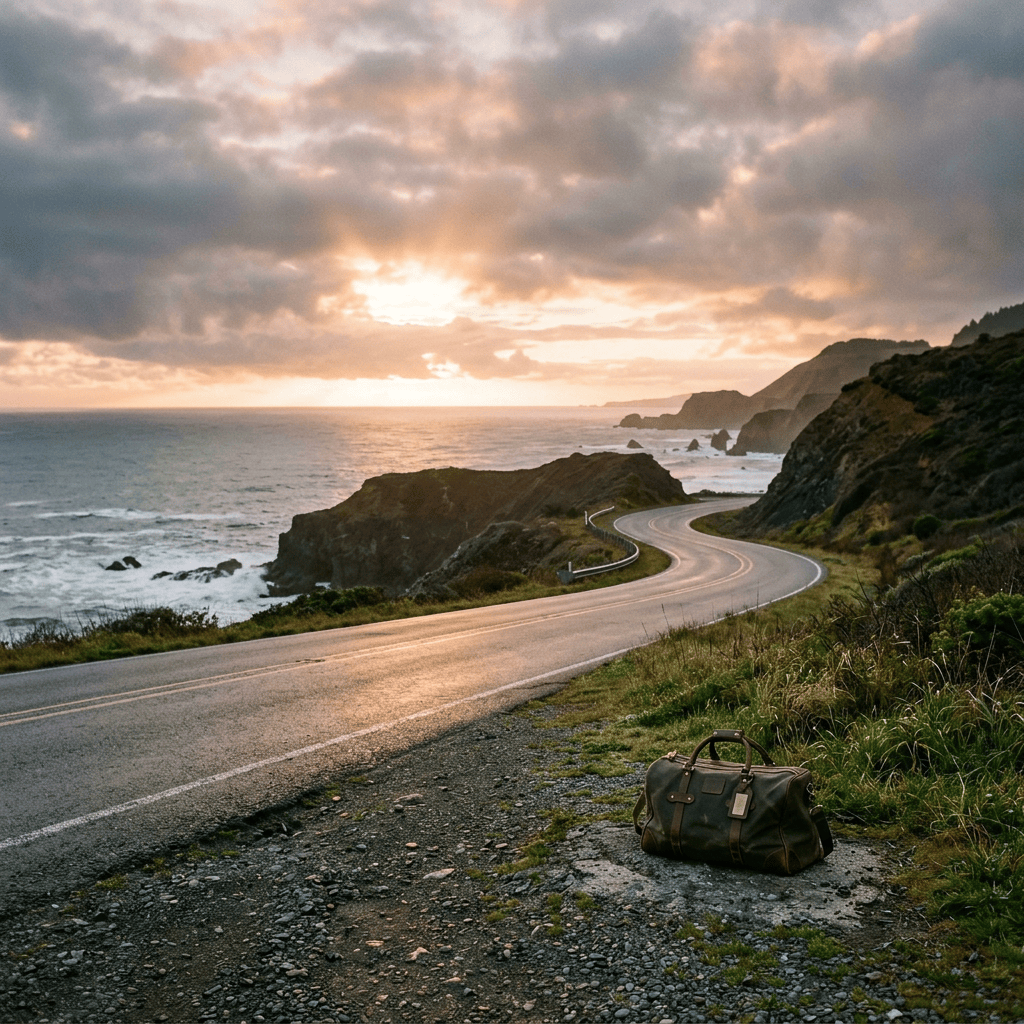
The year I would relive has not happened yet.
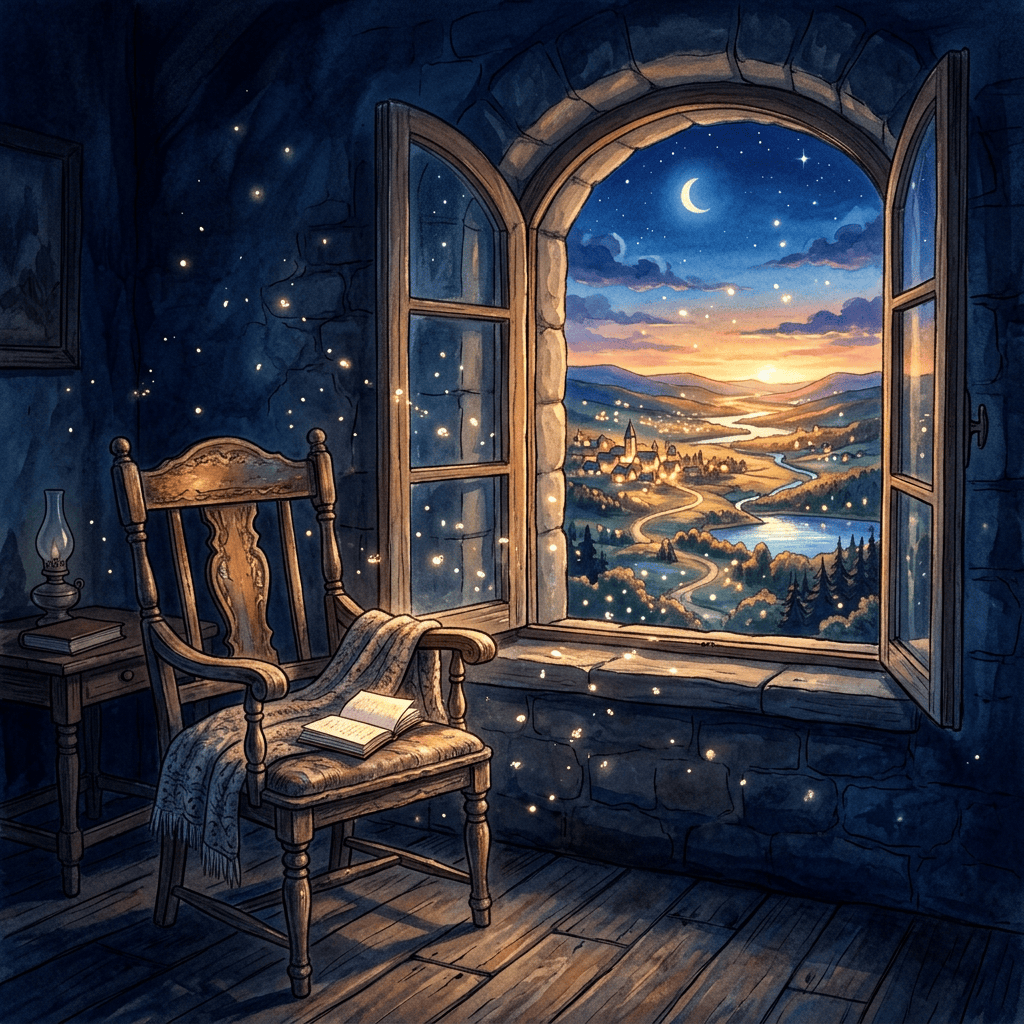
An open window reveals a moonlit valley while a cozy chair invites quiet reading.
I keep turning that sentence over in my hand like a stone I found on the beach. Smooth. Heavy. A little warm from being held too long. Most people, when asked which year they would live again, reach backward. The summer they were twenty-two. The winter everything still felt possible. The year before the diagnosis, or the accident, or the slow unfolding of whatever it was that rearranged their life. I understand the impulse. I have my own catalog of almosts and if-onlys. There always seems to be something I would like to change.
I would never do it though.
Glowing coral and gold lines converge across a moody blue textured background, evoking movement and inspiration.
I say that with the same half-superstitious firmness I use when I knock on wood. Everything happens for a reason. I have repeated the phrase so many times it has worn a groove in me. Some days it feels like wisdom. Other days it feels like a lullaby I repeat so I will not scream. Both can be true at once. The body learns to live with contradictions the way it learns to live with weather.
Still, I froth at the mouth when I envision my future.
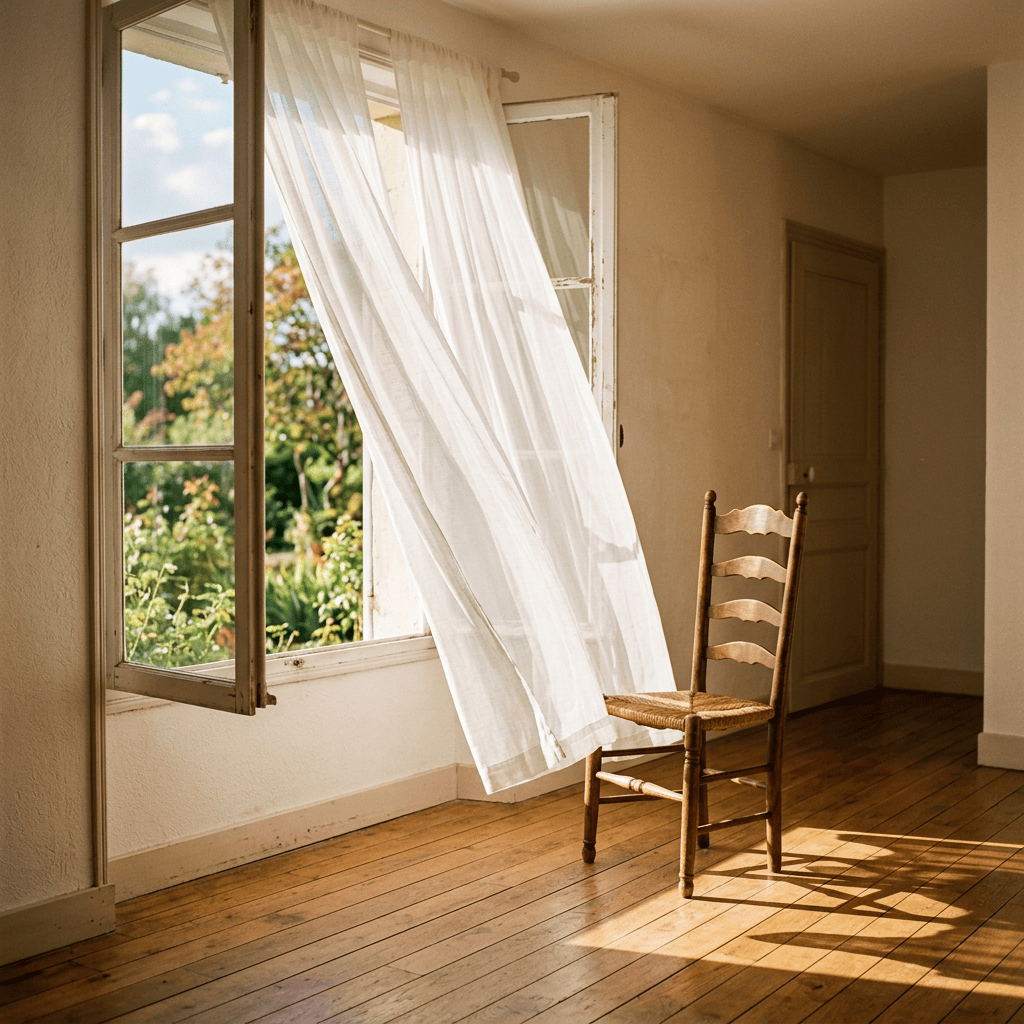
A vintage chair rests beside an open window as sheer curtains drift in the sunlight.
Not the glittering, cinematic future. Not the one with applause or sudden wealth or a body that has never known limitation. Just a simple little life. Ordinary in the way sunlight on a kitchen table is ordinary, which is to say: almost unbearable in its tenderness if you look at it long enough.
With him.
The sentence does not need embroidery. With him. The two words sit in the center of the picture like a house with the lights already on. I see the unremarkable days first: grocery lists, the sound of an espresso machine, the particular way someone who loves you says your name when they are only half awake. I see the quieter victories. Getting through a morning without bargaining with pain. Walking a little farther than last month. Laughing at something stupid and not having to pay for it later with exhaustion. A life that does not constantly announce itself as a project of endurance.
And without disability.
A luminous winding path flows through a dreamlike blue landscape toward the rising sun.
I write that last part carefully, because I know how it can sound. I mean the specific, private longing for a version of days that do not require so much translation. Days in which my body is not a burden Days in which the body is not the first negotiation. Days in which “simple” is actually simple.
I froth at the mouth thinking about it. The phrase is ugly and exact. Anticipation that is almost feral. Hope that has teeth. I am not serene about the future. I am hungry for it.
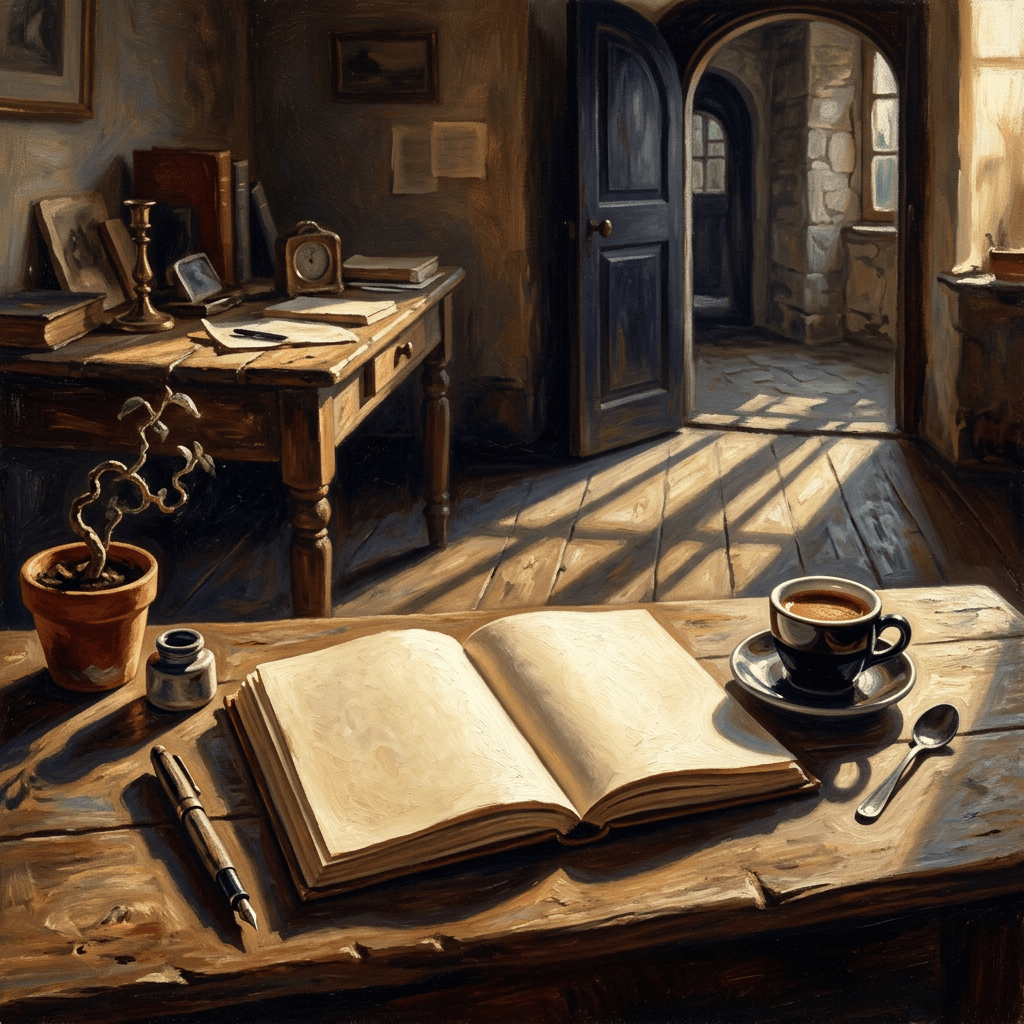
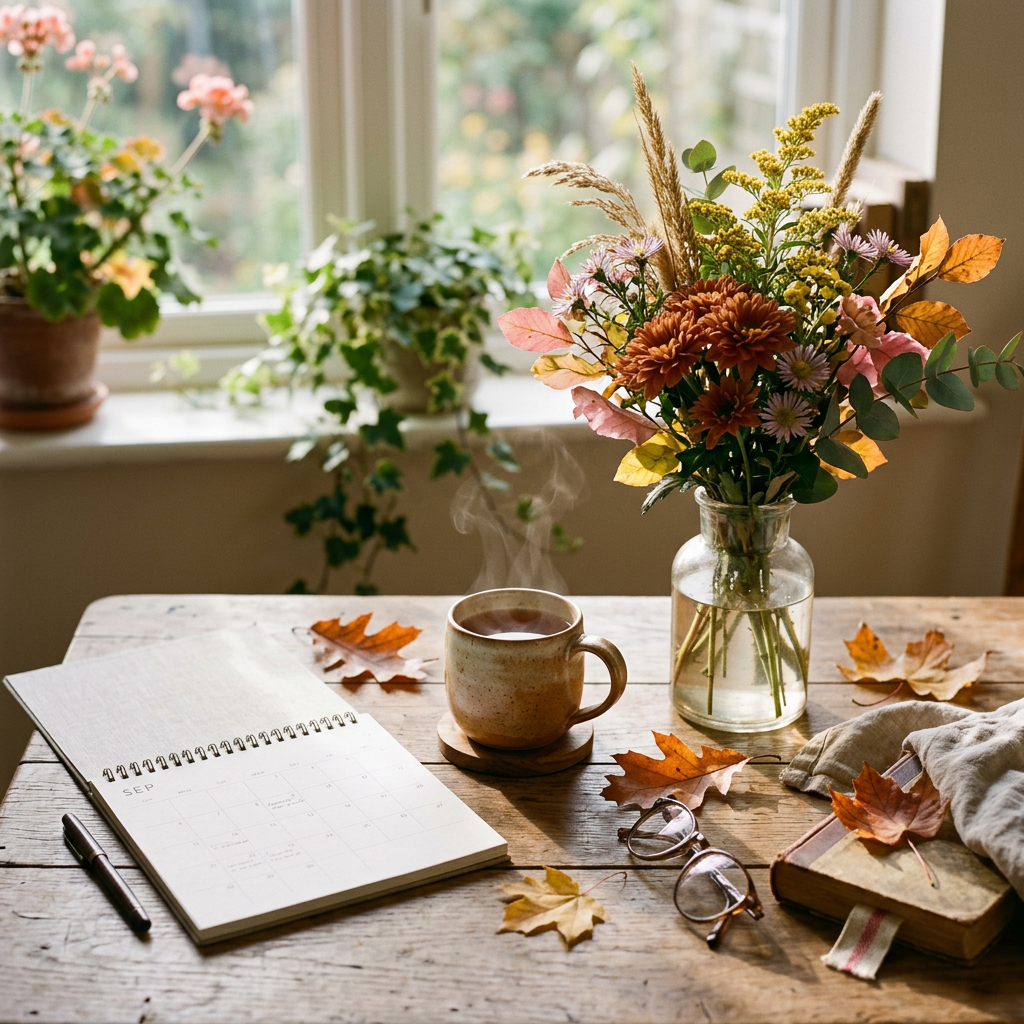
An open journal and fresh coffee create a peaceful, sunlit writing retreat.
The paradox is that I would not go back and unscrew the past to get there. I would not trade the particular chain of hours that led me to this exact now, even the hours that hurt. Everything happens for a reason is, in my mouth, less a philosophy than a truce. I will not pretend the suffering was decorative. I will also not pretend it was meaningless. Meaning is something we make afterward, with whatever materials we have left.
So the year I would relive is still ahead of me. It has no date yet. It might look, from the outside, almost dull. A rented apartment or a small house. A person I already know how to love. Mornings that do not begin with inventory. Evenings that end without calculation. The ordinary miracle of a body that cooperates more often than it argues.
I want that year so badly I can taste metal.
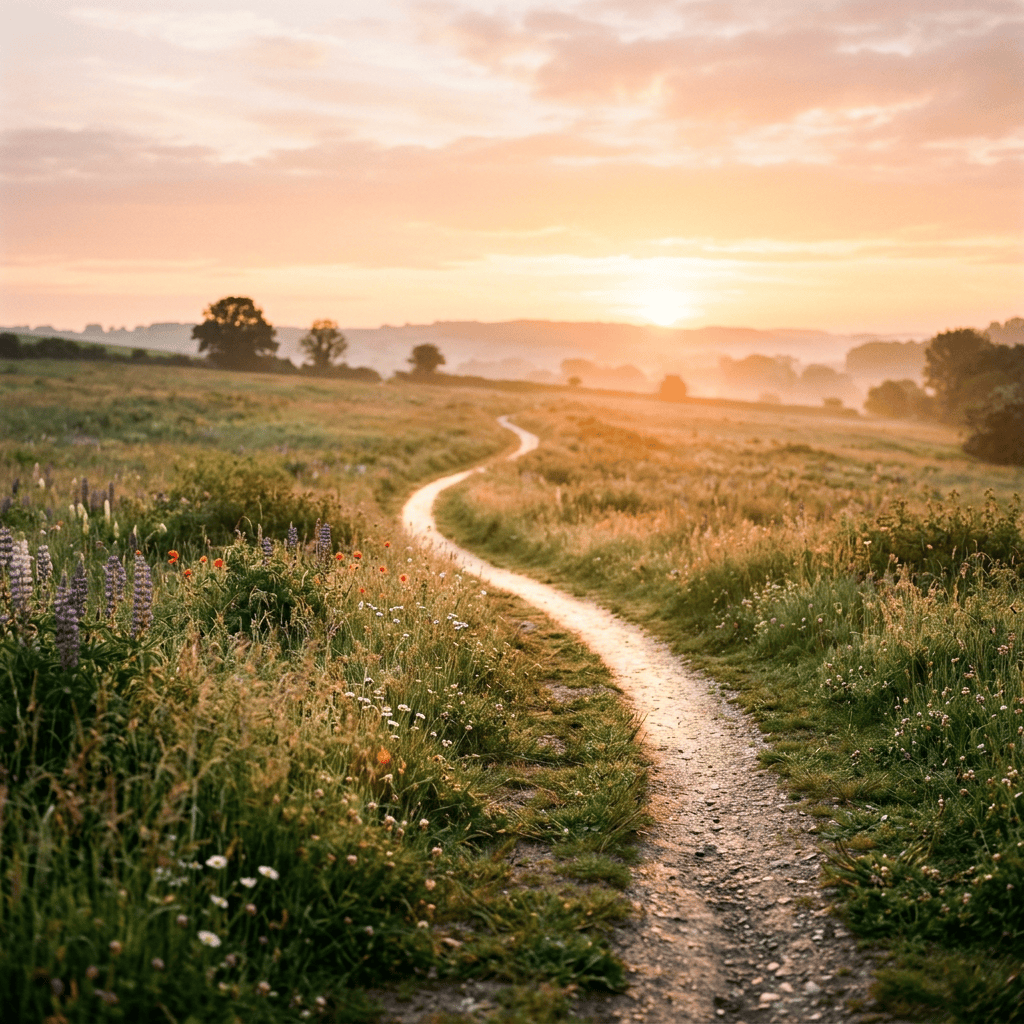
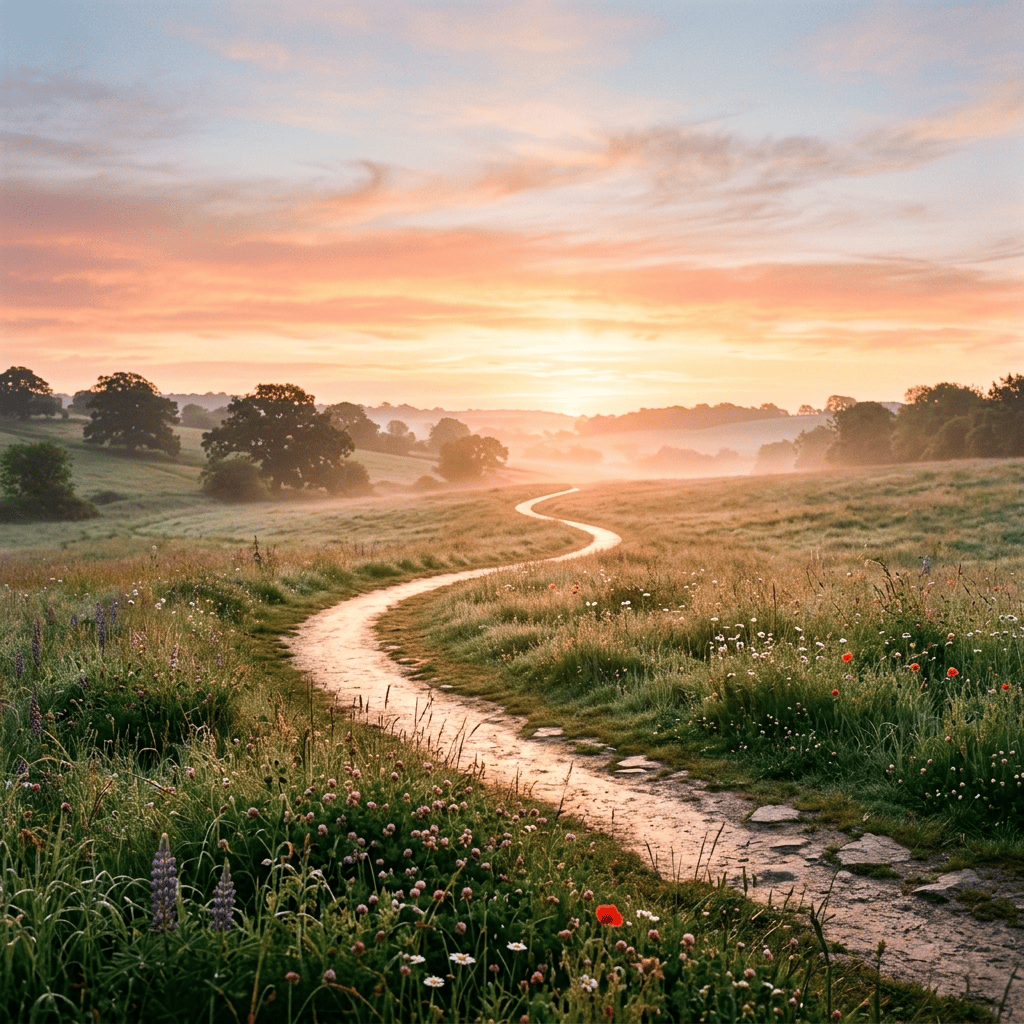
A winding path leads through a flower-filled meadow toward a glowing sunrise.
And if it arrives, I will not spend it wishing I were somewhere else. I will try to live it the first time the way people live the years they later want back: imperfectly, gratefully, with both hands.
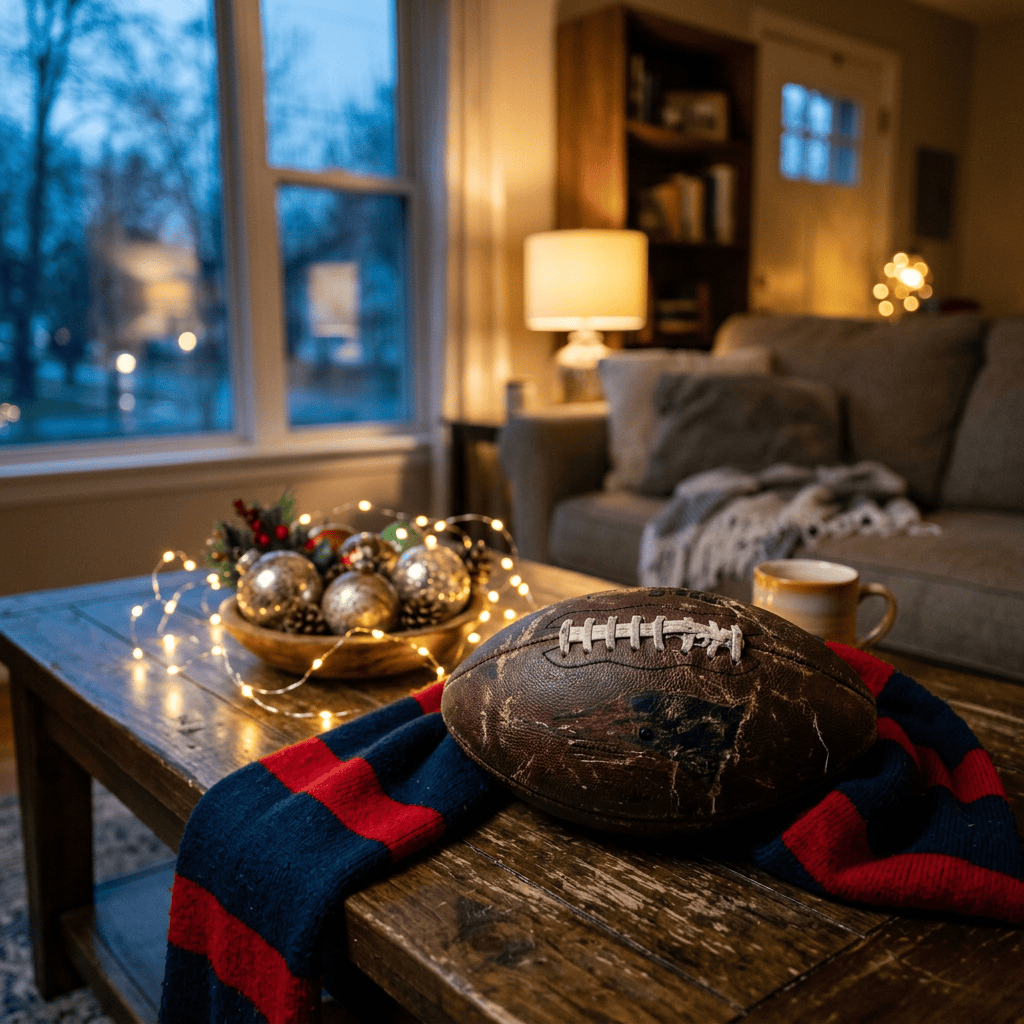
I love football. I love the first Patriots kickoff of the year, that stupid surge of hope. I even love pumpkin spice, the whole corporate autumn circus, the lattes that taste like a candle and a dessert had a baby. What I do not love is being cold. Being cold all the time is depressing as hell. It does not feel seasonal or charming. It feels like the air is quietly stealing from you.
Everyone else is out here romanticizing the -ber months like September through December is a personality. Sweater weather. Cozy season. Holiday magic. I am not buying it. I am not looking forward to any of it. Maybe that is because I do not have a man here to warm my feet, so I sleep in my fuzzy socks like I am hiding from the temperature. Fuzzy socks in bed. Slippers and socks all day. I look like I am preparing for a blizzard that never quite arrives. Cold is not “crisp.” Cold is just uncomfortable. It makes the house feel like it is working against you.
What I actually want is a body next to mine. Not the holiday version. The everyday version. Cuddle weather should not be a seasonal event. I want it when it is raining, when it is ugly out, when there is nothing special happening. This time of year just turns the volume up on the distance. I loathe that part. The earlier dark, the extra blankets, the empty side of the bed all start sounding the same sentence: he is not here.
And still. I love the holidays. I love that he visits. I love the stretch of days when the house finally has another pulse in it and my parents and I briefly look like an actual family instead of three people orbiting the same rooms. He does that. He stitches it together. Those visits are the only reason I tolerate the rest of this stretch.
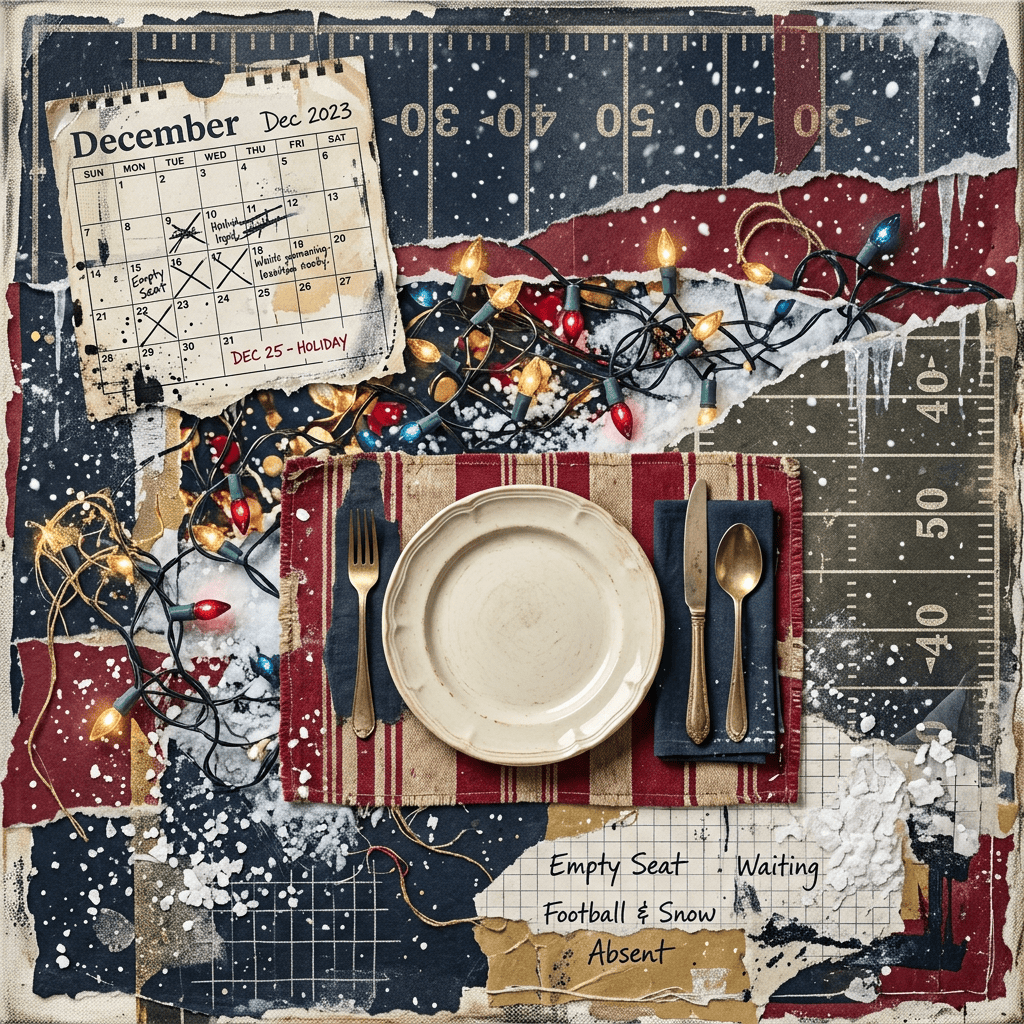
A festive place setting sits beneath Christmas lights beside a December calendar marked for an empty seat.
So here is the whole messy thing: I love that football is back. I love the ridiculous coffee flavors. I love being with him when he is here. I just do not miss the cold, and I do not miss having to wear a second life of clothes just to exist indoors. I prefer not to wear clothes at all. Autumn can keep its aesthetic. I want heat, contact, and someone on the other side of the mattress who does not disappear.
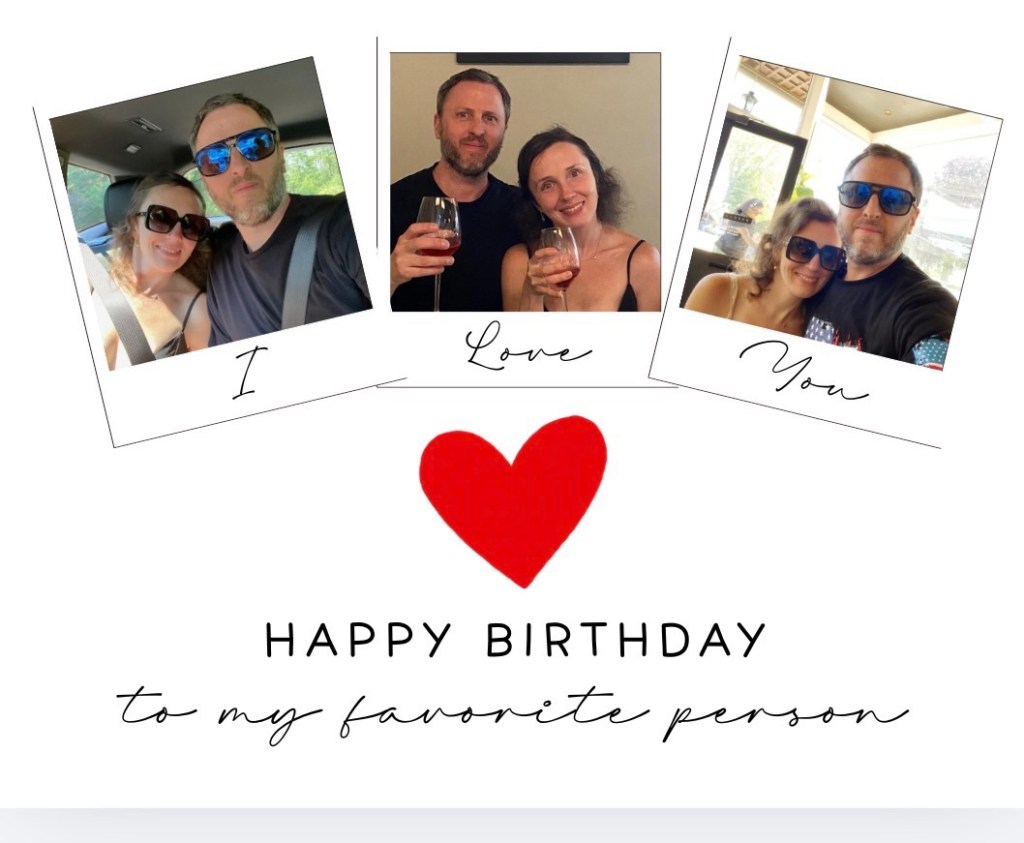
Happy Birthday to the Man Who Taught Me How to Believe Again
Happy birthday to my man.
I met you in a season of my life when I no longer believed in love. Not the kind people write about. Not the kind that lasts. Not even the kind that felt safe enough to hope for. I had already decided that some parts of a person stay locked away forever, that certain armor is worn for a reason, and that loneliness, once it settles in, is simply the new normal.
Then there was you.
You did not arrive with grand speeches or instant certainty. You arrived with time. With persistence. With a patience so steady it felt almost unbelievable at first. Little by little, you taught me how to believe in love again. More than that, you taught me how to believe in myself. I am forever grateful for your pure heart and for the quiet, consistent way you made space for me to grow into someone I had only ever pretended to be.
When we first met online, I did not know myself. Not really. I portrayed the version of me I wanted to become. Fake it till you make it, I told myself. I showed up as someone lighter, more open, more possible than I felt on the inside. Most people would have grown impatient with the gap between the performance and the person. You did not. You were kind enough, and patient enough, to wait while I slowly eased out of my shell. You let me become more feminine. You let me set down the armor I had been wearing for years. You never treated my caution like a flaw. You treated it like something that could, with enough safety, finally rest.
By the time we met in person, I had already dedicated my life to you. That dedication did not happen in a single dramatic moment. It happened in the months and years of messages, of waiting, of watching each other become more ourselves. I had a front-row seat as you grew into the incredible man who stood in front of me in November 2022. I saw the becoming. I still see it.
Our lives intertwined when we were in completely different places. Different cities. Different time zones. Different realities. Different versions of what we thought the future would look like. None of that mattered as much as the fact that we kept choosing each other. Now I am completely addicted. I only want more. Not more noise or more spectacle. A simple little life entirely dedicated to you. That is the life I want.
There was a time I wanted life to end. After I became disabled, after the loneliness became so complete it felt like the air itself had thinned, I could not imagine excitement ever returning. Days ticked forward without purpose. Hope felt like a luxury I could no longer afford.
And then you.
You made me feel excited for life again. Not in a vague, inspirational way. In a specific, daily, breathtaking way. I wake up wanting the next day because you are in it. I look forward to ordinary hours because they belong to us. I cannot wait to start this new life with you. The one we have already been building in pieces, across distance and difficulty, until it finally becomes the only life I want.
Happy birthday to the kindest, most loving man who has ever come into my life.
Thank you for seeing me before I knew how to be seen. Thank you for staying. Thank you for making a future feel possible again.
I love you. I am yours. And I cannot wait for everything that comes next.
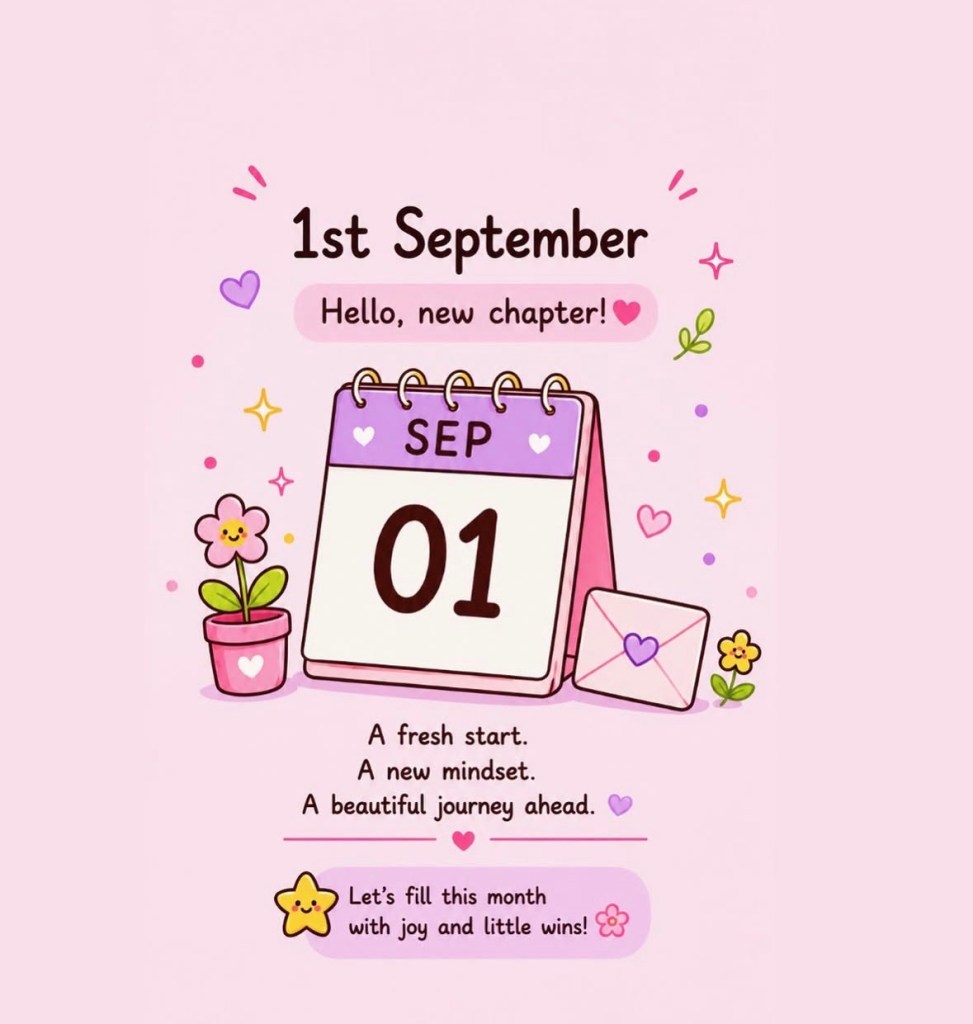
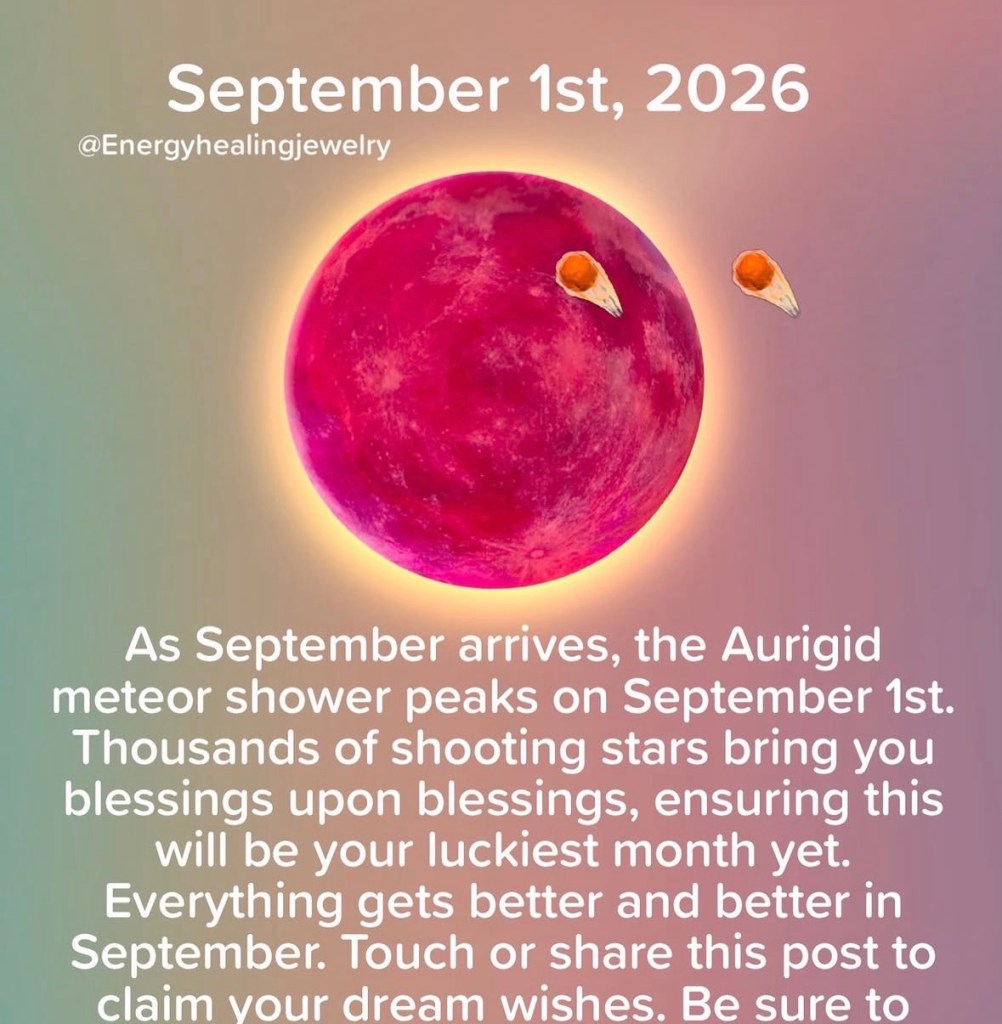
September is here. The calendar has flipped, the light is shifting, and the year has entered its most transitional stretch: still warm in many places, already carrying the first hints of autumn in others.
A new month is a clean page. It is also a reminder that most of what we actually do with time is continue the conversations we were already having. If we have been talking about routines, projects, travel, food, or how to start something again, September is a useful month to pick those threads back up instead of pretending we are starting from zero.
Labor Day weekend in the United States and Canada marks the unofficial close of summer. Schools reopen. The autumnal equinox arrives around the 22nd or 23rd, when day and night briefly balance. Around the world there are observances for literacy, peace, the ozone layer, and tourism. None of these dates require you to reinvent yourself. They simply give the month a rhythm.
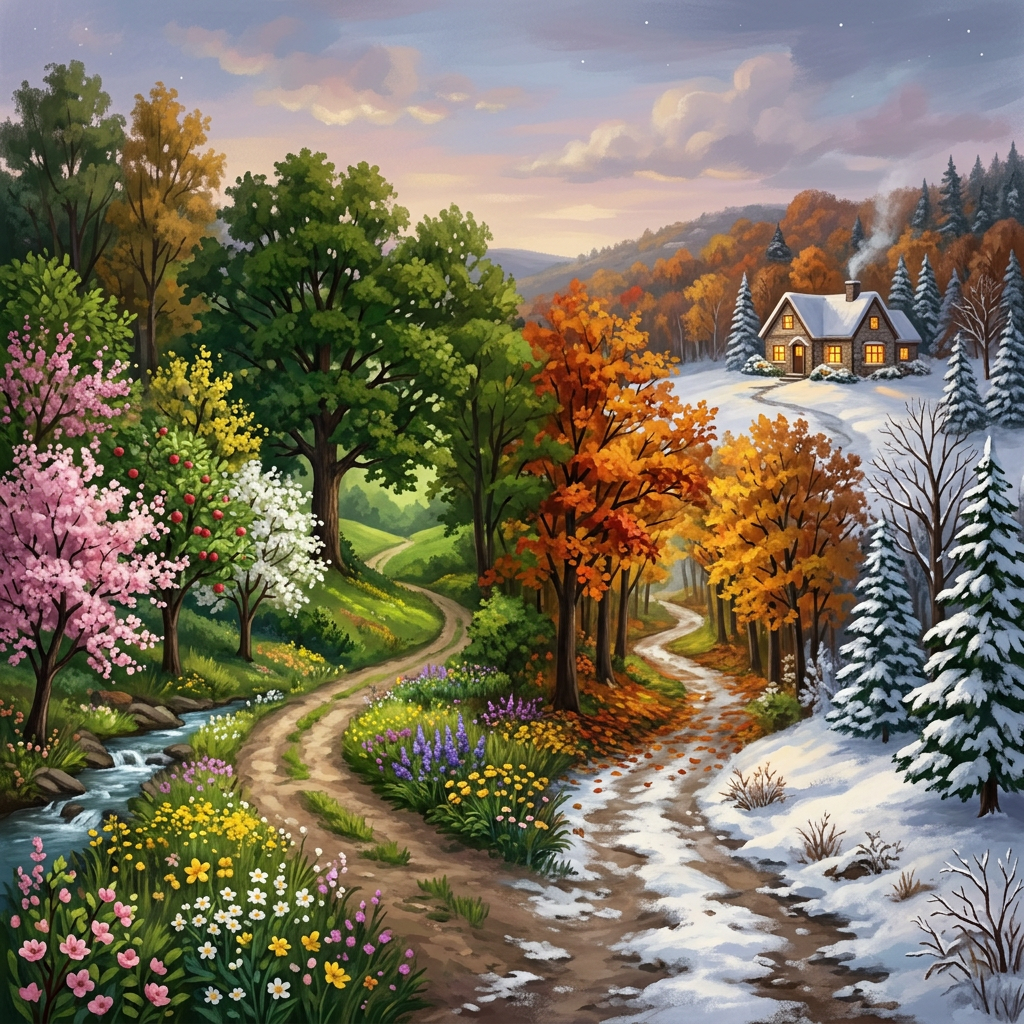
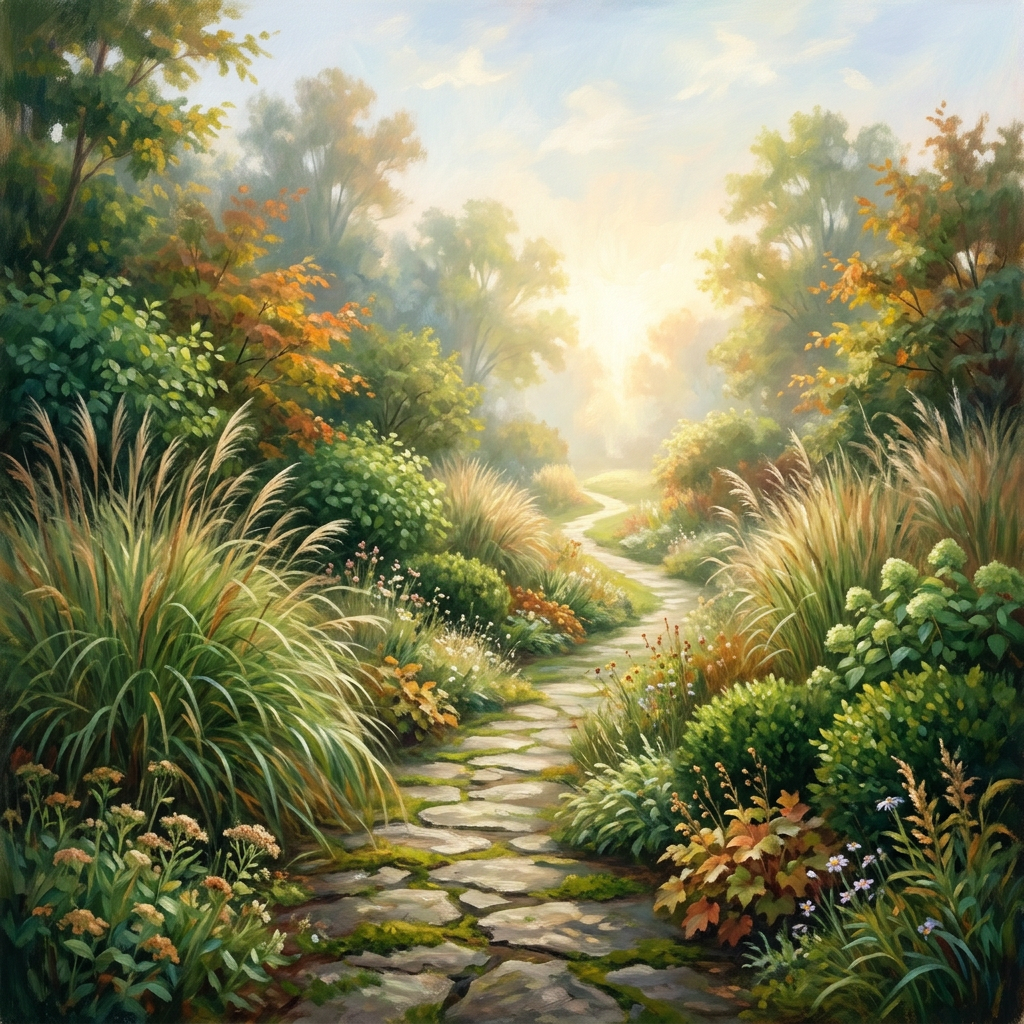
A sunlit stone path winds through lush grasses, flowers, and colorful autumn foliage.
The useful move is usually modest. Finish the half-done thing you mentioned last time you asked how to get unstuck. Try the recipe or the itinerary you were weighing. Adjust the schedule you were already trying to make work. September rewards continuation more than spectacle.
The days are still long enough to use. The evenings are starting to feel different as now when I get outside to write, my body covers itself in goose pimples. That is enough of a reason to treat the month as an invitation rather than a demand.
Welcome to September. Let’s keep going with whatever we were already working on.
What’s the weirdest coincidence you’ve ever experienced?
The Universe Doesn’t Whisper Twice
I do not believe in coincidences. Not the small ones that make you smile and shrug, and not the large ones that rearrange your life. If something is meant to happen, it will happen. It will find the crack in the schedule, the delayed train, the wrong turn that somehow becomes the right street. It will arrive wearing the face of chance so that those who need to dismiss it can do so without discomfort. I have stopped dismissing it.
Everything is a sign from the universe. Not in the loud, cinematic way people imagine when they talk about destiny. There is no booming voice, no sky writing, no sudden spotlight. It is quieter than that. A whisper. A particular song playing at a particular moment. A sentence overheard in a café that answers a question you have not yet asked out loud. A person appearing in your path with the exact piece of information, or the exact kindness, or the exact friction you needed. Most people walk past these things. They call them random. They keep their eyes on the ground and their minds on the next task. The whisper is easy to miss when you have already decided the world is only noise.
I used to miss it too. I treated life like a series of isolated events that happened to me rather than through me. Something fell through and I called it bad luck. A conversation ended abruptly and I called it timing. Even my brain injury somehow managed to lead me to my twin flame. I could just shrug it off and say that my brain blew up because of a bad diet, stress, bad luck, a body that finally called in a debt I had been ignoring. That version of the story is tidy. It keeps the event inside the realm of cause and effect I can name. It lets me treat the injury as an accident that interrupted my life instead of a rupture that redirected it. But if I tell it that way, I erase the chain that followed. I would never have found myself scrolling my life away in the aftermath, half-present, half-searching, desperate for a face or a voice that felt like home. I would never have been cracked open enough to look that hard. I would never have been still enough, or raw enough, or lonely enough in the particular way that made recognition possible when it finally arrived.
Dried leaves, dark berries, and fine threads create a moody autumn-inspired still life.
The injury did not feel like a gift when it happened. It felt like theft. It took language, stamina, certainty, the old version of myself that knew how to move through a day without having to invent the day from scratch. And still, something in that wreckage made a path. Not because suffering is noble. Not because pain is always a teacher we should thank on the spot. Because the life I had been living was not going to bring me to that person. The uninjured version of me was too occupied, too armored, too convinced she already knew the shape of her story. The universe did not cause the injury so that a romance could bloom. I do not need the story to be that clean. What I know is simpler and stranger: the injury happened, the searching began, and the person who felt like a missing frequency appeared inside that searching. To call the whole sequence a coincidence would require me to pretend the seeking never mattered.
The more I paid attention, the more the pattern revealed itself. Not a rigid script. Not a promise that every desire will be granted or every wound will be explained. Something subtler: a conversation between the inner life and the outer world. When I am restless, the universe sends restlessness back to me in the form of unexpected delays and unfinished conversations, as if to say, sit with this. When I am ready to move, doors that were locked for months swing open with almost embarrassing ease. People I needed to meet appear in places I had no logical reason to be. Opportunities arrive wearing the clothes of inconvenience. Losses arrive wearing the clothes of protection I only recognize later.
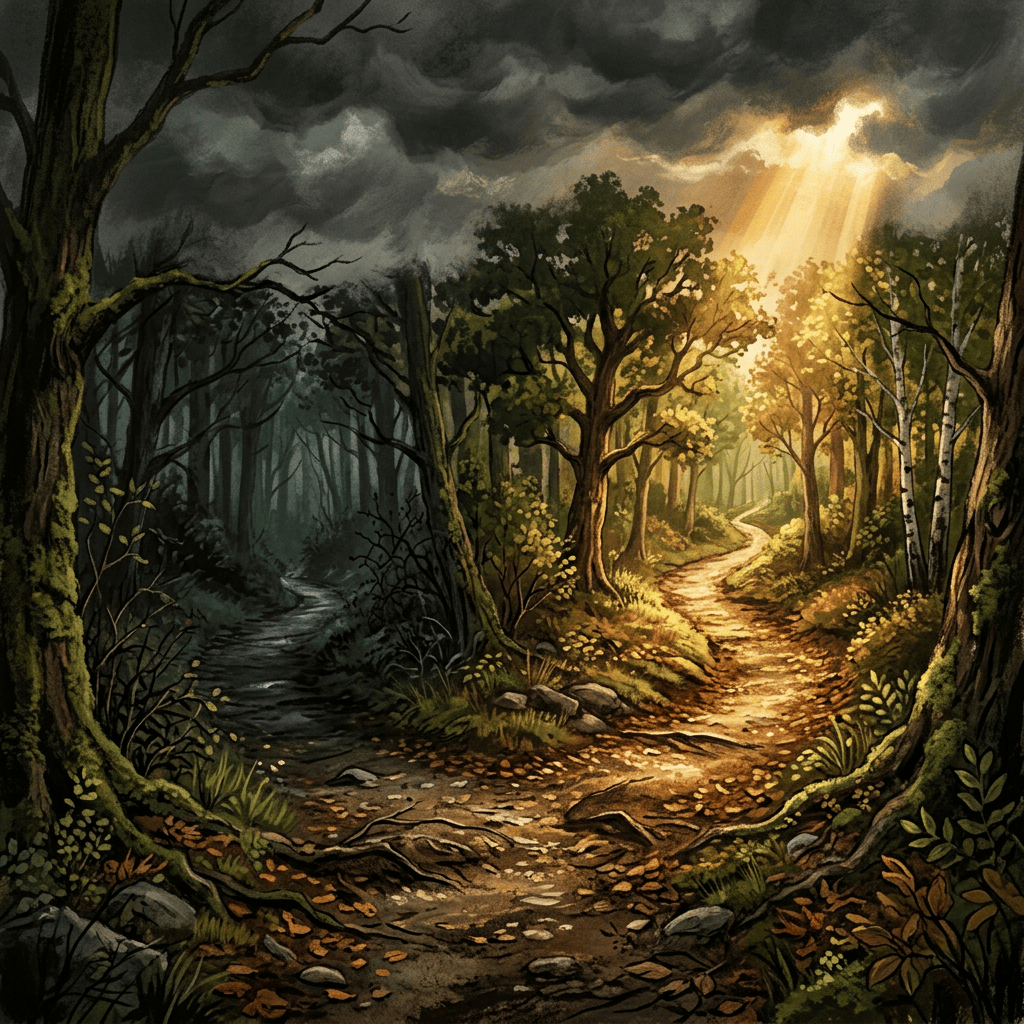
A winding woodland trail emerges from shadow as golden sunlight breaks through stormy clouds.
It is easy to romanticize this and turn it into a slogan. “Trust the universe.” “Everything happens for a reason.” Those phrases can become another way to avoid looking closely. I am not interested in comfort slogans. I am interested in the texture of the moments themselves. The way a certain light falls across a room at the exact second a decision crystallizes. The way a stranger’s offhand comment lodges in the mind and will not leave until you act on it. The way the same number (17,27,37), the same image, the same phrase keeps appearing until you finally stop and ask what it is pointing toward.
Many people fail to notice because noticing requires a kind of stillness that modern life does not reward. We are trained to explain things away. Coincidence is a tidy category. It lets us keep our sense of control. If the meeting was random, then we remain the authors of our story. If the meeting was a sign, then something larger is participating, and that is both comforting and unsettling. It means we are not as separate as we pretend. It means the world is speaking, and we have been talking over it.
I have learned to treat the whisper with more respect. Not superstition. Not the desperate search for meaning in every fallen leaf. A quieter discipline: when something repeats, I listen. When an opportunity arrives wrapped in inconvenience, I consider whether the inconvenience is the point. When a person crosses my path more than once without an obvious reason, I stop assuming it is nothing. Sometimes it is nothing. Sometimes the universe is simply dense with possibility and not every thread is meant for me. Discernment still matters. But I no longer start from the assumption that the thread is accidental.
If something is meant to happen, it will happen. That sentence used to sound passive to me, as if I could sit still and wait for life to deliver itself. I still kind of hate it when my boyfriend approaches our relationship path this way. But it is not an excuse for inaction. It is a recognition that timing has its own intelligence. Effort still matters. Showing up still matters. Doing the work still matters. But the work is not only the visible kind. There is also the work of becoming the kind of person who can recognize the sign when it arrives, and the kind of person who can act on it without needing the entire map first.
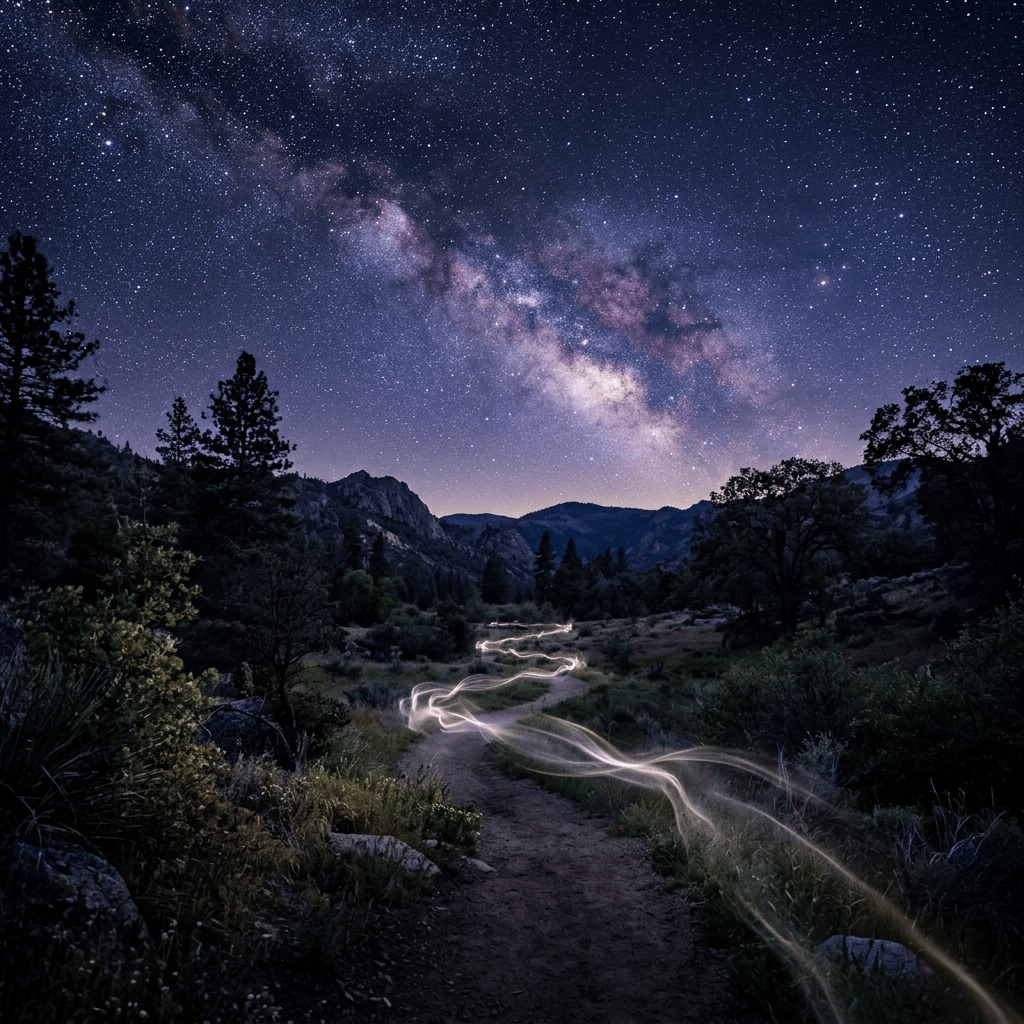
The Milky Way glows above a mountain trail traced by flowing light trails.
The universe does not shout. It does not compete with the noise we generate. It waits. It repeats itself politely. It leaves small, persistent traces for those willing to look up from their phones and their plans and their certainty that they already know how the story is supposed to go. Most people will keep walking. That is their right. I have decided I would rather not miss the whisper again.
It has been speaking the whole time. I was simply too busy calling it coincidence.