
There is a story moving through the country about a night at Cornell in October 2024, and almost everyone who heard the first version of it decided the ending before they heard the middle. A young woman, a Tri Delt, says she was drugged and gang-raped for hours by members of Chi Phi. “Legacy” media refers to her as Jane Doe. A Snapchat group called “Chi Phi Actives” contains messages that read like a recruitment poster for a bad reputation: “free pussy” upstairs, “like you can walk in and whip it out,” and later “Shop still open?” The chapter is now unfortunately gone. Two of the men were expelled. Others were suspended or told to write reflection papers. The national fraternity says it expelled the accused. No one thinks that this punishment was enough. The lawsuit that was re-filed in September 2026 is against basically everyone. Kathy Hochul had Letitia James reopen the case after she claimed that it had no right to be thrown out.

That sequence is enough, for a lot of [normie] people/ media, to close the case (and possibly even restart #MeToo). Privileged boys, a group chat, a woman who says she was incapacitated. At first she told campus police that it was all consensual. The moral of the story writes itself. It also wrote itself in Durham in 2006, and that is the problem. A story that truly disgusted me (my boyfriend just recently had me watch the 30 For 30). Admittedly, I now generally side with the men in most situations. So my knee jerk reaction to this story: Jane Doe wants money.
The Duke lacrosse comparison is not a claim that the facts are identical. It is a claim about the reflex. In both episodes, a lurid allegation landed on a class of young men that the press already disliked, the ugliest available texts were treated as a confession, and the parts of the record that complicated the indictment were filed under “trauma” or ignored. At Cornell the complication is not subtle. Tompkins County District Attorney Matthew Van Houten reviewed a six-page statement drawn from the woman’s November 2024 interview with campus police and declined to take the case to a grand jury. His public account of that statement is blunt: she did not allege she was drugged against her will or gang-raped; the statement described drug use and sexual conduct as voluntary, conscious, and consensual; when she asked to stop, the conduct stopped.
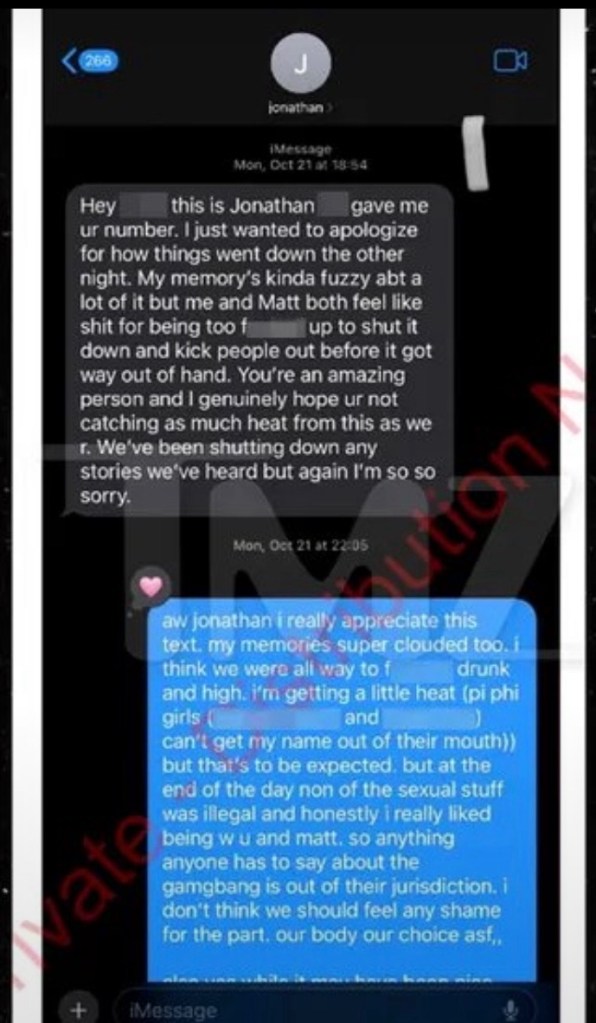
The texts do not resolve it either, and they cut both ways. Days after the night, one of the men apologized for “how things went down” and said he and another brother had been too drunk to shut it down. She replied that her memory was clouded, that they had all been heavily intoxicated, and that “none of the sexual stuff was illegal.” She said she liked being with him and another man, and suggested they smoke again “but like leave out the extra 5 billion men and ketamine.” Later she wrote that everyone knew, that the episode was ruining her life, that 90 percent of what happened was not consensual, and that she felt like a sex doll. Her lawyer has said she was in denial. Maybe. Denial is a real thing. So is a civil complaint that arrives almost two years later, after campus discipline has already produced expulsions and a closed chapter, and that is more severe than the account the prosecutor says he was given. Yeah right.
TMZ published that exchange, and the New York Post and others have since reproduced it. The messages are dated October 21, 2024, the day after the night, between Jane Doe and Jonathan Newell, one of the two men Cornell later expelled. They are the strongest contemporaneous record in the case, and they are very hard to reconcile with the lawsuit.
Newell opens by apologizing for how things went down. He says his memory is fuzzy, that he and Matt both feel bad for being too drunk to shut it down and kick people out, and that they have been shutting down stories. Her reply is not the reply of someone who believes she was raped the night before. She thanks him. She says her memory is clouded too, that they were all way too drunk and high, and that she is catching heat. Then she draws the legal line herself: none of the sexual stuff was illegal, she really liked being with him and Matt, and anything anyone has to say about the “gamgbang” is out of their jurisdiction. She adds that they should not feel any shame for the part. “Our body our choice asf.”
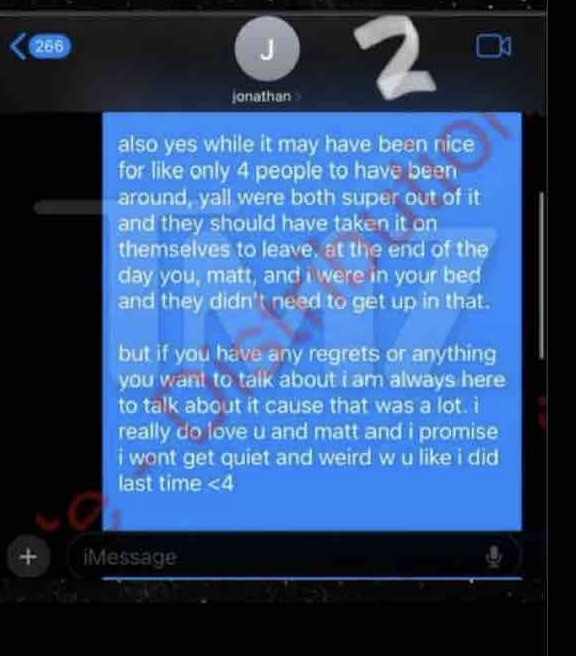
She also sorts the room. Four people might have been fine. He and Matt were “super out of it,” and the others should have taken it on themselves to leave. “At the end of the day you, matt, and i were in your bed and they didn’t need to get up in that.” She offers to talk if he has regrets, says that was a lot, says she really loves him and Matt, and promises she will not get quiet and weird the way she did last time. A later report of the same chain has her writing that she did ketamine off his penis and that it was one of the most insane moments of the night.
That is not a trauma narrative written in denial’s code. It is a participant describing a gangbang, assigning the sex with Newell and Ingalls to the category of legal and wanted, blaming the extras for not leaving, and comforting one of the men she would later sue for rape. “Our body our choice” is an affirmative claim of agency. “Out of their jurisdiction” is an affirmative claim that outsiders have no standing to reclassify the night. The clouded memory is shared, and she treats it as a reason the stories should be shut down, not as proof she could not consent.
What the group chat proves is narrower than the viral version. It proves that some of these men talked about a woman in their house as if she were an amenity. That is low, but also common, and it is the sort of thing fraternities have been producing in writing since phones learned to screenshot. It also points to the [likely] class difference between “Jane Doe” and the fraternity members. This is not, by itself, proof of a coordinated rape, but a game amongst class differences. A man can send a disgusting message about a sexual situation that the woman has already described, in her own early account, as a threesome she was “pretty OK with,” and still be a creep without being a conspirator. Cornell’s own disciplinary panel, which is not a criminal court and does not use the beyond-a-reasonable-doubt standard, did not find every accused man responsible for assault. The punishments ran from expulsion to a paper. The men deny criminal wrongdoing. Some of them have said the sex was consensual.
None of that makes the night admirable. But also does not make it a rape. She had already been drinking hard before she walked to the house alone. Ketamine was in the room. More men came upstairs after the chat. Memory is patchy on every side. A situation that starts as a drunken threesome and turns into a crowd is a bad situation even when every participant is awake and saying yes. The question the first wave of coverage refused to ask is whether “bad” and “rape” are the same word.
They are not, and the difference is the whole criminal law. New York requires proof beyond a reasonable doubt of lack of consent. Van Houten’s office said the 2024 statement did not clear that bar. Governor Hochul has now handed the file to Letitia James, citing new information and doubts about how the first investigation was handled. That is a procedural fact. It is not a verdict. A special prosecutor can still look at the full transcript, the Snapchat, the Title IX record, and the civil complaint and decide there is no charge to bring. Or she can seek indictments. Until one of those things happens, the honest description is an unresolved allegation with a serious inconsistency between the early sworn account and the later lawsuit.
The inconsistency is what the Duke reflex cannot metabolize. If the early statement is closer to the truth, then a night of heavy drinking, voluntary drugs, and group sex was later recast as a gang rape, and a university and a national audience punished the recasting. If the lawsuit is closer to the truth, then a condensed police statement buried a rape and a prosecutor waved it through. Those are different scandals. Treating the second as already proved, because the group chat is ugly and the men are in a fraternity, is the same move that produced the Duke lacrosse disaster: moral certainty first, documents second.
There is a cultural point underneath the legal one, and it is worth saying without the slogan. A generation of students has been told that regret, intoxication, and a bad reputation can be retrofitted into a crime, and that the retrofit will be believed on contact if the accused are the right kind of accused. The same generation of young men has been told that a group chat is a private joke, and then discovered that the joke is the exhibit. Both lessons are half-true and badly taught. Women are not helped by a standard in which an early statement that sex was legal can be overwritten, two years later, by a complaint that makes national news. Men are not helped by houses where “shop still open” is how you talk about a person. The adult response is to hold both facts at once: the chat is contemptible, and contemptible is not the elements of rape.
The useful moral is older than either side’s caption. Do not treat a group chat as a conviction. Do not treat a civil complaint as a confession. Do not treat intoxication as a substitute for the elements of a crime, in either direction. And do not let the pleasure of having your priors confirmed — about fraternities, or about false reports — do the work that evidence is supposed to do. Duke already ran that experiment. The results were not ambiguous. Maybe instead of blaming the wealthy white men, we focus more on the types of ladies we raise in this society.