Tag: election

  • Sophie Cunningham’s Post-Midterms Message: Personal Excellence Is the Ultimate Rebellion

    Sophie Cunningham’s Post-Midterms Message: Personal Excellence Is the Ultimate Rebellion

    The day after Democrats swept the 2026 midterm elections and reclaimed control of both the House and Senate, Indiana Fever guard Sophie Cunningham shared a pointed message with her followers. Rather than reacting with partisan commentary or analyzing specific races, she reposted a statement from entrepreneur and podcaster Andy Frisella to her Instagram Stories. She offered no additional written comment of her own, letting the words stand as her contribution to the post-election conversation.
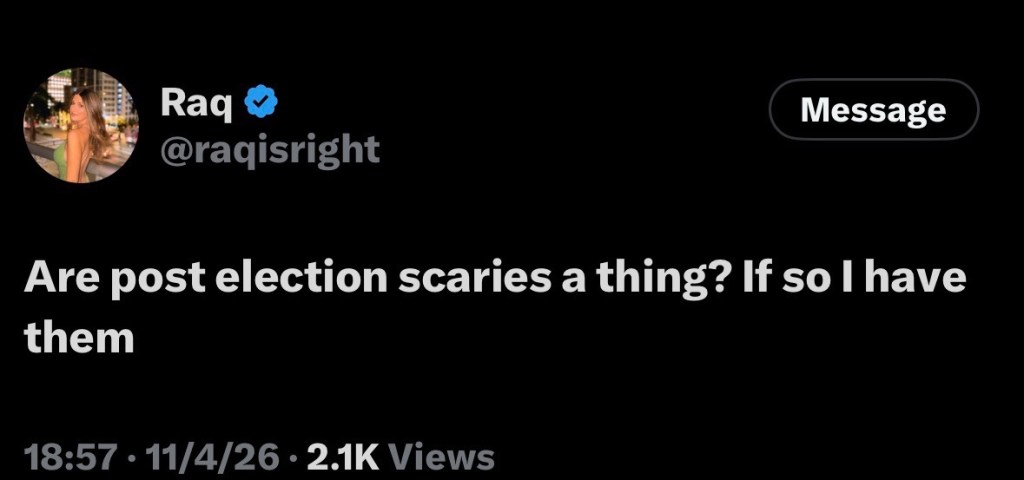
    The message focuses on culture, personal responsibility, and the limits of political change. Here is the full text of the post she shared:

    “One of the strangest things about our culture is how much faith we’ve placed in elections to change our lives and how little faith we’ve placed in our own ability to do the same. People will spend months arguing about who should lead the country while spending zero time considering how they could better lead themselves … and THAT is a much bigger problem than most people realize.

    Because the strength of a country is ultimately a reflection of the character, discipline and standards of the people who make it up. That’s you. Politics is downstream of culture. We can keep changing the people in charge, passing new laws and arguing over which party has the answers … but until we change the culture fostering, producing and tolerating the problems we have as a society, nothing fundamentally changes.

    A population of weak, unhealthy, uninformed and dependent people is a hell of a lot easier to control than a population of strong, healthy, educated and self-reliant people. Your responsibility is to become the exact opposite of everything they want for you to the best of your abilities. Your REAL best. In my opinion that’s our obligation as Americans.

    A culture of personal excellence is the foundation of a great country. There is no election, politician, policy or law that can substitute for that … and the best thing about that is the same behaviors that make you a better American also make your own life better quickly. If we want a better America … It starts with better Americans. There is no other way. Personal excellence is the Ultimate Rebellion.”

    Mountain path overlooking a village, river valley, and sunset peaks
    A winding mountain path overlooks a peaceful village, river valley, and distant peaks at sunset.

    Cunningham’s decision to amplify this message fits the pattern of her public voice in 2026. She has described herself as politically moderate—agreeing with ideas from both sides and disagreeing with others—while consistently prioritizing truth, personal accountability, and the protection of women’s and girls’ spaces and sports. The WNBA is a terrible product but I always liked Cunningham. She is hot and she is real (and yes I tend to agree with her politics). She has previously emphasized that love and honesty can coexist, and that she is proud to be an American citizen who supports those who serve.

    The shared post does not name candidates, parties, or specific election results. Its timing, however, is unmistakable: it appeared less than a day after a major Democratic victory. In sharing it, Cunningham directed attention away from who controls Congress and toward the character, habits, and standards of ordinary Americans. The core claim is straightforward—lasting national improvement depends more on individual excellence than on electoral outcomes, because politics ultimately reflects the culture that produces it.
    Diverse group walking across a historic square beside a columned building
    A diverse group walks together across a sunlit historic square framed by autumn trees and grand civic architecture.

    Whether readers agree with every line or not, the message Cunningham chose to circulate is clear: if the goal is a better America, the work begins with becoming better Americans. Personal excellence, in this framing, is not optional self-help; it is the most practical and rebellious form of civic duty available.
  • Opting Out of the Script: Politics, Sports, and Forced Belonging

    Opting Out of the Script: Politics, Sports, and Forced Belonging

    It is Election Day, which means another round of the same ritualized theater I already know the ending to. Living in Washington state makes the whole thing feel especially pointless and grating. The politics here are not subtle. They are loud, self-congratulatory, and almost entirely one-directional. From Seattle outward, the dominant culture treats progressive orthodoxy as the only legitimate way to exist, and anyone who declines to perform the required enthusiasm is treated as a moral defective. Taxes stay high, housing stays expensive, crime in the major cities stays stubbornly higher than it should be, and the public conversation still revolves around the same narrow set of priorities—equity statements, climate timelines, and the constant ranking of people by identity categories. I do not find any of that interesting or persuasive. I find it tedious.

    Empty chair between opposing arrows on a stormy football field
    An empty chair between opposing arrows stands on a windswept football field beneath dark storm clouds.

    The sports side is only marginally better. Washington has teams, and people treat them with the same forced civic enthusiasm they apply to everything else. The Seahawks, the Mariners, the Huskies, the Sounders—pick your poison. Wins are celebrated as proof of regional virtue; losses are explained away with the same managerial language used for failed policy. I do not feel a tribal obligation to root for the local side just because the stadium is nearby. Watching people invest emotional capital in professional athletes and then act surprised when the results do not match their hopes is, to me, another form of the same groupthink— unless you are talking about the elite/ good looking teams and athletes (like the Boston sports teams). It is all noise—unless you are talking about the elite/ good looking teams and athletes (like the Boston sports teams).

    Abstract charts and checklists layered over a mountain landscape and winding river
    Abstract charts, checklists, and data forms merge with a sweeping mountain landscape to suggest planning and progress.

    I live as a consistent contrarian and, frankly, as a bah humbug about most of it. I do not sign on to the obligatory cheerfulness. I do not pretend that every cause, every team, every demographic narrative deserves my automatic respect or emotional investment. I despise a lot of things more or less equally: the political machine, the sports culture that mirrors it, the constant demand that I sort people into approved groups and then perform the correct attitude toward each group. That includes minorities as a category and disabled people as a category. I do not organize my life around those identities, I do not find them inherently sympathetic or interesting, and I do not think the social pressure to treat them as sacred is any more rational than the pressure to treat any other group that way. Some people with intellectual disabilities strike me as unsettling—the mannerisms, the unpredictability, the way the surrounding culture insists I must find it all endearing or else be labeled cruel. I do not. That does not mean I want anyone harmed; it means I decline the required emotional script.

    None of this is a political program or a call to action. It is just the private stance of someone who has decided most of the public enthusiasms on offer—political, athletic, demographic—are not worth joining. Election Day changes none of it. The ballots get [mis]counted, the same coalitions reassert themselves, the teams keep playing, and the expectation that I care remains. I do not.