My boyfriend and I have been mainlining our childhood like it is a caffeine drip—Beverly Hills, 90210, Melrose Place, and now it is my turn to open his eyes to my own high school drama—the glossy, sun-soaked fever dream that was The OC. God, I used to worship that world. I wanted the luxury car, the beach house, the effortless drama. Mostly I wanted the body. Marissa Cooper’s surfboard silhouette—long, lean, zero percent body fat, the kind of thin that makes clothes hang on your protruding bones. Paris Hilton-esque. vacant-eyed and untouchable. I wanted to be built like a surfboard. Instead, I got my own high school experience, which played out less like a Fox teen soap and more like a psychological horror.
I changed school districts right before freshman year so that I could attend private school. Fresh start! New hallways, new faces, new chance to reinvent myself as someone people actually wanted to sit with at lunch. I showed up with the kind of desperate optimism only a fourteen-year-old can muster. I smiled too wide. I laughed at jokes that were not actually funny. I even joined the school soccer team, even though I was only a little speedster without any soccer ball skills. I was ready to collect friends like limited-edition.
Middle school had already done its damage, though (read here). That was where I learned the rules of the game: be thin, get straight A’s, and the world will throw compliments at you like confetti. Teachers beamed. Boys stared. My mother bragged. It was the easiest dopamine I had ever scored. So when high school hit, I doubled down like a junkie with a new dealer. Social life? Optional. Body? A full-time job. Grades? Non-negotiable. Everything else could rot.
I did try, in my own half-assed way. I met boys. Kissed one. The “bad boy” ala Ryan from The OC. Let him finger me through my Juicy Couture jeans (try explaining that hole in your jeans). I even went back to my old district just to play tennis for their team—commuting like a masochist because apparently I still needed some thread connecting me to “normal” teenage life. Those bus rides were surreal: me in my little skirt, racquet between my knees, pretending I was just like everyone else while my brain screamed calorie counts and tomorrow’s biology test.
But the obsession was already metastasizing. One solid year of high school—that is all I really got before the sickness took the wheel. Freshman year had moments of light. I remember walking the halls in low-rise jeans that showed the sharp edges of my hip bones like trophies. I remember the rush when a senior looked twice. I remember thinking, This is working. Keep going.
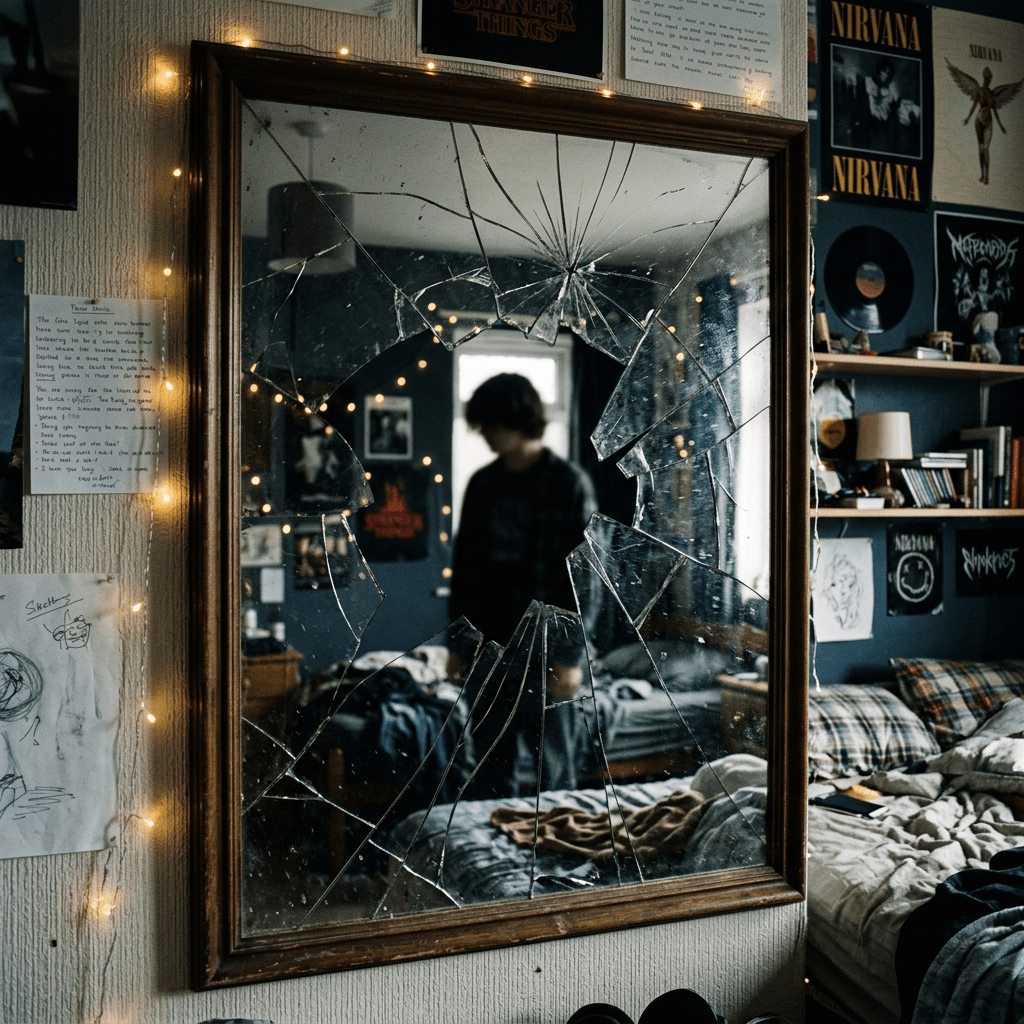
Then the mirror became my enemy, my priest, and my dealer all at once. I stopped eating lunch. I did sit-ups until 2 am. I measured my worth in the gap between my thighs and the numbers on the scale. Straight A’s were never enough anymore—they were just part of the game. The real prize was disappearing. Becoming so small that people worried. That kind of worry felt like love.
The new school never really knew me. How could they? I was a ghost in Abercrombie. I showed up, aced everything, then vanished into my room to count ribs and cry over missed carbs. Friends tried. I pushed them away with the polite brutality of a girl who is already in love with her own destruction. Boys were easier—they wanted the fantasy, not the full dossier of my neuroses. So I became that girl… the boys’ friend. I gave them pieces. Never the whole haunted house.
Looking back, it is grotesque how romantic I made it all seem. The OC soundtrack in my head while I did crunches at midnight. The way I would stare at Marissa’s collarbones like they were scripture. I wanted that coastal California emptiness so badly I carved it into myself in the middle of nowhere suburbia. Meanwhile, the real kids around me were making memories—bonfires, breakups, bad decisions with cheap beer. I was making spreadsheets of my intake and hating myself in HD.
There is something darkly funny about it now. I traded four years of messy, stupid, glorious teenage chaos for a body that still was not thin enough and a transcript that could not hug me back. I was the girl who had it “together.” Teachers loved me. My report cards were porn for my Russian parents. And I was rotting from the inside out, polite smile stapled to my face.
If I could go back, I would tell that wide-eyed freshman something brutal: the praise feels good until it does not. The boys will not save you. The scale lies. And no amount of straight A’s will make you feel safe in your own skin. Sometimes the rebellion is not starving—it is eating the pizza and going to the dumb party anyway.
But I cannot go back. So instead I am here, rewatching The OC with my boyfriend, laughing at how fake it all looks now. Marissa’s tragic glamour hits different when you have lived a version of it and survived. I am softer now. Older. Still fucked up in new and exciting ways. But at least I am not measuring my worth in negative space anymore.
High school me would call that weak. Adult me calls it winning.
What a twisted little victory lap.